Two Papers, One Argument
Aggregated Intelligence and One Number You Can Defend are now published
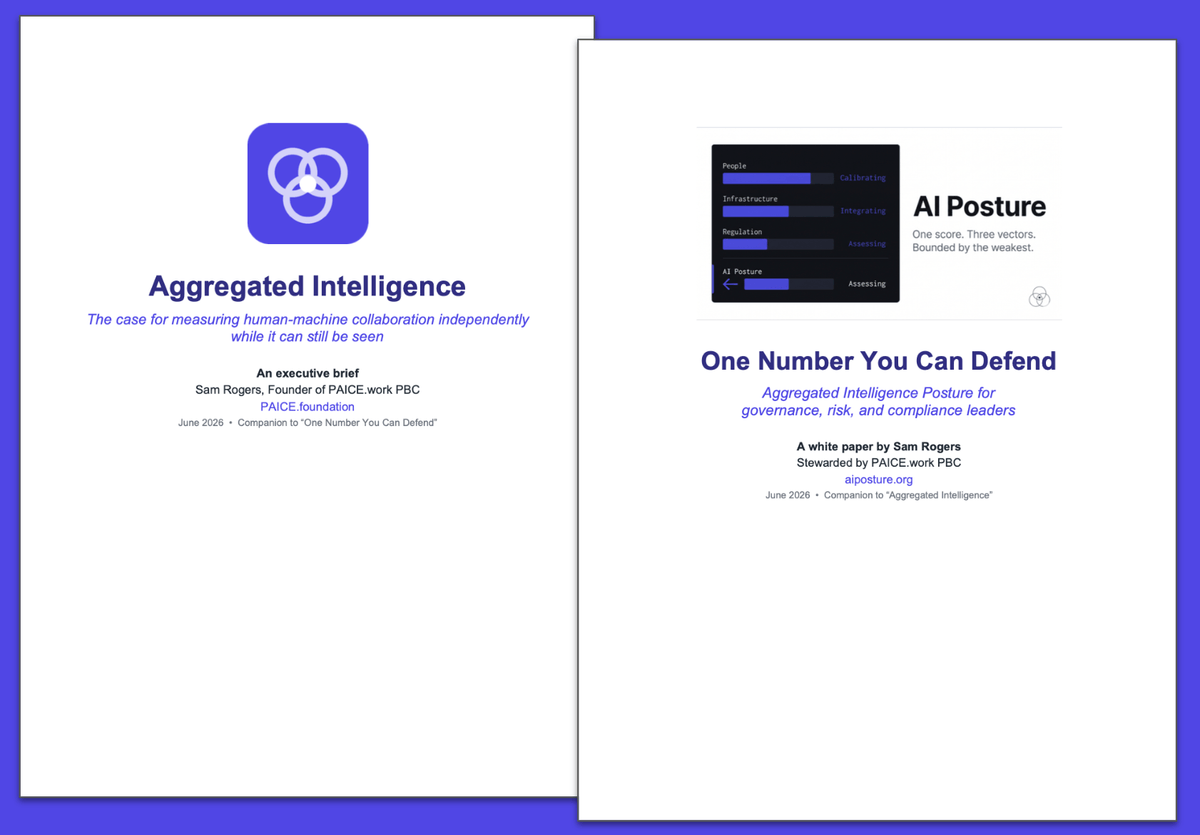
Organizations measure AI model capabilities. They measure individual AI skills. They almost never measure the collaboration between them — which is what actually determines outcomes. Two papers published this month address that gap directly.
The Problem Both Papers Solve
Governance teams have spent three years trying to account for AI risk. Most of that work focuses on models: what the model is permitted to do, how its outputs get audited, what the vendor attests to. Some of it focuses on individual training: did the analyst complete the AI literacy module?
Neither line of work asks the harder question: when the person and the model are working together on a high-stakes task, does that collaboration actually produce reliable outcomes?
That is the gap. An organization can have capable people, capable models, and still produce systematic errors — because the collaboration between them is unexamined, unmeasured, and managed on vibes and vendor assurances.
Both papers sit at that gap from different angles. The executive brief defines the concept. The whitepaper operationalizes it for governance teams.
Aggregated Intelligence: The Executive Brief
Aggregated Intelligence makes a three-part argument.
First: the collective output of People+AI collaboration — what the brief calls Aggregated Intelligence — is a real thing that determines organizational outcomes, and it can be measured. "The intelligence that determines an organization's outcomes is not its people alone, and not its models alone — it is the two working together, well or badly."
Second: only a measurement system that operates independently of the tools it scores can be trusted. A vendor-provided readiness assessment is not a readiness assessment. It is a marketing asset dressed in methodology. If the tool you use to assess your AI collaboration was built by the vendor selling you AI, you are not measuring anything except their preferred narrative.
Third: timing matters. The window to baseline this collaboration is open now and narrowing. Organizations that wait for compliance mandates to force the question will be measuring against a standard they didn't help shape, against a baseline they don't have. The habit of examining People+AI collaboration is easier to build while the asymmetries between human and AI capability are still manageable.
Available as PDF, audio overview, and video summary at paice.foundation/papers/.
One Number You Can Defend: The AI Posture Whitepaper
One Number You Can Defend is the companion whitepaper, written for governance, risk, and compliance leaders.
The brief makes the case that Aggregated Intelligence matters. The whitepaper answers the governance question that follows: how does an organization express its AI readiness as a single number it can show a board, a regulator, or a partner — and actually defend?
AI Posture's answer: bound by the weakest vector, not averaged across all of them. An organization that scores well on people readiness but has no AI infrastructure policies does not average out to "moderate." It scores at the floor of its weakest component. That is the number a compliance team can defend, because it reflects what would actually happen under adversarial scrutiny. An average can be gamed. A floor cannot.
The audio overview is titled "Stop averaging your AI risks." That is the thesis in five words.
Available as PDF, audio overview, and video summary at aiposture.org/papers/.
How They Fit Together
The executive brief and the whitepaper were written as companion pieces. The brief establishes that the People+AI collaboration layer is the unit that matters for organizational outcomes. The whitepaper gives governance teams the instrument to score it — one number, bounded by the weakest vector, defensible to any external audience.
PAICE (People + AI Collaboration Effectiveness) is where the individual-level measurement lives. The assessment measures each person's actual collaboration behaviors: whether they catch errors, verify outputs, maintain appropriate skepticism, and improve over time. Organizational posture and individual performance are adjacent scales in the same framework, with a shared vocabulary.
If you read the earlier essay on Aggregated Intelligence when it went up in May, these papers are the formal treatment of what that essay explored. The concept is now documented in a form that a governance team can act on.
Ready to measure your People+AI collaboration at the individual level? Take the PAICE assessment for personalized insights.
متجسس لیکن وقت کم ہے؟
3 منٹ کا PAICE Pulse کریں — ایک فوری اعتماد چیک جو یہ ظاہر کرتا ہے کہ آپ اپنی AI تعاون کی پوزیشن کو کیسے دیکھتے ہیں۔ لاگ ان کی ضرورت نہیں۔