Can PAICE Measure Policy Compliance?
Mapping behaviors to policy requirements for defensible governance
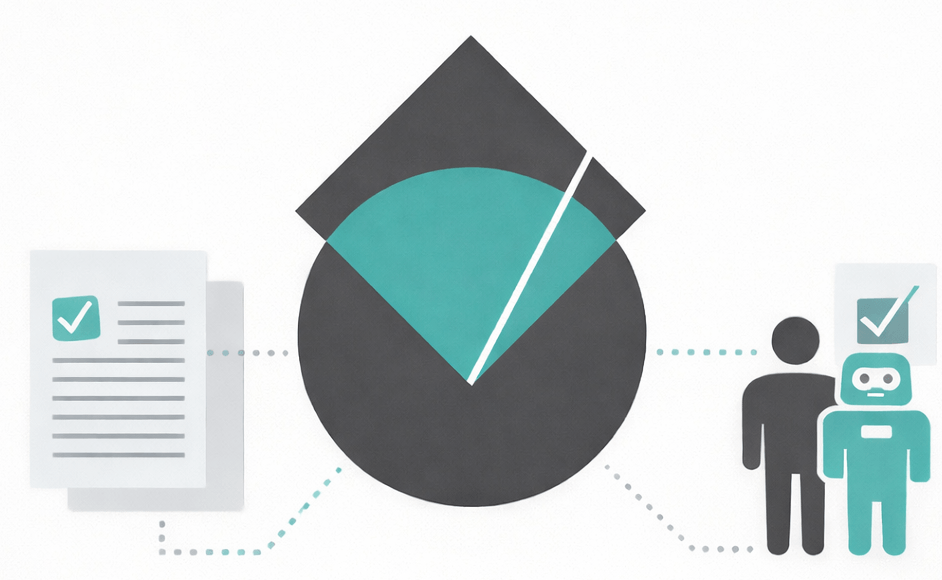
Question: "Can PAICE measure whether people are following our AI policy?"
Short answer: Yes, but not through surveillance. PAICE maps observed behaviors during assessment to common policy themes, revealing gaps between policy requirements and actual practice.
The Policy Compliance Challenge
What Most Organizations Face
You've invested time creating and communicating an AI use policy. It covers:
- Approved tools and use cases
- Verification requirements
- Data handling rules
- Disclosure obligations
- Escalation procedures
The problem: How do you know if people actually follow it?
Traditional Compliance Approaches
Self-certification: "I have read and agree to the AI policy"
- Reality: Checkbox compliance, no behavior change
- Evidence: None
Spot audits: Review random work samples for policy violations
- Reality: Time-intensive, inconsistent, reactive
- Evidence: Limited, biased toward visible work
Incident tracking: Count policy violations after they occur
- Reality: Lagging indicator, misses near-misses
- Evidence: Only captures failures that get reported
Surveys: Ask people if they follow the policy
- Reality: Social desirability bias, knowledge-behavior gap
- Evidence: Self-reported, not verifiable
Why This Matters
For regulated industries: Auditors and regulators want to see that you have a policy document. But that's just the beginning, their job is to verify how people follow it.
For risk management: The gap between policy and practice is where incidents happen.
For governance: You can't improve what you can't measure.
How PAICE Measures Policy Compliance
Behavioral Mapping Approach
PAICE doesn't check policy compliance directly. Instead, it observes behaviors during real AI collaboration, then maps those behaviors to common policy themes.
The process:
- Observe: Capture behavioral patterns during 25-minute assessment
- Analyze: Identify verification practices, information handling, escalation decisions
- Map: Compare observed behaviors to policy requirements
- Report: Highlight gaps between policy expectations and actual practice
What PAICE Can Detect
Verification Requirements
Policy says: "All AI outputs must be verified before use"
PAICE observes:
- Do they verify AI outputs?
- How thorough is their verification?
- Do they catch (deliberate) errors?
Example Gap identified: 40% of cohort accepts AI outputs without verification
Information Handling
Policy says: "Do not share confidential data with external AI tools"
PAICE observes:
- Does the person demonstrate awareness of data sensitivity?
- Do they redact or generalize sensitive information?
- Do they handle hypothetical sensitive scenarios appropriately?
Example Gap identified: 25% show unsafe information handling patterns
Disclosure Requirements
Policy says: "Disclose AI's role in work products"
PAICE observes:
- Does the person acknowledge AI's contribution?
- Do they distinguish between AI-generated and human-created content?
- Do they demonstrate transparency about AI's role?
Example Gap identified: 60% don't naturally disclose AI assistance
Model Selection
Policy says: "Use approved tools only for work tasks"
PAICE observes:
- Does the person demonstrate understanding of tool selection?
- Do they consider task appropriateness?
- Do they show awareness of tool limitations?
Example Gap identified: 35% show limited tool selection judgment
Escalation Paths
Policy says: "Escalate when AI provides uncertain or high-stakes outputs"
PAICE observes:
- Does the person recognize when to seek help?
- Do they escalate appropriately complex scenarios?
- Do they demonstrate judgment about risk levels?
Example Gap identified: 50% don't escalate when they should
Practical Applications
Use Case 1: Policy Gap Analysis
Scenario: Healthcare organization with strict AI policy
Policy requirement: "Verify all AI-generated clinical documentation against source records"
PAICE findings:
- 70% of clinical staff verify thoroughly
- 20% perform partial verification
- 10% accept outputs without verification
Potential Action: Targeted training for the 30% with verification gaps, not blanket retraining
Use Case 2: Risk Prioritization
Scenario: Financial services firm with compliance obligations
Policy requirements: Multiple verification, disclosure, and escalation rules
PAICE findings:
- High risk: 15% show multiple accountability failures
- Medium risk: 35% show verification gaps
- Low risk: 50% demonstrate strong compliance behaviors
Potential Action: Focus resources on mitigation for high-risk failures, instituting internal monitoring for medium-risk gaps
Use Case 3: Policy Refinement
Scenario: Technology company with evolving AI policy
Policy requirement: "Use AI for drafting only, not final decisions"
PAICE findings:
- 80% demonstrate appropriate AI use boundaries
- 20% show over-reliance patterns
Insight: Policy is mostly working, but 20% need clarity on "final decisions"
Potential Action: Refine policy language, add examples, provide decision framework
What PAICE Doesn't Do
Not surveillance: Assessment happens only when people choose to participate, we do not provide continuous or user-specific monitoring.
Not policy enforcement: PAICE identifies gaps, doesn't punish violations or identify individuals.
Not a replacement for policy: You still need clear policies; PAICE helps determine how they're followed.
Not 100% coverage: Measures behaviors in simulation, not all possible policy scenarios.
For Compliance and Risk Teams
Defensible Evidence
When auditors ask "How do you know people follow your AI policy?", PAICE provides:
Documented methodology: Behavioral observation approach with clear assessment criteria
Quantified gaps: Percentage of cohort demonstrating policy-aligned behaviors
Risk profiles: Identification of high-risk behavioral patterns
Longitudinal tracking: Measure improvement over time after training or policy updates
Governance Artifacts
Baseline assessment: Document current state before policy rollout
Post-training validation: Measure whether training improved compliance behaviors
Quarterly monitoring: Track compliance trends across cohorts
Audit support: Provide evidence of proactive risk management
Integration with Existing Programs
PAICE complements (doesn't replace) existing compliance programs:
Policy development: Use behavioral insights to inform policy design
Training programs: Identify specific gaps for targeted training
Risk assessments: Quantify behavioral risk across teams
Audit preparation: Document compliance measurement approach
Mapping Your Policy to PAICE
Step 1: Identify Behavioral Requirements
Review your AI policy and extract behavioral expectations:
Example policy statement: "Employees must verify AI outputs for accuracy before using them in client deliverables"
Behavioral requirement: Verification behavior
PAICE dimension: Accountability (verification patterns)
Step 2: Define Compliance Criteria
Translate policy requirements into observable behaviors:
Policy requirement: "Verify AI outputs"
Observable behaviors:
- Checks facts and claims
- Catches deliberate errors
- Questions uncertain outputs
- Uses multiple verification methods
PAICE measurement: Verification subscore, error detection rate
Step 3: Set Thresholds
Define what "compliance" looks like:
Example thresholds:
- Strong compliance: 80%+ of cohort demonstrates verification behaviors
- Acceptable compliance: 60-79% demonstrates verification behaviors
- Gap requiring action: <60% demonstrates verification behaviors
Step 4: Plan Interventions
Define actions based on findings:
If gap identified: Targeted training, policy clarification, additional resources
If compliance strong: Maintain current approach, share best practices
If mixed results: Segment cohort, differentiate interventions
Common Questions
"Can PAICE replace our compliance audits?"
No. PAICE provides behavioral insights that complement audits, not replace them. Use PAICE for proactive capability measurement; use audits for comprehensive compliance verification.
"What if someone 'games' the assessment?"
PAICE uses strategic failure injection and behavioral pattern analysis. Gaming requires consistently demonstrating policy-aligned behaviors under realistic conditions, which is exactly what you want. Agentic behaviors are identified and disallowed from simulation.
"How often should we assess for compliance?"
Baseline: Before policy rollout or training
Post-intervention: 30-60 days after training or policy updates
Ongoing: Quarterly or semi-annually for high-risk teams
Triggered: After incidents or significant policy changes
"Can we customize PAICE to our specific policy?"
PAICE currently measures universal collaboration behaviors (verification, information handling, escalation). We can help you map these to your specific policy requirements. For highly specialized policies, contact us about custom assessment design.
Implementation Approach
Phase 1: Baseline (Week 1-2)
- Map your policy requirements to PAICE dimensions
- Define compliance thresholds
- Assess representative cohort (20-100 people)
- Identify gaps between policy and practice
Phase 2: Intervention (Week 3-6)
- Design targeted training for identified gaps
- Clarify policy language where needed
- Provide resources and support
- Communicate expectations clearly
Phase 3: Validation (Week 7-8)
- Re-assess cohort after intervention
- Measure behavior change
- Validate training effectiveness
- Document improvement for governance
Phase 4: Monitoring (Ongoing)
- Quarterly assessments for high-risk teams
- Annual assessments for all teams
- Track trends over time
- Refine policy and training based on data
The Bottom Line
PAICE won't tell you if someone read your policy or signed the acknowledgment form.
But it will tell you whether people actually demonstrate the behaviors your policy requires, which is what actually matters most for risk management and compliance.
The value:
- Defensible evidence: Behavioral observation vs. self-reports
- Targeted interventions: Focus resources where gaps exist
- Continuous improvement: Measure whether interventions work
- Audit readiness: Document proactive compliance measurement
If your AI policy matters enough to create, it matters enough to measure whether people follow it.
Need to measure policy compliance in your organization?
Explore the Founding Partner Program for cohort assessment and governance support, or contact our governance team to discuss your specific compliance requirements.
Related Reading
متجسس لیکن وقت کم ہے؟
3 منٹ کا PAICE Pulse کریں — ایک فوری اعتماد چیک جو یہ ظاہر کرتا ہے کہ آپ اپنی AI تعاون کی پوزیشن کو کیسے دیکھتے ہیں۔ لاگ ان کی ضرورت نہیں۔