The Hidden Costs of AI Collaboration
What ROI Calculations Miss
Every AI collaboration ROI calculation you've seen focuses on the same metrics: time saved, productivity gained, costs reduced. And they're not wrong—these benefits are real and measurable.
But they're incomplete.
Traditional ROI calculations miss a category of costs that are harder to quantify but equally important: cognitive costs, skill atrophy, opportunity costs, quality debt, and dependency risks.
This post explores what standard ROI calculations miss—and why understanding these hidden costs is essential for sustainable AI collaboration.
Why Traditional ROI Calculations Fall Short
What They Measure Well
Visible benefits:
- Time saved on tasks
- Increased output volume
- Reduced labor costs
- Faster project completion
- Measurable productivity gains
Visible costs:
- Tool subscriptions
- Training programs
- Infrastructure
- Implementation time
- Support resources
The calculation:
ROI = (Benefits - Costs) / Costs × 100%

Example:
Benefits: $1M in time savings
Costs: $200K in tools and training
ROI: 400%
What's missing:
These calculations assume AI collaboration is a simple input-output equation. They miss the systemic, long-term, and second-order effects that compound over time.
The Hidden Cost Categories
1. Cognitive Costs
- Mental overhead of AI collaboration
- Decision fatigue from verification
- Context switching between human and AI thinking
- Cognitive load of managing AI limitations
2. Skill Atrophy
- Erosion of fundamental capabilities
- Loss of deep expertise
- Reduced problem-solving skills
- Weakened critical thinking
3. Opportunity Costs
- Time spent on AI collaboration vs. other activities
- Learning opportunities missed
- Relationship building foregone
- Strategic thinking displaced
4. Quality Debt
- Accumulated subtle errors
- Degraded work quality over time
- Loss of craftsmanship
- Reduced attention to detail
5. Dependency Risks
- Over-reliance on AI tools
- Inability to work without AI
- Vendor lock-in
- Systemic fragility
6. Organizational Costs
- Cultural shifts and tensions
- Trust erosion
- Coordination overhead
- Change management burden
Cognitive Costs: The Mental Overhead
The Verification Tax
What it is:
Every AI output requires verification. This creates constant cognitive overhead that traditional ROI calculations ignore.
The hidden cost:
Scenario: Using AI to draft emails

Traditional calculation:
- Time to write email manually: 10 minutes
- Time with AI assistance: 3 minutes
- Time saved: 7 minutes (70% reduction)
- ROI: Excellent!

Hidden costs:
- Reading AI draft: 1 minute
- Evaluating quality: 2 minutes
- Fact-checking claims: 3 minutes
- Adjusting tone: 2 minutes
- Verifying accuracy: 2 minutes
- Total verification: 10 minutes

Actual time: 13 minutes (30% increase)
Why this matters:
The verification tax is invisible in productivity metrics but very real in cognitive load. You're not just writing faster—you're also becoming an AI output editor, which is a different (and often more taxing) cognitive task.
Decision Fatigue
What it is:
AI collaboration requires constant micro-decisions:
- Should I use AI for this?
- Is this output good enough?
- What needs verification?
- How much should I trust this?
- When should I start over?
The hidden cost:
Each decision depletes cognitive resources. By the end of the day, you're making worse decisions—not because of the work itself, but because of the meta-work of managing AI collaboration.
Example:
Morning: Sharp judgment about AI outputs
- Catches subtle errors
- Makes good verification decisions
- Knows when to trust AI

Afternoon: Decision fatigue setting in
- Misses subtle errors
- Over-trusts AI outputs
- Accepts lower quality

Evening: Cognitive depletion
- Minimal verification
- Accepts AI outputs uncritically
- Quality suffers significantly
The compounding effect:
Decision fatigue doesn't reset daily. It accumulates over weeks and months, leading to chronic cognitive depletion that affects all work, not just AI-assisted tasks.
Context Switching Costs
What it is:
AI collaboration requires constant switching between:
- Human thinking mode
- AI collaboration mode
- Verification mode
- Integration mode
The hidden cost:
Research shows context switching costs 20-40% of productive time.

Example workflow:
1. Think about problem (human mode)
2. Formulate AI prompt (collaboration mode)
3. Evaluate AI response (verification mode)
4. Integrate into work (integration mode)
5. Return to problem (human mode)

Each switch: 5-15 minutes of cognitive overhead
Switches per hour: 4-8
Daily cost: 2-4 hours of reduced productivity
Why traditional ROI misses this:
You appear productive (generating outputs), but your deep work capacity is significantly reduced.
Skill Atrophy: The Expertise Erosion
The Use-It-or-Lose-It Problem
What happens:
When AI handles tasks you used to do manually, those skills atrophy. This isn't hypothetical—it's neurological reality.
The hidden cost:
Year 1: AI assists with data analysis
- You verify AI work carefully
- Catch errors effectively
- Maintain analytical skills

Year 2: Increased AI reliance
- Verification becomes routine
- Miss some subtle errors
- Analytical skills declining

Year 3: Significant atrophy
- Can't verify effectively
- Don't recognize errors
- Lost analytical capability

Result: You're dependent on AI for tasks you used to master
Real-world example:
Software developer using AI code generation:

Month 1: Reviews AI code carefully, catches issues
Month 6: Reviews less carefully, trusts AI more
Month 12: Struggles to write code without AI
Month 18: Can't debug AI-generated code effectively

Hidden cost: Lost the ability to code independently
The Expertise Paradox
The paradox:
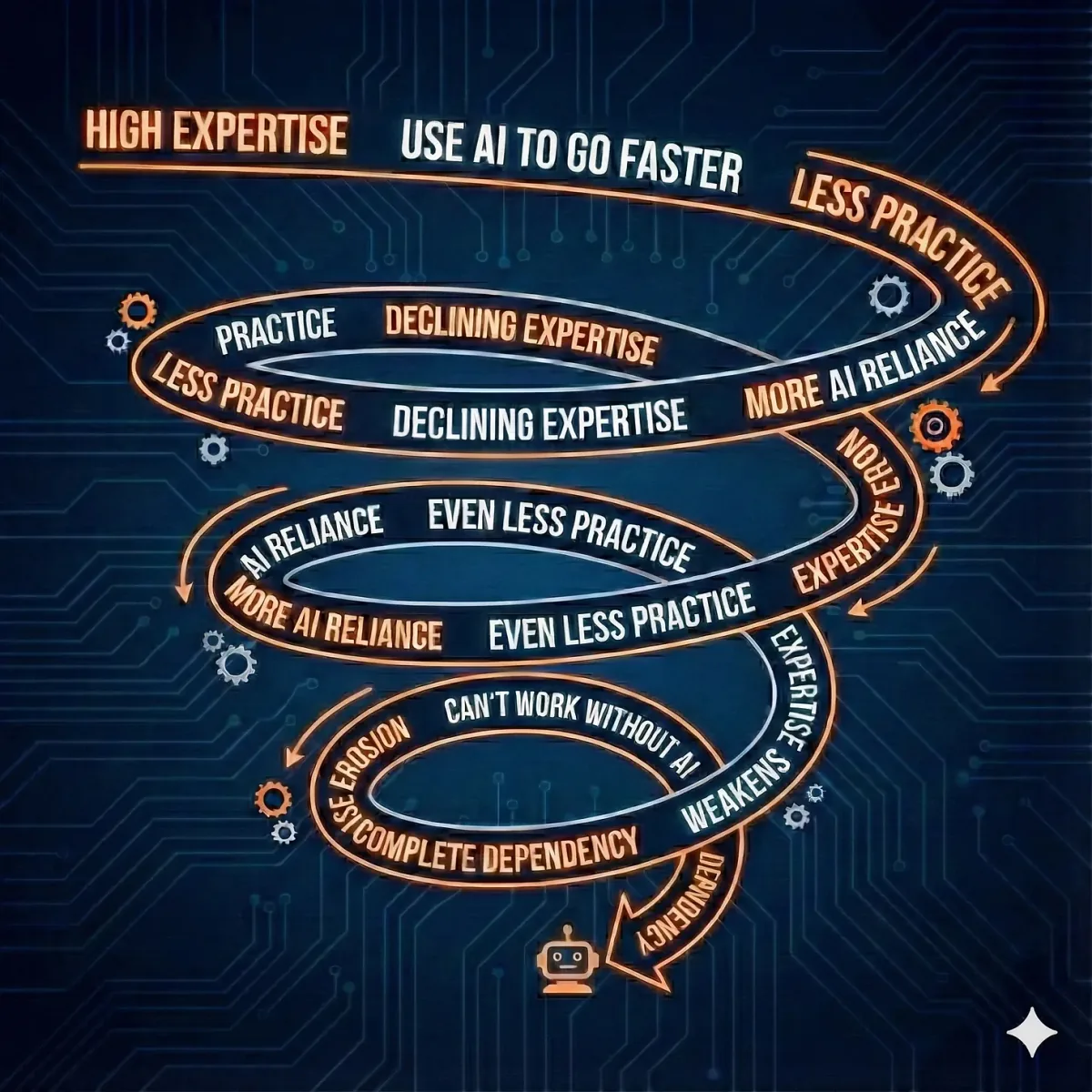
The better AI gets at a task, the less you practice it. The less you practice, the worse you get. The worse you get, the more you need AI. The more you need AI, the less you practice.
The spiral:
High expertise → Use AI to go faster → Less practice
Less practice → Declining expertise → More AI reliance
More AI reliance → Even less practice → Expertise erosion
Expertise erosion → Can't work without AI → Complete dependency
Why this matters:
You're trading current productivity for future capability. The ROI calculation shows gains today but misses the capability loss tomorrow.
The Junior Developer Problem
What it is:
New team members who learn with AI assistance never develop fundamental skills.
The hidden cost:
Traditional learning path:
- Struggle with problems
- Develop deep understanding
- Build problem-solving skills
- Become expert over time

AI-assisted learning path:
- Get AI solutions quickly
- Shallow understanding
- Weak problem-solving skills
- Plateau at intermediate level

Result: Team of AI-dependent practitioners, not experts
The organizational impact:
Year 1: Senior experts + AI = High productivity
Year 3: Seniors retiring, juniors AI-dependent
Year 5: No one can work without AI
Year 7: Lost institutional knowledge and expertise

Hidden cost: Organizational capability erosion
Opportunity Costs: What You're Not Doing
The Time Allocation Shift
What changes:
AI collaboration doesn't just save time—it reallocates how you spend time.
The hidden cost:
Before AI:
- Deep work: 40%
- Collaboration: 30%
- Learning: 20%
- Administration: 10%

With AI:
- AI collaboration: 35%
- Verification: 20%
- Deep work: 25%
- Collaboration: 15%
- Learning: 5%

What you lost:
- 15% less deep work
- 15% less human collaboration
- 15% less learning time
Why this matters:
You're more productive at tasks AI helps with, but less capable at everything else. The ROI calculation shows the productivity gain but misses the capability loss.
The Learning Opportunity Cost
What you miss:
Struggling with problems builds expertise. AI removes the struggle, which removes the learning.
Example:
Problem: Complex data analysis challenge

Without AI:
- Struggle for hours
- Try multiple approaches
- Learn deeply
- Build expertise
- Solve future problems faster

With AI:
- Get solution quickly
- Move on immediately
- Learn superficially
- Don't build expertise
- Need AI for every similar problem

Hidden cost: Lost learning opportunity
The compounding effect:
Year 1: Miss 100 learning opportunities
Year 2: Miss 200 (you're less capable, need AI more)
Year 3: Miss 400 (significant capability gap)
Year 5: Miss 1,000+ (expertise erosion complete)
The Relationship Opportunity Cost
What you miss:
Time spent with AI is time not spent with humans. This has hidden costs for:
- Mentorship relationships
- Team cohesion
- Knowledge sharing
- Collaborative problem-solving
- Organizational culture
Example:
Before AI: Junior asks senior for help
- 30-minute conversation
- Junior learns deeply
- Relationship strengthens
- Knowledge transfers
- Culture of mentorship

With AI: Junior asks AI for help
- 5-minute interaction
- Junior learns superficially
- No relationship building
- No knowledge transfer
- Culture of independence

Hidden cost: Weakened organizational fabric
Quality Debt: The Accumulation of Subtle Errors
What Quality Debt Is
Definition:
Like technical debt, quality debt is the accumulation of small quality compromises that compound over time.
How it accumulates:
Day 1: AI output is 95% correct
- You catch the 5% errors
- Quality maintained

Day 30: Verification fatigue setting in
- You catch 90% of errors
- 0.5% error rate accumulates

Day 90: Significant fatigue
- You catch 80% of errors
- 1% error rate accumulates

Day 180: Quality debt visible
- Accumulated errors causing problems
- Rework required
- Trust eroding
The Compounding Effect
Why it's insidious:
Small errors compound. A 1% error rate doesn't mean 1% of your work is wrong—it means errors accumulate exponentially.
Example:
Project with 100 AI-assisted tasks:
- Each task: 99% accurate
- Seems excellent!

But:
- Task 1 builds on Task 0: 99% accurate
- Task 2 builds on Task 1: 98% accurate
- Task 3 builds on Task 2: 97% accurate
- Task 10: 90% accurate
- Task 50: 60% accurate
- Task 100: 37% accurate

Result: Final output is mostly wrong
The hidden cost:
Traditional ROI:
- 100 tasks completed quickly
- High productivity!

Hidden cost:
- Massive rework required
- Lost credibility
- Damaged relationships
- Wasted effort
The Craftsmanship Loss
What it is:
AI collaboration optimizes for "good enough" rather than excellence. Over time, this erodes standards.
The progression:
Year 1: High standards maintained
- AI provides drafts
- You refine to excellence
- Quality remains high

Year 2: Standards slipping
- AI drafts accepted more readily
- Less refinement
- Quality declining

Year 3: New normal
- AI output is the standard
- Minimal refinement
- Quality significantly lower

Year 5: Lost craftsmanship
- Don't remember what excellence looked like
- Can't produce it anymore
- Quality debt massive
Dependency Risks: The Fragility Problem
The Single Point of Failure
What it is:
When AI becomes essential to your workflow, you've created a single point of failure.
The hidden cost:
Scenario: AI service outage

Traditional ROI calculation:
- Productivity gain: 40%
- Cost: $100/month
- ROI: Excellent!

Hidden cost during outage:
- Can't work effectively
- Productivity drops 60% (not 40%)
- Why? You've lost the skills to work without AI
- Recovery time: Days or weeks
Real-world example:
Company relies heavily on AI coding assistant:

Normal operation:
- High productivity
- Fast development
- Great ROI

AI service outage:
- Developers can't code effectively
- Projects stall
- Deadlines missed
- Revenue impact: $500K

Hidden cost: Systemic fragility
The Vendor Lock-In Problem
What it is:
Your workflows, skills, and processes become optimized for specific AI tools. Switching becomes prohibitively expensive.
The hidden cost:
Year 1: Adopt AI tool
- Productivity gains
- Positive ROI
- Happy users

Year 3: Deeply integrated
- Workflows optimized for tool
- Skills developed around tool
- Switching cost: High

Year 5: Vendor increases prices 300%
- Can't switch (too expensive)
- Can't negotiate (locked in)
- Must pay

Hidden cost: Lost negotiating power
The Capability Ceiling
What it is:
AI tools have limitations. When you depend on them, their limitations become your limitations.
Example:
AI writing assistant:
- Excellent at clear, simple prose
- Poor at nuanced, complex arguments
- Can't handle deep technical content

Result after 2 years:
- You're excellent at clear, simple prose
- You've lost ability to write complex arguments
- You can't produce deep technical content

Hidden cost: Your capability ceiling is now AI's ceiling
The True Total Cost of Ownership
A More Complete Calculation
Traditional ROI:
Benefits: $1,000,000 (time savings)
Costs: $200,000 (tools + training)
ROI: 400%
True TCO including hidden costs:
Visible Benefits: $1,000,000

Visible Costs: $200,000

Hidden Costs:
- Cognitive overhead: $150,000
  (decision fatigue, context switching)

- Skill atrophy: $300,000
  (lost expertise, reduced capability)

- Opportunity costs: $200,000
  (missed learning, relationships)

- Quality debt: $250,000
  (rework, errors, lost trust)

- Dependency risks: $100,000
  (fragility, vendor lock-in)

Total Hidden Costs: $1,000,000

True ROI: ($1M - $1.2M) / $1.2M = -17%
The reality:
Many AI collaboration initiatives that appear profitable are actually destroying value when hidden costs are included.
When Hidden Costs Dominate
High-risk scenarios:
1. Critical expertise domains
- Medicine, law, engineering
- Skill atrophy is dangerous
- Quality debt is catastrophic
- Hidden costs >> visible benefits
2. Long-term capability building
- Junior development
- Skill acquisition
- Expertise development
- Hidden costs compound over years
3. High-stakes decisions
- Strategic planning
- Major investments
- Critical operations
- Quality debt is unacceptable
4. Relationship-dependent work
- Client services
- Team collaboration
- Mentorship
- Opportunity costs are high
Managing Hidden Costs
Awareness and Measurement
Track what matters:
Cognitive costs:
- Decision fatigue levels
- Context switching frequency
- Verification time
- Mental overhead
Skill atrophy:
- Capability assessments over time
- Independent work quality
- Problem-solving effectiveness
- Expertise retention
Opportunity costs:
- Time allocation shifts
- Learning opportunities
- Relationship building
- Strategic thinking time
Quality debt:
- Error rates over time
- Rework frequency
- Quality metrics
- Customer satisfaction
Dependency risks:
- AI reliance levels
- Switching costs
- Vendor concentration
- Capability gaps
Mitigation Strategies
1. Deliberate Practice
Maintain skills through regular practice without AI:
- Weekly "AI-free" work sessions
- Monthly capability assessments
- Quarterly skill refreshers
- Annual deep skill development
2. Verification Discipline
Prevent quality debt through rigorous verification:
- Defined verification standards
- Peer review processes
- Quality checkpoints
- Error tracking
3. Balanced Allocation
Protect high-value activities:
- Reserve time for deep work
- Maintain learning time
- Prioritize relationships
- Preserve strategic thinking
4. Dependency Management
Reduce fragility:
- Maintain alternative workflows
- Develop tool-agnostic skills
- Avoid vendor lock-in
- Build redundancy
5. Cultural Norms
Establish healthy AI collaboration culture:
- Value expertise and craftsmanship
- Celebrate learning and growth
- Maintain quality standards
- Balance efficiency and excellence
The Sustainable Approach
Principles:
1. AI as Augmentation, Not Replacement
- Use AI to enhance capabilities
- Don't let AI replace capabilities
- Maintain fundamental skills
- Build on AI, don't depend on it
2. Quality Over Speed
- Optimize for sustainable quality
- Don't sacrifice standards for productivity
- Invest in verification
- Maintain craftsmanship
3. Long-Term Capability
- Prioritize learning and growth
- Protect expertise development
- Invest in relationships
- Think in years, not quarters
4. Measured Adoption
- Start small and learn
- Track hidden costs
- Adjust based on data
- Scale sustainably
Conclusion: The Complete Picture
The reality:
AI collaboration has real benefits. Time savings are real. Productivity gains are real. Cost reductions are real.
But hidden costs are also real. And for many organizations, hidden costs exceed visible benefits.
The challenge:
Traditional ROI calculations make AI collaboration look like a no-brainer. But they're measuring the wrong things.
The opportunity:
Organizations that understand and manage hidden costs will build sustainable AI collaboration practices. Those that don't will face:
- Eroded capabilities
- Quality problems
- Dependency risks
- Long-term value destruction
The path forward:
- Measure completely - Track hidden costs, not just visible benefits
- Manage proactively - Mitigate hidden costs before they compound
- Optimize sustainably - Balance short-term gains with long-term capability
- Think systemically - Consider second-order and long-term effects
Remember:
The goal isn't to avoid AI collaboration. It's to do it sustainably—capturing benefits while managing hidden costs.
The organizations that succeed won't be those with the highest AI adoption rates. They'll be those with the most sustainable AI collaboration practices.
Want to assess your AI collaboration effectiveness, including verification practices and accountability? Take the PAICE assessment to understand your strengths and risks.
Building sustainable AI collaboration practices in your organization? Explore the PAICE Pilot Program for structured capability development.
Recommended Reading
📖 ROI and Measurement:
- Measuring AI Collaboration ROI, Part 1: Framework and Metrics - Traditional ROI framework
- Measuring AI Collaboration ROI, Part 2: Real-World Case Studies - Practical examples
- Measuring AI Collaboration ROI, Part 3: Building Your Measurement System - Implementation guide
📖 Risk Management:
- Recovering from AI Collaboration Failures: A Practical Framework - Managing failures
- Why Your Accountability Score Is Probably Lower Than Your Other Dimensions - Verification challenges
- Common AI Collaboration Mistakes (And How to Avoid Them) - Pitfalls to avoid
📖 Strategic Perspective:
- The Executive's Guide to AI Collaboration Readiness - Strategic risk assessment
- AI Collaboration for Managers: Leading Teams in the AI Era - Managing team adoption
- The AI Governance Clock Is Ticking - Governance imperatives
متجسس لیکن وقت کم ہے؟
3 منٹ کا PAICE Pulse کریں — ایک فوری اعتماد چیک جو یہ ظاہر کرتا ہے کہ آپ اپنی AI تعاون کی پوزیشن کو کیسے دیکھتے ہیں۔ لاگ ان کی ضرورت نہیں۔