ObligationFirst: Making Law Agentically Legible
An agent-native schema for legal obligations, and the portfolio that runs on it
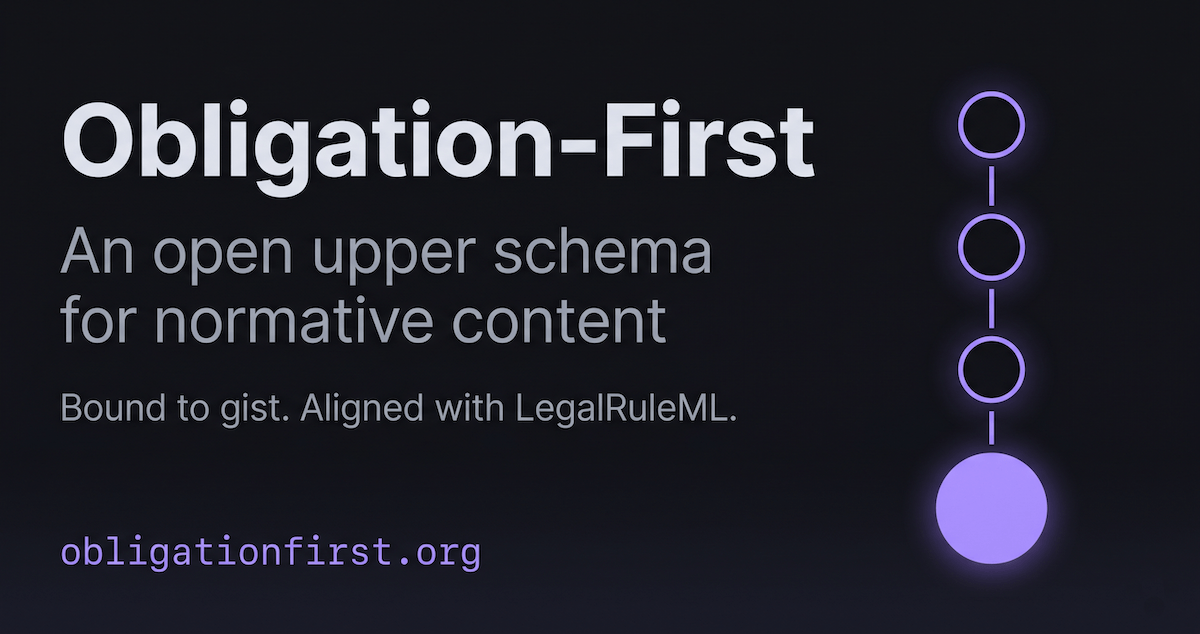
Statutes are written for humans. Agents read them anyway — and they read them badly. Today, almost every "AI compliance" tool follows the same pattern: scrape the statute text, hand it to a language model, hope the interpretation holds. That is not a foundation. It is a guess wearing professional clothing.
Today we are announcing ObligationFirst.org, and the way it ties together the rest of the PAICE portfolio. ObligationFirst is an open schema for representing legal obligations in a form an agent can actually reason about. It is free, and open for adoption by anyone. And it is the layer that lets PAICE do something no other AI collaboration measurement system can do.
The Missing Layer
When an agent has to comply with a statute, the model is currently asked to be three things at once: a reader of legal prose, an interpreter of legislative intent, and an executor of the resulting obligation. Conflating those jobs is how compliance theater happens. The agent sounds compliant. Whether it is compliant is a separate question, and one nobody is wired to answer.
The semantics of the obligation need to live outside the model. They need to be structured, queryable, and stable across model versions and across vendors. That is what a schema is for. ObligationFirst captures the parts of an obligation an agent actually needs: who must act, what they must do, under what condition, by what deadline, on whose authority, and with what exceptions.
What ObligationFirst Is
ObligationFirst is a public schema and reference implementation. It is intentionally small to start. Each obligation is a structured record that names the regulated actor, the required action, the conditions under which the obligation applies, the timing, the issuing authority, and the recognized exceptions. The schema is paired with reference data and worked examples drawn from real statutes, so adopters have something concrete to follow.
The schema is free to use. Tooling built on top of it is free to build. We will publish governance details, contribution norms, and versioning policy on the project site as the work matures.
Not the First Attempt. The First for Agents.
Machine-readable law is not a new idea. LegalRuleML, Akoma Ntoso, OpenFisca, and a long line of academic and government efforts have made meaningful progress on representing legislation, rules, and entitlements in structured form. ObligationFirst stands on that work. Interoperability with those projects is a design goal, not an afterthought. Where we can map cleanly into an existing standard, we will.
The difference is who the schema is shaped for. Prior efforts modeled law for humans operating software: lawyers, legislative drafters, benefits administrators. ObligationFirst is shaped around how an agent queries, plans, and acts against an obligation. Field choices, query patterns, and the granularity of conditions all reflect that. That reframing is small in the abstract and large in practice. It is the difference between a representation that a person can browse and a representation that an agent can execute against without hallucinating the parts it cannot see.
Interstitial Tissue Across the Portfolio
ObligationFirst is the connective layer behind three other PAICE-portfolio sites, each of which views the same body of law from a different angle.
EveryAILaw.com is the statute corpus, structured. It is the regulator's lens: what the law says, in what jurisdiction, against which AI activity. EveryAILaw is free to use as a reference. It has a paid tier that supports working law offices doing professional research, and that paid tier is open for business today. But the information that's public is free.
AIIncidentLaw.org maps real AI incidents to the obligations they touched. It is the litigant's lens: when an AI system causes harm, which obligations are in play, and what does the trail of authority actually look like. We intend to expand the number of cases listed globally, and keep this current and free. It shows real-world examples of real-world litigation from the simple allegation of "AI got it wrong, and someone is responsible for damages."
PubLedge.org is a civic recordkeeping protocol. It carries the authority artifacts — letters, opinions, advisories — that ObligationFirst points at, so the citations underneath the schema are durable and verifiable. Sample use cases exist now, mostly focused on AI regulation in the state of Utah. This will be expanded upon in the future. Also free.
None of these can carry the full picture alone. Together, with ObligationFirst as the shared substrate, they do.
Three Lenses, One Substrate
Regulator, regulated party, and litigant read the same obligations from very different positions. The regulator writes them. The regulated party has to operationalize them. The litigant tests them in court. Without a shared schema, those three views drift apart and the drift is exactly where compliance failures hide. With a shared schema, they reconcile against the same structured object. Disagreement becomes legible instead of mysterious.
This is the move that makes the portfolio coherent. The same obligation, with the same identifier, appears in the statute index, in the incident map, and in the operational checklist a regulated firm runs. When any one of those three changes, the others can see it.
Why This Unlocks PAICE
PAICE measures human behavior in AI collaboration. That is the product. It is a behavioral assessment, not a knowledge test. The question we answer is whether a licensed professional, working with AI on a real task, behaves in the ways that produce safe and defensible outcomes.
Today PAICE links that behavior to functional risk: did the person catch the injected error, did the output mislead, did the workflow recover. With ObligationFirst as a foundation, PAICE can link that same behavior to regulatory risk: which specific obligation, under which statute, in which jurisdiction, was at stake in the behavior we just measured. That is a different and much stronger claim.
It is also a claim no other AI assessment vendo can make. The reason is structural. Linking behavior to regulation requires both a behavioral measurement layer that is rigorous enough to mean something, and a machine-readable obligation graph that is agent-native rather than lawyer-native. PAICE has the first. ObligationFirst is the second. Together via MCP they connect the two layers regulated industries care about most.
Open for Adoption
ObligationFirst is public. The schema, the reference data, and the integration patterns are available for anyone building compliance tooling, regulator dashboards, audit pipelines, or agent harnesses that have to operate inside a regulated environment. We absolutely want adopters outside the PAICE portfolio. The point of a substrate is that it is shared.
If you are working on machine-readable law and want to compare notes, we want the conversation. Interoperability with prior standards is in scope, and pull requests are welcome.
What's Free, What's Paid
The schema is free. ObligationFirst.org, AIIncidentLaw.org, and PubLedge.org are free. The reference content on EveryAILaw.com is free. EveryAILaw also offers a paid tier built for law offices doing professional legal research, and that tier funds the rest. If you run a law office and want a closer look at the paid tier, get in touch.
Try It. Contribute. Tell Us What We Missed.
All four sites are live now, and this is just the beginning. The schema is published. Worked examples are growing. If you work in a regulated industry — legal, insurance, healthcare, finance, cybersecurity — open ObligationFirst, look at how an obligation in your domain is modeled, and tell us where the schema is wrong or thin. That feedback is how this becomes load-bearing.
If you regulate, look at how your jurisdiction is represented in EveryAILaw and AIIncidentLaw. If a statute or an incident is missing, send it.
Want to understand your own readiness profile? Take the PAICE assessment to discover your strengths and opportunities.
متجسس لیکن وقت کم ہے؟
3 منٹ کا PAICE Pulse کریں — ایک فوری اعتماد چیک جو یہ ظاہر کرتا ہے کہ آپ اپنی AI تعاون کی پوزیشن کو کیسے دیکھتے ہیں۔ لاگ ان کی ضرورت نہیں۔