From Tool to Assistant to Partner: The Evolution of People+AI Working Relationships
How our relationship with AI is fundamentally changing, and what it means for you
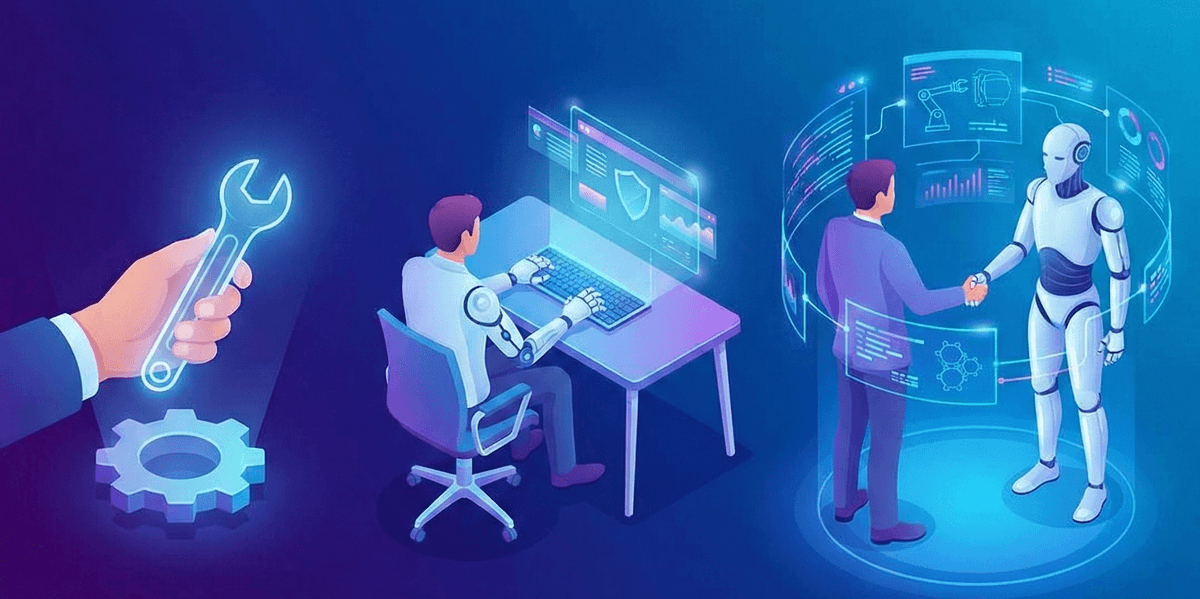
The way we talk about AI reveals how we think about it.
In 2022, we "used" AI tools. In 2024, we "worked with" AI assistants. Now in 2026, we're finally beginning to talk about "collaborating with" AI partners, perhaps even regarding agents as collegues. These aren't just semantic shifts, they reflect a fundamental evolution in the People+AI relationship that's reshaping how we work, think, and create.
Understanding this evolution isn't academic. It's practical. The skills that made you effective with AI-as-tool are different from those needed for AI-as-assistant, which are different still from AI-as-partner. And the trajectory isn't slowing down.
The Three Eras of People+AI Interaction
Era 1: AI as Tool (2015-2022)
The Relationship: Command and execute. You tell the AI what to do; it does exactly that (or fails trying).
Characteristics:
- One-directional: Human inputs, AI outputs
- Deterministic: Same input produces same output
- Narrow: Each tool does one thing well
- Passive: AI waits for instructions, never initiates
Examples:
- Spell checkers that flag errors
- Translation services that convert text
- Image classifiers that label photos
- Recommendation engines that suggest content
Human Role: Operator. You learned the tool's interface, understood its capabilities, and applied it to appropriate tasks. The tool had no understanding of your goals—it just executed functions.
Key Skills:
- Understanding tool capabilities and limitations
- Selecting the right tool for each task
- Interpreting outputs correctly
- Working around tool limitations
The Mindset: "How do I get this tool to do what I need?"
Era 2: AI as Assistant (2022-2025)
The Relationship: Request and respond. You describe what you want; AI interprets and attempts to deliver.
Characteristics:
- Conversational: Natural language interaction
- Interpretive: AI infers intent from context
- Generalist: One system handles many tasks
- Responsive: AI adapts based on feedback
Examples:
- ChatGPT answering questions and generating content
- Copilot suggesting code completions
- AI writing assistants drafting emails
- Virtual assistants scheduling meetings
Human Role: Director. You learned to communicate effectively with AI, provide appropriate context, and guide it toward useful outputs. The assistant understood your requests but not necessarily your broader goals.
Key Skills:
- Clear communication and prompting
- Providing appropriate context
- Iterating based on outputs
- Verifying and refining results
The Mindset: "How do I communicate what I want effectively?"
Era 3: AI as Partner (2026-?)
The Relationship: Collaborate and co-create. You work together toward shared goals, each contributing unique capabilities.
Characteristics:
- Bidirectional: Both parties contribute ideas and direction
- Contextual: AI maintains relevant memory across interactions
- Strategic: AI can help with planning, not just execution
- Proactive: AI anticipates needs and offers suggestions
Examples:
- AI that remembers your project context across sessions
- Systems that challenge your assumptions constructively
- Collaborative problem-solving where AI contributes novel approaches
- AI that identifies gaps in your thinking
Human Role: Collaborator. You're learning to leverage AI's unique capabilities while contributing your own—judgment, creativity, domain expertise, ethical reasoning. The partnership produces leveraged outcomes neither could achieve alone.
Key Skills:
- Strategic collaboration design
- Leveraging complementary capabilities
- Maintaining appropriate oversight
- Integrating AI contributions with human judgment
The Mindset: "How do we work together most effectively?"
What Changes at Each Transition
From Tool to Assistant: The Communication Shift
When AI became conversational, everything changed.
Before: You learned the tool's language (commands, interfaces, parameters). After: The tool learned your language (natural speech, context, intent).
What This Required:
- New mental models: Thinking about AI as something you talk to, not operate
- Communication skills: Learning to express intent clearly in natural language
- Iteration mindset: Understanding that first outputs are starting points
- Verification habits: Recognizing that interpretation can go wrong
What Many Got Wrong:
- Treating AI like a search engine (single query, expect perfect answer)
- Over-specifying (providing so much detail that AI couldn't add value)
- Under-specifying (expecting AI to read minds)
- Assuming AI retained context by default (it doesn't)
- Binary trust, either fully trusting or fully distrusting AI
From Assistant to Partner: The Collaboration Shift
The current transition is more subtle but more profound.
Before: You directed, AI executed. After: You collaborate, outcomes emerge from the partnership.
What This Requires:
- Strategic thinking: Planning how to leverage AI across entire workflows
- Complementary awareness: Understanding what you do better vs. what AI does better
- Trust calibration: Knowing when to rely on AI judgment vs. override it
- Meta-cognition: Reflecting on the collaboration itself, not just the outputs
What Many Are Getting Wrong:
- Over-delegation: Handing off tasks that still require human judgment
- Under-delegation: Doing everything yourself when AI could help
- Static approaches: Using the same collaboration pattern for every task
- Ignoring the relationship: Treating each interaction as isolated
- Assuming ability: Expecting that collaboration will be seamless without practice
The Skill Evolution
Tool-Era Skills (Still Relevant)
These foundational skills don't disappear, they evolve:
| Tool-Era Skill | Partner-Era Evolution |
|---|---|
| Selecting the right tool | Designing the right collaboration |
| Understanding capabilities | Understanding complementary strengths |
| Interpreting outputs | Integrating AI contributions |
| Working around limitations | Compensating for each other's gaps |
Assistant-Era Skills (Being Transformed)
The skills that defined effective AI use in 2023-2024 are being transformed:
| Assistant-Era Skill | Partner-Era Transformation |
|---|---|
| Clear prompting | Strategic collaboration design |
| Providing context | Building shared understanding |
| Iterating on outputs | Co-evolving solutions |
| Verifying results | Mutual quality assurance |
Partner-Era Skills (Emerging)
New capabilities are becoming essential:
1. Collaboration Architecture
Designing how you and AI will work together on complex projects:
- What decisions require human judgment?
- Where can AI take the lead?
- How will you integrate contributions?
- What checkpoints ensure quality?
2. Complementary Leverage
Understanding and exploiting the differences between human and AI capabilities:
- AI: Speed, consistency, breadth, pattern recognition
- Human: Judgment, creativity, context, ethical reasoning
- Together: Outcomes neither could achieve alone
3. Dynamic Trust Calibration
Adjusting your reliance on AI based on context:
- High trust: Well-defined tasks with verifiable outputs
- Moderate trust: Complex tasks requiring human review
- Low trust: Novel situations, high stakes, ethical dimensions
4. Meta-Collaboration
Reflecting on and improving the collaboration itself:
- What's working in our partnership?
- Where are we creating friction?
- How can we work together more effectively?
- What patterns should we change?
The Organizational Implications
Team Structures Are Changing
Tool Era: Teams used AI tools individually. Assistant Era: Teams shared AI assistants. Partner Era: AI is becoming a team member.
What This Means:
- Role definitions must account for AI capabilities
- Workflows must explicitly incorporate AI collaboration
- Quality assurance must address People+AI handoffs
- Performance evaluation must consider collaboration effectiveness
Management Is Evolving
Tool Era: Managers ensured people had the right tools. Assistant Era: Managers guided AI adoption. Partner Era: Managers orchestrate People+AI teams.
New Management Challenges:
- How do you evaluate individual contribution when AI is involved?
- How do you develop people when AI handles routine tasks?
- How do you maintain team cohesion with AI "members"?
- How do you ensure accountability in People+AI workflows?
Competitive Advantage Is Shifting
Tool Era: Advantage came from having better tools. Assistant Era: Advantage came from using AI more effectively. Partner Era: Advantage comes from superior People+AI collaboration.
The New Differentiator: Organizations that develop strong people+AI collaboration capabilities will outperform those that simply adopt AI tools. The technology is increasingly commoditized; the collaboration is not.
The Societal Implications
Work Identity Is Being Redefined
When AI can do much of what you do, what makes you valuable?
The Old Answer: Your skills and knowledge. The Emerging Answer: Your judgment, accountability, creativity, and collaboration capability.
This isn't a threat, it's an evolution. Just as calculators didn't eliminate mathematicians (they elevated them to more interesting problems), AI partnership doesn't eliminate human contribution. It transforms it.
Education Must Adapt
Tool Era: Learn to use specific tools. Assistant Era: Learn to communicate with AI. Partner Era: Learn to collaborate with AI as a fundamental capability.
What This Means for Learning:
- AI collaboration should be integrated across curricula, not siloed
- Critical thinking and verification become more important, not less
- Meta-cognitive skills (learning how to learn, reflecting on thinking) gain importance
- Domain expertise is even more valuable, it's what you bring to the partnership
Ethics Become More Complex
Tool Era: Ethical questions focused on tool design and deployment. Assistant Era: Ethical questions expanded to include AI-generated content. Partner Era: Ethical questions now include the nature of the collaboration itself.
New Ethical Dimensions:
- Attribution: Who deserves credit for collaborative work?
- Accountability: Who's responsible when partnerships fail?
- Authenticity: What does "your work" mean in a partnership?
- Dependency: How do we maintain human capability alongside AI partnership?
Preparing for What's Next
The Near Future (2026-2027)
Expect:
- AI partners that maintain context across weeks or months
- Proactive AI that anticipates needs before you articulate them
- Specialized AI partners for different domains and tasks
- Deeper integration of AI into professional workflows
Prepare By:
- Developing strategic collaboration skills now
- Building habits of reflection on people+AI interaction
- Experimenting with different collaboration patterns
- Staying current with evolving capabilities
The Medium Future (2027-2030)
Expect:
- AI partners that genuinely contribute better-than-human novel ideas
- Seamless multimodal collaboration (text, voice, visual, code)
- AI that can represent you in certain contexts
- Regulatory frameworks that define People+AI collaboration standards
Prepare By:
- Developing strong meta-cognitive skills
- Building expertise that complements AI capabilities
- Understanding the ethical dimensions of deep partnership
- Participating in shaping collaboration norms
The Longer Future (2030+)
Expect:
- Humans learn to work with intelligences greater than they can biologically possess
- New forms of creativity emerging from People+AI partnership
- Fundamental changes to how we think about work and contribution
- Questions we can't yet anticipate
Prepare By:
- Maintaining adaptability as a core capability
- Staying engaged with the evolution rather than resisting it
- Contributing to the conversation about what partnership should look like
- Keeping human values central as the relationship deepens
The PAICE Framework in Context
The PAICE framework was designed for this evolution:
Performance measures how effectively you communicate and collaborate—skills that matter more as AI becomes a partner.
Accountability measures how you handle failures and maintain oversight—critical as you delegate more to AI partners.
Integrity measures how you maintain quality and ethical standards—essential as collaboration deepens.
Collaboration measures how you iterate and refine together—the core of partnership.
Evolution measures how you learn and adapt—necessary as the relationship continues to change.
These dimensions aren't static. As people+AI relationships evolve, so does what it means to excel in each dimension. The framework provides a foundation for understanding and developing the capabilities that matter at each stage.
The Bottom Line
The evolution from tool to assistant to partner isn't just a change in AI capability, it's a change in the fundamental nature of how humans and AI relate.
Tool: You operated it. Assistant: You directed it. Partner: You collaborate with it.
Each transition requires new skills, new mindsets, and new ways of thinking about work. The organizations and individuals who recognize this evolution and develop accordingly will thrive. Those who try to treat AI partners like tools or assistants will struggle.
The good news: You can develop these capabilities. The skills of effective people+AI partnership can be learned, practiced, and improved. The PAICE.work assessment provides a starting point for understanding where you are and what to develop.
The challenge: The evolution isn't slowing down. What works today may not work tomorrow. Adaptability itself becomes a core capability.
The opportunity: We're at the beginning of something genuinely new. The humans who learn to partner effectively with AI won't just be more productive, they'll be capable of things that neither humans nor AI could achieve alone. How well we collaborate with AI will soon become the most important meta-skill that a human can possess.
That's not a threat to human value. It's an expansion of human possibility. And it's just beginning.
Ready to understand your collaboration capabilities?
Take the PAICE assessment to see where you stand across all five dimensions, or explore the Founding Partner Program for organizational assessment.
Related Reading
- The PAICE Framework: Five Dimensions of AI Readiness - Understanding what effective collaboration looks like
- The Ethics of AI Collaboration - Navigating the ethical dimensions of partnership
- AI Collaboration Is the Master Skill for 2026 - Why collaboration capability matters now
- The Future of AI Collaboration: Trends to Watch in 2026 - What's coming next
- What "Research Preview" Really Means for PAICE Users - Understanding PAICE's evolving approach
متجسس لیکن وقت کم ہے؟
3 منٹ کا PAICE Pulse کریں — ایک فوری اعتماد چیک جو یہ ظاہر کرتا ہے کہ آپ اپنی AI تعاون کی پوزیشن کو کیسے دیکھتے ہیں۔ لاگ ان کی ضرورت نہیں۔