The Future of AI Collaboration: Trends to Watch in 2026
Emerging capabilities, regulatory shifts, and the evolution of people+AI partnership
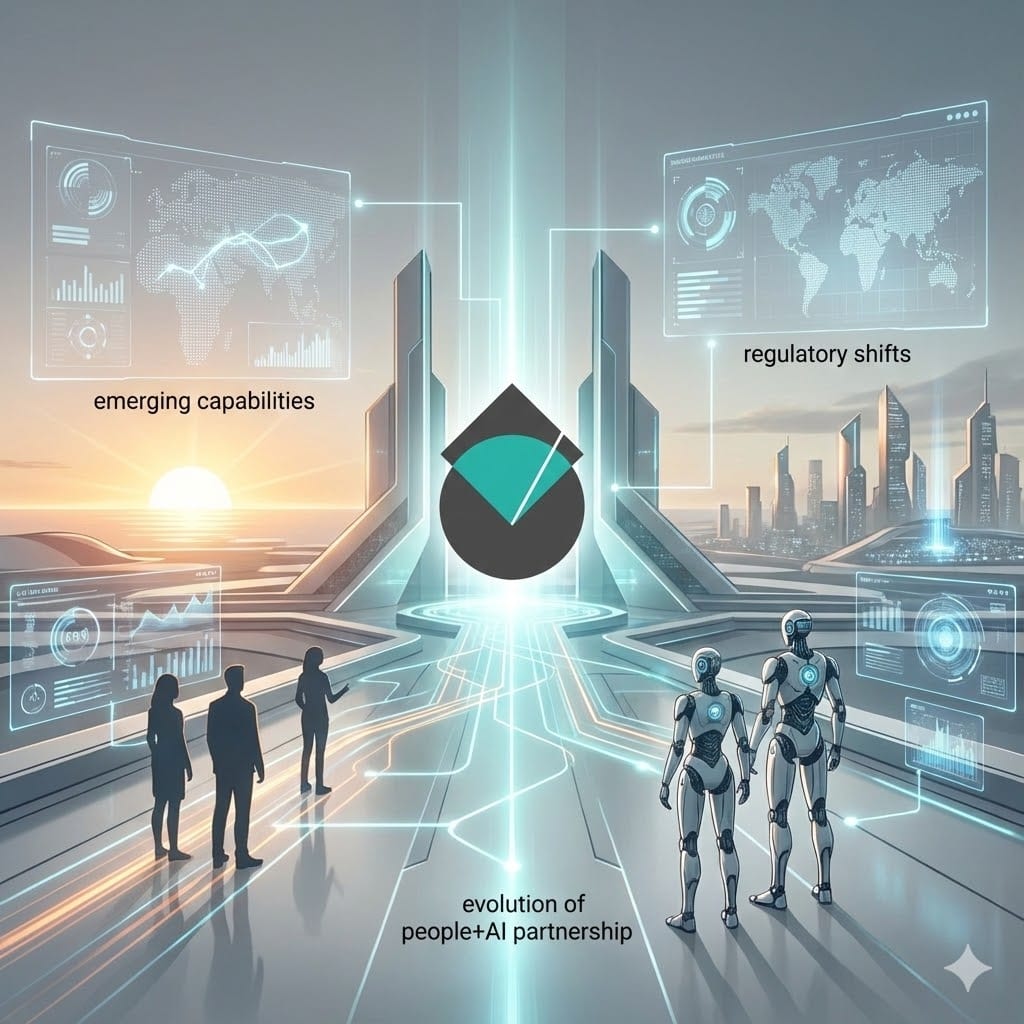
As we approach 2026, AI collaboration is transitioning from an experimental practice to a fundamental workplace capability. The landscape is evolving rapidly across multiple dimensions: technical capabilities, regulatory frameworks, organizational maturity, and individual skill requirements. Understanding these trends isn't just about staying current, it's about positioning yourself and your organization for success in an AI-enhanced future.
This analysis draws on current trajectories, emerging patterns, and the evolution of frameworks like PAICE to identify the most significant trends that will shape AI collaboration in 2026 and beyond. We'll explore these trends through the lens of the PAICE framework here. If you're interested in more such content, sign up for the Signals & Subtractions weekly newsletter (published by PAICE Founder & CEO Sam Rogers) to receive updates every Monday.
1. Emerging Technical Capabilities
Multimodal Integration Becomes Standard
The Shift: AI systems in 2026 will seamlessly integrate text, voice, image, video, and code across single interactions. The distinction between "text AI" and "image AI" will blur into unified multimodal assistants.
What This Means for Collaboration:
- Richer Context Sharing: Instead of describing a problem in text, you'll share screenshots, diagrams, or video clips alongside your explanation
- More Natural Interaction: Voice-first collaboration will become viable for complex tasks, not just simple queries
- Visual Verification: AI will generate visual representations of concepts, allowing you to verify understanding before proceeding
Skill Implications:
- Ability to leverage multiple modalities strategically (when to use voice vs. text vs. visual)
- Understanding which modalities work best for different types of tasks
- Developing "multimodal prompting" skills that combine inputs effectively
PAICE Framework Evolution: Assessment will need to evaluate multimodal collaboration competency, not just text-based interaction.
Context Windows Expand Dramatically
The Shift: Context windows will grow from hundreds of thousands to millions of tokens, enabling AI to maintain coherent understanding across entire codebases, lengthy documents, or extended conversations.
What This Means for Collaboration:
- Whole-Project Awareness: AI can understand your entire project structure, not just individual files
- Long-Term Memory: Conversations can span days or weeks without losing context
- Reduced Repetition: Less need to re-explain background information in each interaction
Skill Implications:
- Strategic context management (what to include in long-term context vs. per-interaction)
- Understanding context window economics (cost vs. benefit of large contexts)
- Developing "context architecture" skills for structuring information AI can maintain
Challenges:
- Information overload: More context isn't always better
- Privacy concerns: What information should be in persistent context?
- Cost management: Larger contexts mean higher API costs
Specialized Domain Models Proliferate
The Shift: Instead of one general-purpose model, 2026 will see specialized models optimized for specific domains—legal, medical, engineering, creative work, etc.
What This Means for Collaboration:
- Higher Quality Domain-Specific Output: Models trained on specialized corpora will understand domain nuances better
- Reduced Hallucination: Domain-specific training reduces confident incorrectness in specialized areas
- Compliance Built-In: Regulated industries will have models with compliance guardrails embedded
Skill Implications:
- Knowing which model to use for which task
- Understanding the strengths and limitations of different specialized models
- Developing domain-specific prompting strategies
PAICE Framework Evolution: Assessment may become more domain-specific, evaluating collaboration skills within particular professional contexts.
Real-Time Collaboration Becomes Seamless
The Shift: AI will move from asynchronous (you prompt, wait, receive response) to synchronous (AI participates in real-time as you work).
What This Means for Collaboration:
- Live Coding Assistance: AI suggests completions, refactorings, and improvements as you type
- Real-Time Document Collaboration: AI participates in document editing like a co-author
- Meeting Participation: AI can actively participate in meetings, not just transcribe them
Skill Implications:
- Managing real-time AI input without disrupting flow
- Knowing when to accept vs. reject real-time suggestions
- Maintaining agency when AI is constantly offering input
Challenges:
- Cognitive overload from constant AI suggestions
- Maintaining creative autonomy
- Distinguishing your ideas from AI contributions
2. Regulatory Landscape Evolution
AI Governance Frameworks Mature
The Shift: 2026 will see the implementation of comprehensive AI regulations in major markets (EU AI Act, potential US federal framework, expanded state-level regulations).
What This Means for Organizations:
- Compliance Requirements: Mandatory documentation of AI use in certain contexts
- Liability Frameworks: Clearer rules about who's responsible when AI makes mistakes
- Transparency Obligations: Requirements to disclose AI involvement in certain outputs
What This Means for Individuals:
- Disclosure Requirements: You may need to disclose AI assistance in professional work
- Audit Trails: Maintaining records of AI collaboration for compliance
- Ethical Guidelines: Professional associations will establish AI collaboration standards
PAICE Framework Evolution: Assessment may need to include regulatory compliance awareness as a competency dimension.
Data Privacy Regulations Tighten
The Shift: Stricter rules about what data can be shared with AI systems, especially in regulated industries.
What This Means for Collaboration:
- Data Minimization: Sharing only necessary information with AI systems
- Anonymization Requirements: Removing PII before AI collaboration
- Geographic Restrictions: Data residency requirements affecting AI service choice
Skill Implications:
- Understanding what data can and cannot be shared with AI
- Techniques for anonymizing data while maintaining utility
- Navigating different regulatory requirements across jurisdictions
Organizational Impact:
- Investment in privacy-preserving AI infrastructure
- Development of internal AI collaboration policies
- Training programs on compliant AI use
Professional Liability Standards Emerge
The Shift: Clear standards for professional responsibility when using AI assistance.
What This Means for Professionals:
- Verification Requirements: Standards for how thoroughly you must verify AI output
- Documentation Obligations: Records of AI assistance in professional work
- Competency Standards: Minimum skill levels required for AI-assisted work in certain fields
Examples by Field:
- Legal: Requirements to verify AI-generated legal research
- Medical: Standards for AI-assisted diagnosis and treatment planning
- Engineering: Liability frameworks for AI-assisted design
- Financial: Compliance requirements for AI-assisted financial advice
3. Organizational Maturity Patterns
From Experimentation to Standardization
The Shift: Organizations will move from "let people experiment" to "here's how we do AI collaboration."
Maturity Stages We'll See in 2026:
Stage 1: Ad Hoc (Declining)
- Individual experimentation
- No organizational guidance
- Inconsistent quality
- Mature organizations moving past this stage
Stage 2: Guided Experimentation (Common)
- Basic policies and guidelines
- Recommended tools and practices
- Informal knowledge sharing
- Where mature organizations are in early 2026
Stage 3: Systematic Integration (Growing)
- Formal training programs
- Standardized workflows
- Quality assurance processes
- Where mature organizations will be by end of 2026
Stage 4: Strategic Optimization (Emerging)
- AI collaboration as core competency
- Continuous improvement systems
- Competitive advantage from AI collaboration excellence
- Where leading organizations will arrive in 2026
Center of Excellence Models Emerge
The Shift: Organizations will establish dedicated teams to guide AI collaboration practices.
Typical CoE Structure:
- Policy Development: Creating and maintaining AI collaboration guidelines
- Tool Evaluation: Assessing and recommending AI tools
- Training & Enablement: Developing training programs and resources
- Quality Assurance: Monitoring and improving AI collaboration quality
- Innovation: Exploring new AI collaboration capabilities
Benefits:
- Consistent practices across the organization
- Faster adoption of new capabilities
- Better risk management
- Knowledge sharing and best practice development
Challenges:
- Balancing standardization with flexibility
- Keeping pace with rapid AI evolution
- Avoiding bureaucracy that slows innovation
AI Collaboration Metrics Become Standard
The Shift: Organizations will develop systematic ways to measure AI collaboration effectiveness.
Key Metrics Emerging:
- Productivity Impact: Time saved, output increased, quality improved
- Quality Metrics: Error rates, revision requirements, stakeholder satisfaction
- Adoption Metrics: Usage rates, skill development, practice consistency
- Risk Metrics: Compliance incidents, security issues, ethical concerns
- ROI Metrics: Cost vs. benefit analysis, value creation measurement
PAICE Framework Role: Standardized assessment provides baseline for organizational metrics.
Hybrid People+AI Teams Become Normal
The Shift: Teams will be explicitly designed with AI as a team member, not just a tool.
What This Looks Like:
- Role Definition: Clear delineation of human vs. AI responsibilities
- Workflow Design: Processes explicitly incorporating AI collaboration
- Quality Assurance: Verification steps built into workflows
- Continuous Improvement: Regular review and optimization of people+AI collaboration
Examples:
- Software Development: AI handles boilerplate, humans focus on architecture and business logic
- Content Creation: AI generates drafts, humans refine and add strategic insight
- Data Analysis: AI processes data, humans interpret and make decisions
- Customer Service: AI handles routine queries, humans handle complex issues
4. Individual Skill Evolution
AI Collaboration Becomes a Core Competency
The Shift: AI collaboration skills will be as fundamental as computer literacy is today.
What This Means:
- Job Requirements: AI collaboration skills in most job descriptions
- Performance Evaluation: AI collaboration effectiveness as a review criterion
- Career Development: AI collaboration skills as a promotion factor
- Compensation: Skill premiums for advanced AI collaboration capabilities
Skill Tiers Emerging:
Basic (Expected of Everyone):
- Effective prompting for common tasks
- Understanding AI limitations
- Basic verification of AI output
- Ethical AI use awareness
Intermediate (Expected of Knowledge Workers):
- Advanced prompting techniques
- Multi-turn conversation management
- Domain-specific AI collaboration
- Quality assurance practices
Advanced (Competitive Advantage):
- Strategic AI collaboration planning
- Custom workflow development
- AI collaboration training/mentoring
- Innovation with new AI capabilities
Expert (Rare, High Value):
- AI collaboration system design
- Organizational AI strategy
- Research and development
- Thought leadership
Verification Skills Become Critical
The Shift: As AI output quality improves, the skill of verifying correctness becomes more important, not less.
Why Verification Gets Harder:
- Plausibility Increases: AI output looks more correct, making errors harder to spot
- Complexity Grows: AI handles more complex tasks, making verification more challenging
- Volume Expands: More AI output means more to verify
- Confidence Bias: Better AI creates false confidence in output
Verification Skill Components:
- Domain Expertise: Deep knowledge to spot subtle errors
- Critical Thinking: Questioning assumptions and logic
- Systematic Checking: Methodical verification processes
- Tool Use: Leveraging verification tools and techniques
PAICE Framework Role: Assessment includes verification capability as a key dimension.
Meta-Cognitive Skills Gain Importance
The Shift: Understanding your own thinking process becomes crucial for effective AI collaboration.
Key Meta-Cognitive Skills:
- Self-Awareness: Knowing your strengths, weaknesses, and biases
- Process Awareness: Understanding how you approach problems
- Reflection: Analyzing what works and what doesn't in AI collaboration
- Adaptation: Adjusting your approach based on results
Why This Matters:
- AI collaboration is most effective when you understand your own thinking
- You need to know what to delegate to AI vs. what to do yourself
- Effective prompting requires understanding your own problem-solving process
- Continuous improvement requires reflection on your collaboration patterns
Prompt Engineering Evolves into Collaboration Design
The Shift: From "how do I write a good prompt" to "how do I design an effective collaboration."
Evolution of Prompting:
2023: Basic AI Interaction
- Focus: Getting AI to do something
- Skills: Simple instructions, basic formatting
2024: Basic Prompting
- Focus: Getting AI to understand what you want
- Skills: Clear instructions, examples, context
2025: Advanced Prompting
- Focus: Optimizing single interactions
- Skills: Chain-of-thought, role-playing, structured output
2026: Collaboration Design
- Focus: Designing multi-turn collaboration workflows
- Skills: Conversation architecture, context management, verification integration, multi-modal & multi-model collaboration
2027+: Strategic Partnership
- Focus: Long-term people+AI collaboration strategies
- Skills: Relationship management, continuous improvement, innovation
5. PAICE Framework Evolution
From Assessment to Development Platform
The Shift: PAICE will evolve from a one-time assessment to a continuous development platform.
Current State (2025):
- Single assessment measuring current capability
- Score across five dimensions
- Insights and recommendations
2026 Evolution:
- Continuous Assessment: Regular check-ins tracking skill development
- Personalized Learning Paths: Customized development recommendations
- Practice Scenarios: Hands-on exercises for skill building
- Progress Tracking: Longitudinal view of skill development
- Benchmarking: Comparison to peers and industry standards
Dimension Refinement
The Shift: The five dimensions will be refined based on research and real-world patterns.
Possible 2026 Additions/Refinements:
- Multimodal Collaboration: Leveraging multiple input/output types
- Context Architecture: Designing effective long-term context
- Verification Methodology: Systematic output validation
- Collaboration Strategy: Planning effective people+AI partnerships
- Regulatory Compliance: Understanding and following AI governance rules
Industry-Specific Variants
The Shift: Domain-specific versions of PAICE for different industries.
Why This Matters:
- Different industries have different AI collaboration needs
- Regulatory requirements vary by sector
- Domain-specific skills and knowledge are crucial
- Generic assessment may miss industry-specific competencies
Potential Industry Variants:
- PAICE for Software Development: Focus on code collaboration, debugging, architecture
- PAICE for Content Creation: Emphasis on creativity, brand voice, audience understanding
- PAICE for Data Analysis: Statistical reasoning, data interpretation, visualization
- PAICE for Legal: Legal research, document analysis, compliance awareness
- PAICE for Healthcare: Clinical reasoning, patient safety, regulatory compliance
Integration with broader Professional Development
The Shift: PAICE scores will be integrated into broader professional development frameworks. We are actively seeking partnerships to fulfill these needs, as opposed to building this ourselves.
Integration Points:
- Performance Reviews: AI collaboration as a review criterion
- Promotion Criteria: Skill levels required for advancement
- Training Programs: PAICE-aligned curriculum development
- Certification Programs: Professional certifications including AI collaboration
- Hiring Processes: PAICE scores as part of candidate evaluation
6. Emerging Challenges
The Skill Polarization Risk
The Challenge: AI collaboration could widen the skills gap between high and low performers.
Why This Happens:
- Skill Amplification: AI amplifies existing capabilities. Good becomes great, poor stays poor.
- Learning Curve: Those who invest in AI collaboration skills pull ahead of their peers exponentially instead of incrementally.
- Access Inequality: Not everyone has equal access to AI tools and trainings.
- Feedback Loops: Success with AI leads to more AI use, creating compounding advantages.
Mitigation Strategies:
- Universal AI collaboration training
- Accessible assessment and development tools (like PAICE)
- Organizational support for skill development
- Focus on inclusive AI collaboration practices
The Authenticity Question
The Challenge: Determining what's "your work" vs. "AI's work" becomes increasingly complex.
Why This Matters:
- Professional & Academic Integrity: What constitutes plagiarism in an AI-assisted world?
- Professional Credibility: How do you demonstrate your capabilities?
- Intellectual Property: Who owns AI-assisted creative work?
- Performance Evaluation: How do you assess individual contribution? Does this even remain relevant?
Emerging Approaches:
- Disclosure Standards: Clear guidelines on when to disclose AI assistance
- Process Documentation: Recording how work was created, not just the output
- Skill Demonstration: Showing capability through process, not just product
- Attribution Frameworks: Clear models for crediting human vs. AI contribution
The Dependency Dilemma
The Challenge: Balancing AI leverage with maintaining independent capability.
The Risk:
- Over-reliance on AI for tasks you should be able to do independently
- Skill atrophy from lack of practice
- Vulnerability when AI is unavailable
- Loss of deep understanding from always using AI assistance
Mitigation Strategies:
- Deliberate Practice: Regular work without AI assistance
- Skill Maintenance: Periodic assessment of independent capabilities
- Strategic AI Use: Conscious decisions about when to use AI vs. work independently
- Fallback Plans: Maintaining ability to work without AI
The Quality Assurance Challenge
The Challenge: As AI handles more complex tasks, verifying correctness becomes harder.
Why This Is Difficult:
- Expertise Requirements: Verification requires deep domain knowledge
- Time Constraints: Thorough verification can take as long as doing the work yourself
- Plausibility Bias: AI output looks correct, making errors hard to spot
- Volume Problem: More AI output means more to verify
Emerging Solutions:
- Automated Verification: Tools that check AI output systematically
- Peer Review: Multiple people reviewing AI-assisted work
- Staged Verification: Different levels of checking based on risk
- Verification Training: Specific skill development for output validation
7. Opportunities for Competitive Advantage
Early Adopter Advantages
The Opportunity: Organizations and individuals who develop strong AI collaboration capabilities early will have significant advantages.
Competitive Advantages:
- Productivity: 2-5x productivity improvements in knowledge work
- Quality: Higher quality output through effective people+AI collaboration
- Innovation: Faster exploration of new ideas and approaches
- Talent Attraction: Top performers want to work where AI collaboration is excellent
- Cost Efficiency: More output with same or fewer resources
How to Capture This:
- Invest in AI collaboration training now
- Develop systematic AI collaboration practices
- Build organizational AI collaboration capabilities
- Create feedback loops for continuous improvement
Niche Specialization
The Opportunity: Becoming an expert in AI collaboration for specific domains or use cases.
High-Value Niches:
- Industry-Specific AI Collaboration: Deep expertise in AI use for particular sectors
- Workflow Design: Creating effective people+AI collaboration workflows
- Quality Assurance: Specializing in AI output verification
- Training & Development: Teaching AI collaboration skills
- Policy & Governance: Developing AI collaboration frameworks
Why This Works:
- Demand for AI collaboration expertise will grow rapidly
- Generalists will be common, specialists will be valuable
- Organizations need help navigating AI collaboration complexity
- Regulatory requirements will create demand for compliance expertise
Innovation Through AI Collaboration
The Opportunity: Using AI collaboration to explore ideas and approaches that weren't previously feasible.
Innovation Patterns:
- Rapid Prototyping: Testing many ideas quickly with AI assistance
- Cross-Domain Synthesis: Combining insights from multiple fields
- Scenario Exploration: Examining many possibilities systematically
- Creative Augmentation: Using AI to enhance creative processes
Examples:
- Product Development: Rapidly iterating on designs with AI assistance
- Research: Exploring research questions more thoroughly
- Strategy: Analyzing more strategic options
- Content Creation: Producing more diverse, higher-quality content
Preparing for 2026: Action Steps
For Individuals
Immediate Actions (Next 3 Months):
- Assess Current Skills: Take the PAICE assessment to understand your baseline (free)
- Develop Core Competencies: Focus on prompting, verification, and ethical awareness. Explore our partner AICred's paid offerings for structured training
- Experiment Systematically: Try AI collaboration in different contexts, document what works (free)
- Build Verification Habits: Develop systematic approaches to checking AI output (free)
- Stay Informed: Follow AI collaboration developments and best practices (free to subscribe to our Substack)
Medium-Term Actions (3-12 Months):
- Develop Domain Expertise: Become proficient in AI collaboration for your field
- Build a Practice: Establish consistent AI collaboration workflows
- Share Knowledge: Teach others, write about your experiences
- Expand Capabilities: Explore advanced techniques and new AI tools
- Track Progress: Regularly reassess skills and adjust development focus
Long-Term Actions (1-2 Years):
- Achieve Mastery: Become an expert in AI collaboration for your domain
- Innovate: Develop new approaches and techniques
- Lead: Help your organization develop AI collaboration capabilities
- Contribute: Participate in developing standards and best practices
- Adapt: Stay ahead of AI collaboration evolution
For Organizations
Immediate Actions (Next 3 Months):
- Assess Current State: Understand how AI is being used across the organization (start with our baseline PAICE assessment)
- Develop Initial Policies: Create basic guidelines for AI collaboration (see UnDesto AI's templates, or our recent blog post)
- Provide Training: Offer foundational AI collaboration training (see our partner Snap Synapse's offerings)
- Identify Champions: Find and support early adopters (see "Signals & Subtractions" issue on The Trust Gap)
- Start Measuring: Begin tracking AI collaboration usage and impact (explore a deeper PAICE integration)
Medium-Term Actions (3-12 Months):
- Establish CoE: Create a center of excellence for AI collaboration
- Standardize Practices: Develop and deploy consistent AI collaboration workflows
- Scale Training: Expand training to all relevant employees
- Implement Governance: Deploy comprehensive AI collaboration policies
- Measure ROI: Systematically track AI collaboration value
Long-Term Actions (1-2 Years):
- Achieve Maturity: Reach systematic integration or strategic optimization stage
- Continuous Improvement: Establish ongoing optimization processes
- Competitive Advantage: Leverage AI collaboration excellence strategically
- Innovation Culture: Foster continuous innovation in AI collaboration
- Thought Leadership: Contribute to industry AI collaboration standards
Conclusion: The AI Collaboration Imperative
2026 will be a pivotal year in the evolution of AI collaboration. The technology will mature, regulations will solidify, organizational practices will standardize, and individual skills will become more clearly defined. The gap between those who develop strong AI collaboration capabilities and those who don't will widen significantly.
The trends outlined here aren't predictions—they're trajectories already in motion. Multimodal AI, expanded context windows, and specialized models are being developed now. Regulatory frameworks are being drafted. Organizations are experimenting with AI collaboration practices. Individuals are developing new skills.
The question isn't whether these trends will materialize, but how quickly and how you'll respond to them.
The opportunity is clear: Those who invest in AI collaboration capabilities now—whether individuals or organizations—will have significant advantages in 2026 and beyond. The PAICE framework provides a starting point for understanding and developing these capabilities, but the real work is in consistent practice, systematic improvement, and strategic application.
The challenge is equally clear: AI collaboration is complex, evolving rapidly, and requires ongoing investment. There are no shortcuts to mastery, no one-size-fits-all approaches, and no final destination—only continuous learning and adaptation.
The imperative is unavoidable: AI collaboration is becoming a fundamental workplace capability. You can choose to develop these skills proactively or be forced to catch up reactively. You can help shape how AI collaboration evolves in your organization and industry, or have practices imposed on you.
The future of work is people+AI collaboration. 2026 will be the year this future becomes present. The time to prepare is now.
Recommended Reading
- Research Preview: What It Means - Understanding PAICE's research-driven approach
- Why Claude? Our Model-Agnostic Design Philosophy - How PAICE stays relevant as AI evolves
- Understanding AI Collaboration Readiness - The foundation of effective AI collaboration
- AI Collaboration for Managers - Leading teams in an AI-augmented workplace
- Executive's Guide to AI Collaboration Readiness - Strategic perspective on organizational AI collaboration
Want to understand your current AI collaboration capabilities? Take the PAICE assessment to get your baseline score and personalized development recommendations.
متجسس لیکن وقت کم ہے؟
3 منٹ کا PAICE Pulse کریں — ایک فوری اعتماد چیک جو یہ ظاہر کرتا ہے کہ آپ اپنی AI تعاون کی پوزیشن کو کیسے دیکھتے ہیں۔ لاگ ان کی ضرورت نہیں۔