The Cost of Invisible AI Risk
A new paper for the board conversation you haven't had yet
Your AI dashboards measure activity. None of them measure reliability.
Your organization has spent on AI: licenses, training, tools. It can report how many people are trained, how many seats are active, and how often the tools are used. It cannot report the one thing that determines whether that spending is safe: when the AI is wrong, do your people catch it?
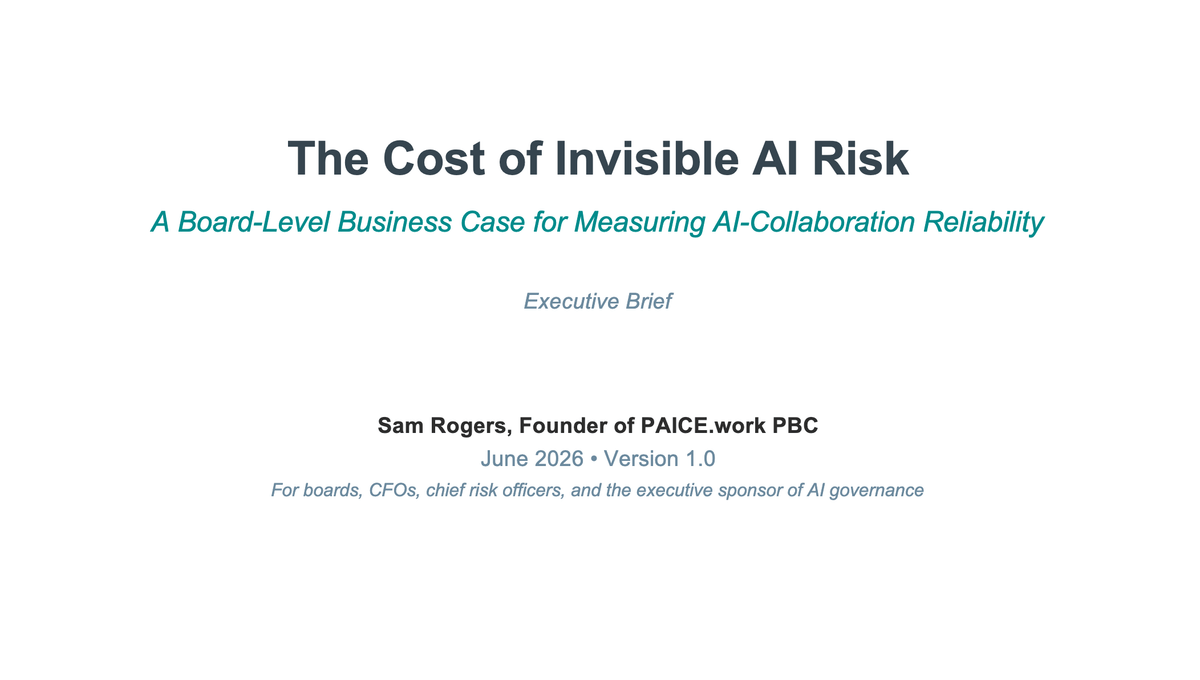
That blind spot is not a reporting gap. It is an unpriced liability. "The Cost of Invisible AI Risk" is a new paper from PAICE (People + AI Collaboration Effectiveness) that makes the financial case for closing it — written for board members, CFOs, and risk committee chairs who need the argument in business terms, not technical ones.
The Missing Term in the Risk Equation
The paper frames AI risk exposure as a simple equation with three terms:
- Population at risk — people doing AI-assisted work in roles that carry liability or regulatory duty. Observable today from HR and usage data.
- Verification-failure rate — the share of AI errors that pass the human reviewer unchallenged. This is the blind spot.
- Cost per uncaught error — liability, remediation, and reputational cost when one error reaches a client, court, or regulator. Partly observable, but only after the fact.
Multiply them and you get your exposure. The problem: without the middle term, the exposure cannot be computed, managed, or reported to the board. PAICE supplies that missing term — a measured, behavioral signal of whether your people actually catch AI error.
The Rulings Are Already In
The paper walks through the case law that establishes the principle a board needs to understand: liability for AI-assisted work lands on the organization, not the model.
In Mata v. Avianca, lawyers submitted a brief citing six judicial decisions that did not exist — ChatGPT fabricated them, and the attorneys did not verify. Sanctioned. In Moffatt v. Air Canada, the airline was held liable for wrong information its own chatbot gave a customer; the tribunal rejected the argument that the chatbot was a separate entity. The direct awards were small. The precedent is not.
The paper draws on the full AI Incident Law corpus — fifty matters spanning U.S. federal courts, state appellate courts, a Canadian tribunal, and federal regulators. Thirty-four of fifty end in a formal sanction. The dominant pattern: fabricated authority in court filings, where counsel used a generative model, did not verify the citations, and filed. The cost scales with the stakes of the work, and the work that uses AI most is increasingly the work with the highest stakes.
Why Current Spending Doesn't Touch It
The reasonable executive response is: we already invest in this. Training, licenses, acceptable-use policies. The paper names why none of that addresses the exposure — because all of it measures inputs. Training completion records attendance, not competence. License counts record access, not judgment. Usage dashboards record activity, not reliability.
A workforce can be fully trained, fully licensed, and fully active while remaining unable to catch the errors that create liability. The spend is real; it simply does not reach the behavior that carries the risk.
What PAICE Changes
PAICE converts the invisible liability into a managed one. It scores observed conduct — not self-report — on a 0–1000 scale, with the heaviest weight on whether the person catches AI error and takes ownership of AI-informed decisions. The output is a credit-score-style measure of AI-collaboration reliability: legible to a non-technical decision-maker, comparable across the organization, and trackable over time.
The paper closes with a concrete next step: run a baseline assessment of one high-stakes cohort. It produces a verification-reliability signal for that group in weeks, at a cost far below a single uncaught-error incident, and turns the exposure framework into a real number the board can act on.
Read the Paper
The full paper is available now at paice.work/papers/cost-of-invisible-ai-risk — readable in-browser or as a PDF download. It includes an appendix mapping the full AI Incident Law corpus: incident patterns, monetary outcomes, and the through-line that connects every case.
Ready to make your AI risk visible? Take the PAICE assessment to see how your verification behaviors hold up, or establish your organization's baseline to scope the exposure across a team.
Get Involved:
- Take the assessment (free, always — ES, PT, FR available)
- Read the full paper (in-browser or PDF)
- Browse all papers (six papers in the library)
- Explore the AI Capability Baseline (cohort-level analytics for organizations)
- Contact us about your specific requirements
Recommended Reading
📖 Related Papers:
- The People-Vector Evidence Layer — Mapping PAICE to NIST AI RMF, ISO/IEC 42001, and the EU AI Act
- Governance Without Surveillance — Why privacy by architecture makes behavioral measurement adoptable
📖 Related Posts:
- The Undercurrent Problem — The invisible workload AI creates for compliance and risk teams
- The Accountability Dimension — Why error-catching carries the highest weight in PAICE
- Two Papers, One Argument — The companion papers on Aggregated Intelligence and AI Posture
متجسس لیکن وقت کم ہے؟
3 منٹ کا PAICE Pulse کریں — ایک فوری اعتماد چیک جو یہ ظاہر کرتا ہے کہ آپ اپنی AI تعاون کی پوزیشن کو کیسے دیکھتے ہیں۔ لاگ ان کی ضرورت نہیں۔