The Undercurrent Problem
Why Your Shared Teams Are Quietly Drowning in AI Work
Your AI adoption dashboard shows 73% of employees using AI tools weekly. Leadership celebrates the momentum. Pilots are expanding. Engagement is up. The numbers look outstanding.
But in the compliance team, three people are quietly reviewing twice as many AI-assisted decisions as they were six months ago. In QA, the same team that tested five workflows now tests fifteen. In risk, the backlog of AI-related assessments grows every sprint. In operations, integration requests have tripled while headcount has not moved.
These teams don't appear on the AI adoption dashboard. They're not "AI users." They're AI absorbers. And they're drowning.
What Undercurrent Pressure Looks Like
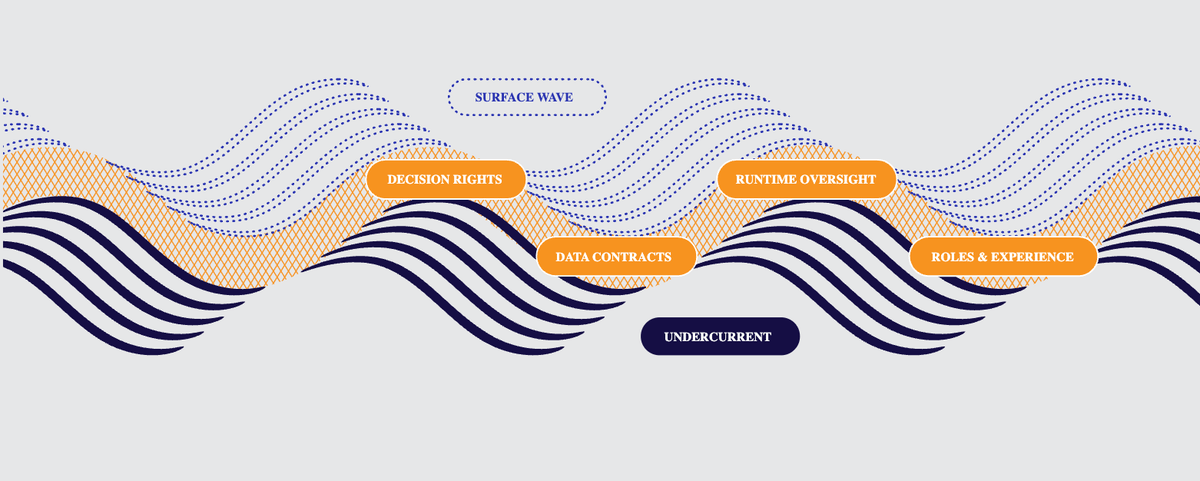
The concept of undercurrent pressure originates with Dr. Markus Bernhardt of Endeavor Intelligence, and was developed further in the Engineering Trust series on Snap Synapse co-authored with Sam Rogers. The idea is straightforward: when AI accelerates work at the edges of an organization, the middle quietly becomes the bottleneck.
Sales teams generate proposals faster. Marketing produces more content. Product ships more features. Engineering writes more code. Every one of these accelerated outputs flows downstream into shared functions that were staffed for a different era of volume.
Compliance reviews more AI-assisted decisions. Legal reviews more AI-drafted contracts. QA tests more AI-generated outputs. Risk evaluates more AI-informed recommendations. Operations integrates more AI-driven workflows. The volume increases, but the team size stays the same.
Here is the part that makes undercurrent pressure so insidious: the shared teams don't experience this as a technology problem. They experience it as a workload problem. The compliance officer doesn't think "AI is creating more work for me." They think "I'm behind on reviews again." The QA lead doesn't connect the testing backlog to the engineering team's new AI coding assistant. They just see the queue growing.
The pressure is invisible because it doesn't register as an "AI problem." It registers as longer lead times. More interrupts. Rising cognitive load. Increasing overtime. And eventually, burnout. Exit interviews cite "unsustainable workload" and "lack of resources." Nobody mentions AI, because from the shared team's perspective, AI isn't something they use. It's something that happens to them.
Nobody connects the dots because nobody is looking at the system holistically. The edge teams celebrate their AI-driven productivity gains. The shared teams absorb the downstream consequences in silence. And when shared-team members leave, the organization loses institutional knowledge about verification standards and governance requirements that took years to develop.
Why AI Dashboards Miss It
Standard AI adoption metrics measure tool usage. Who's logging in. Who's generating output. How many prompts per week. How many documents created. How many hours saved.
These are useful metrics. They are also dangerously incomplete.
They don't measure the downstream impact on teams that process AI-generated output. The compliance officer who now reviews three times as many AI-assisted recommendations doesn't show up as an "AI adopter." The QA engineer who tests fifteen AI-modified workflows instead of five doesn't register on any adoption dashboard. The risk analyst whose assessment backlog grows every week doesn't appear in any "time saved" calculation.
The teams under the most AI-related stress often have the lowest "AI adoption" scores. Because they're not the ones prompting. They're the ones verifying, approving, and integrating. Their workload increase is a direct consequence of everyone else's AI adoption, but it's attributed to operational inefficiency rather than downstream AI pressure.
This creates a perverse incentive structure. Leadership sees high AI adoption scores and green dashboards. Leadership sees shared teams struggling with lead times and backlogs. Leadership concludes the shared teams need to "adopt AI too" or "work more efficiently." The actual cause of the overload goes undiagnosed.
Consider the feedback loop this creates. Edge teams get celebrated for adoption. Shared teams get pressured for throughput. Edge teams adopt more AI tools, generating even more downstream output. Shared teams fall further behind. Leadership doubles down on the message that shared teams need to modernize. At no point does anyone ask whether the verification infrastructure was designed for this volume of AI-generated work. The answer, almost universally, is that it was not.
The Hidden Risk
Here is where undercurrent pressure becomes a governance problem, not just a workload problem.
When shared teams are overloaded, verification quality drops. Not because people become less skilled. Because the ratio of work to reviewer time becomes unsustainable. Reviews become faster. Faster reviews become cursory reviews. Cursory reviews become rubber stamps.
Approvals become checkboxes. The compliance officer who used to read every AI-assisted recommendation now skims the summary. The QA engineer who used to test edge cases now runs the happy path and moves on. The risk analyst who used to evaluate each AI model's limitations now copies the assessment template and changes the dates.
The governance structures that looked complete on paper become what we might call synthetic trust in practice. The organization believes it has oversight. In reality, the oversight function has been overwhelmed by volume.
This is particularly dangerous in regulated industries. A law firm whose compliance team rubber-stamps AI-assisted filings because they can't keep pace with volume is not a firm with a compliance function. It is a firm with compliance theater. A healthcare organization whose QA team can't properly verify AI-generated clinical documentation is not managing risk. It is accumulating it.
The risk doesn't appear on any dashboard. The compliance reports still get filed. The QA sign-offs still happen. The approvals still flow. Everything looks normal right up until the moment it isn't.
And when it isn't, the organizational response is predictable. An incident occurs. An investigation follows. The investigation discovers that the verification process was inadequate. Someone asks why. The answer is that the team was overwhelmed and cutting corners. Someone asks why the team was overwhelmed. The answer, eventually, traces back to AI-accelerated volume that nobody planned for. But by then, the damage is done, the regulatory inquiry is underway, and the shared team that was drowning all along gets blamed for the failure.
How Behavioral Measurement Reveals the Undercurrent
PAICE (People + AI Collaboration Effectiveness) Baseline measures collaboration quality across teams, including teams that don't see themselves as "AI users." This is where the undercurrent becomes visible.
When an organization runs PAICE Baseline across its workforce, the data reveals patterns that adoption dashboards cannot. Consider what happens when you measure the Accountability dimension across successive assessment waves.
Edge teams might show stable or improving Accountability scores. They're using AI in their domain, getting comfortable with verification workflows, developing intuitions about where AI outputs need checking. Their AI collaboration skills are developing alongside their AI adoption.
Shared teams tell a different story. If compliance or risk teams show declining Accountability scores over successive assessment waves, that's a signal. Not a signal that those individuals have become less capable. A signal that the verification function is degrading under load. The same people who demonstrated strong verification skills six months ago are now cutting corners because they have to.
This data doesn't appear in any AI adoption dashboard. It doesn't appear in any productivity metric. It only appears when you measure the behavioral quality of People+AI collaboration across the entire organization, including the teams that absorb AI-generated output rather than produce it.
The pattern is distinctive. High-adoption teams with stable collaboration quality alongside low-adoption teams with declining collaboration quality points directly to undercurrent pressure. The shared teams aren't failing. They're being overwhelmed.
Critically, this measurement approach respects the privacy of individual team members. PAICE's privacy architecture ensures that cohort-level trends are visible to leadership while individual scores remain private. A compliance officer's personal assessment data never reaches their manager. What reaches leadership is the aggregate pattern: this team's verification quality is declining, and the trajectory suggests capacity is the issue. That's the data leaders need to act on. It identifies the organizational problem without exposing the individuals who are working hardest to compensate for it.
What Organizations Can Do
The first step is recognition. Undercurrent pressure is a staffing and workflow problem, not a training problem. Sending the compliance team to an AI training workshop doesn't help when the issue is that they're reviewing three times the volume with the same headcount. Telling QA to "adopt AI" doesn't fix the fact that they need to verify more outputs than their capacity allows.
Staff shared functions for post-AI volume, not pre-AI volume. If your edge teams have doubled their output through AI adoption, your shared teams need capacity planning that accounts for that increase. This sounds obvious. It almost never happens, because the adoption dashboards don't connect edge-team output growth to shared-team workload growth.
Measure collaboration quality in shared teams over time. Use PAICE cohort data to track Accountability, Integrity, and Collaboration scores in your compliance, QA, risk, and operations teams across assessment waves. Stable or improving scores indicate sustainable workload. Declining scores indicate the verification function is degrading.
Treat declining collaboration scores in shared functions as an early warning, not a performance issue. When a compliance team's Accountability scores drop, the instinct is to view it as a training gap. In the undercurrent context, it's more likely a capacity gap. The individuals know how to verify. They no longer have time to verify properly.
Map the downstream flow of AI-generated work. Before celebrating edge-team adoption metrics, trace where that output goes next. Who reviews it? Who approves it? Who integrates it? Those teams are your undercurrent. Their capacity is your actual governance capacity, regardless of what your dashboards say.
Build verification capacity into AI adoption planning. When planning an AI rollout for a business unit, include the downstream shared functions in the capacity plan. If marketing is going to produce three times more content with AI, the legal review team needs to be sized for three times more content. This should be a standard part of AI adoption planning. Today, it rarely is.
Create feedback channels between shared teams and AI adoption leadership. The people closest to the undercurrent problem are the ones experiencing it. Compliance officers, QA leads, risk analysts, and operations managers can tell you exactly where the pressure is building. But they need a structured way to surface that information without it being dismissed as resistance to change. Regular check-ins that explicitly ask about downstream volume changes give shared teams a voice in the adoption conversation.
The Leadership Shift
The undercurrent problem requires a change in how leaders evaluate AI adoption success. The question is not "how many people are using AI?" That question is easy to answer and satisfying to report on. The question is "can our oversight functions keep pace with what AI is producing?"
This is a harder question. It requires looking beyond the adoption dashboard and into the operational reality of the teams that keep the organization safe. It requires connecting the productivity gains at the edges to the workload increases in the middle. It requires treating shared functions as part of the AI adoption system, not as independent cost centers that happen to be slowing down.
The organizations that navigate this well will be the ones that measure what matters: not just how much AI-generated work is being produced, but whether that work is being verified, reviewed, and integrated at a quality level that meets their obligations.
This means redefining what "AI adoption success" looks like. It's not a dashboard with high utilization numbers. It's a system where AI-generated work flows through verification functions that have the capacity, skills, and support to do their jobs properly. It's an organization where the benefits of AI acceleration at the edges are matched by investment in the teams that ensure those outputs are trustworthy.
The undercurrent problem is not inevitable. It's a predictable consequence of measuring AI adoption in one place and ignoring its impact everywhere else. Organizations that see it early, measure it properly, and act on the data will be the ones that capture the value of AI adoption without sacrificing the governance that makes it safe.
Your AI adoption numbers might look great. The question is whether the teams that keep those numbers honest can sustain the pace.
Concerned about invisible AI workload pressure on your shared teams? Learn about the AI Capability Baseline to understand how cohort-level behavioral data reveals undercurrent risks before they become governance failures.
The undercurrent pressure concept is the work of Dr. Markus Bernhardt of Endeavor Intelligence. Explore his frameworks at endeavorintel.com/frameworks.
Get Involved:
- Take the assessment (free, always)
- Explore our Baseline offerings (for organizations)
- Read the whitepaper (comprehensive framework)
- Contact us about your specific requirements
Recommended Reading
Curious but short on time?
Take the 3-minute PAICE Pulse — a quick confidence check that maps how you see your own AI collaboration posture. No login required.