AI Collaboration for Cybersecurity Professionals
Threat Intelligence, Incident Response, and the Accountability Imperative
When Every Output Carries Risk
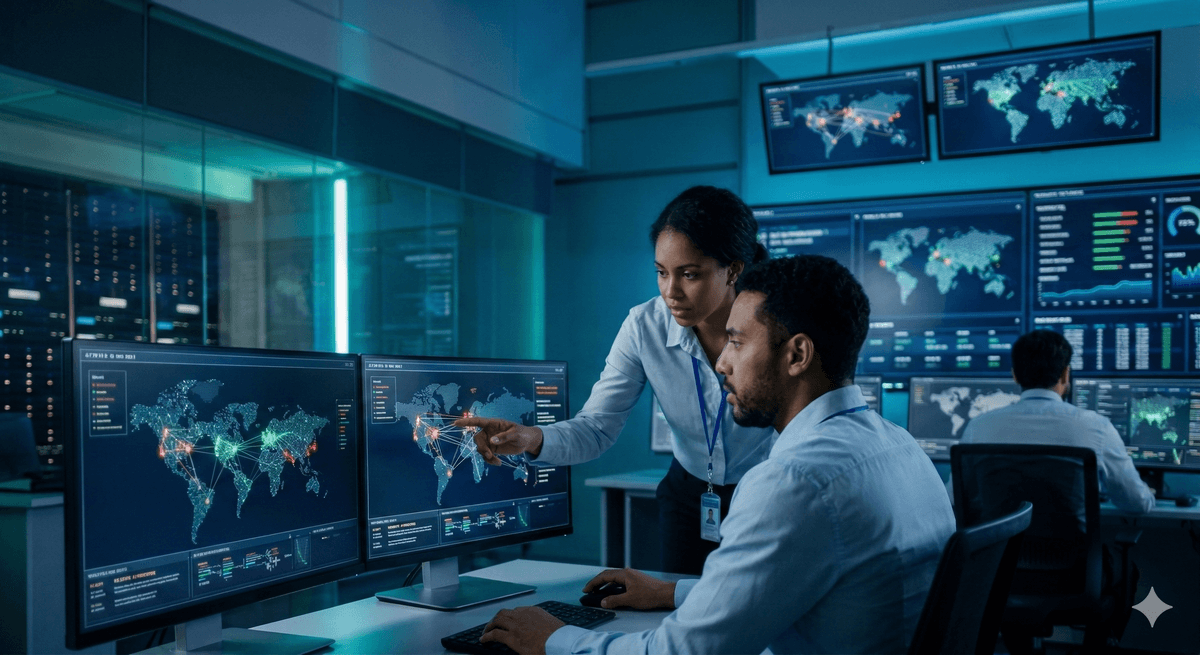
Jordan, a cybersecurity analyst, receives an alert at 2 AM. Network traffic patterns suggest a potential data exfiltration attempt. They turn to an AI assistant to help analyze the packet captures, cross-reference indicators of compromise, and draft an initial incident report. The AI produces a confident, well-structured analysis.
But here's the question that separates effective People+AI collaboration from dangerous over-reliance: How do you verify the analysis before acting on it?
Cybersecurity is one of the fields where AI collaboration carries the highest stakes. A missed indicator of compromise can mean a breach goes undetected. A false positive can trigger an expensive incident response that disrupts business operations. And unlike many professions, cybersecurity professionals face both technical and regulatory accountability for their decisions.
This guide explores how cybersecurity professionals can build effective AI collaboration practices that enhance their capabilities without compromising the verification rigor their field demands.
The Unique Position of Cybersecurity
Licensed, Liable, and Under Pressure
Cybersecurity professionals share a characteristic with lawyers, clinicians, and financial advisors: they are individually accountable for outcomes. A CISO who relies on AI-generated risk assessments without verification isn't just making a professional mistake; they may be violating regulatory obligations under frameworks like NIST CSF, SOC 2, or industry-specific mandates like HIPAA or PCI DSS.
This creates a specific dynamic for AI collaboration:
- Speed matters: Threats don't wait for careful deliberation. AI can accelerate analysis significantly.
- Accuracy is non-negotiable: A wrong answer isn't just unhelpful, it can be actively dangerous.
- Audit trails are required: Many compliance frameworks require documented evidence of how decisions were made.
- Adversarial context: Unlike most fields, cybersecurity professionals work against intelligent adversaries who actively try to deceive detection systems, including AI-powered ones.
Where AI Collaboration Adds Genuine Value
AI collaboration in cybersecurity isn't about replacing analyst judgment. It's about augmenting the analyst's capacity to process information at scale while preserving the critical thinking that no automated system can replicate.
High-value collaboration areas:
- Parsing and correlating large volumes of log data
- Identifying patterns across disparate data sources
- Generating initial drafts of compliance documentation
- Exploring attack scenarios and threat models
- Translating technical findings for non-technical stakeholders
Threat Intelligence and Analysis
Your Research Partner, Not Your Analyst
AI assistants excel at helping cybersecurity professionals process threat intelligence feeds, research emerging vulnerabilities, and correlate indicators of compromise across multiple sources. The key distinction is using AI as a research accelerator, not as the decision-maker.
Effective Collaboration Pattern:
- Present the data: Share relevant log entries, network captures, or alert details
- Request structured analysis: Ask for potential explanations, ranked by likelihood
- Challenge the output: Ask what alternative explanations the AI hasn't considered
- Cross-reference independently: Verify key claims against authoritative sources (CVE databases, vendor advisories, MITRE ATT&CK)
- Document your reasoning: Record which AI suggestions you accepted, which you rejected, and why
What It Looks Like: An analyst reviewing suspicious DNS queries can use AI to quickly categorize query patterns, identify known malicious domains, and draft a timeline. But the analyst must independently verify the domain reputation data and confirm the AI hasn't confused benign CDN traffic with command-and-control communication.
Why It Matters: AI models are trained on historical data. Novel attack techniques, zero-day exploits, and sophisticated adversaries specifically design their tactics to evade pattern-based detection. An AI that confidently identifies traffic as "benign" based on historical patterns may be wrong precisely when it matters most.
Incident Response Partnerships
Accelerating Without Cutting Corners
During an active incident, time pressure is intense. AI collaboration can significantly accelerate the response cycle, but the stakes of getting it wrong are also highest during an incident.
Where AI Helps During Incidents:
- Log analysis at scale: Processing thousands of log entries to identify the initial compromise vector
- Timeline construction: Building a chronological narrative from disparate data sources
- Communication drafting: Creating stakeholder notifications, regulatory disclosures, and internal briefings
- Playbook execution: Walking through established incident response procedures step by step
- Scope assessment: Identifying potentially affected systems based on network topology and access patterns
Where Human Judgment Remains Essential:
- Containment decisions: Isolating systems affects business operations. The trade-off analysis requires organizational context AI doesn't have.
- Attribution assessment: Determining who is behind an attack involves geopolitical context and intelligence that AI should not be trusted to evaluate independently.
- Regulatory notification timing: Deciding when and how to notify regulators involves legal judgment that varies by jurisdiction.
- Evidence preservation: Forensic integrity requires strict chain-of-custody procedures that must be verified by qualified professionals.
The False Confidence Trap
During high-pressure incidents, AI-generated analysis that sounds authoritative can create a dangerous sense of false confidence. The AI might present a root cause analysis with technical precision that masks fundamental uncertainty.
Counter This By:
- Explicitly asking "What assumptions are you making in this analysis?"
- Requesting confidence levels for each conclusion
- Assigning a team member to specifically challenge AI-generated conclusions
- Documenting AI-assisted findings separately from independently verified findings
Security Code Review and Vulnerability Assessment
A Force Multiplier for AppSec
Application security teams are perpetually understaffed. AI collaboration offers a genuine force multiplier for code review, but with important caveats about the types of vulnerabilities AI can and cannot reliably detect.
AI Excels At:
- Identifying common vulnerability patterns (SQL injection, XSS, path traversal)
- Reviewing code against established security standards (OWASP Top 10)
- Suggesting secure coding alternatives for flagged patterns
- Generating test cases for identified vulnerability classes
- Explaining complex code paths to junior security analysts
AI Struggles With:
- Business logic vulnerabilities (authentication bypass through workflow manipulation)
- Race conditions and timing-dependent vulnerabilities
- Context-dependent authorization flaws
- Supply chain risks in dependency chains
- Novel vulnerability classes that don't match known patterns
Effective Practice: Use AI for an initial pass to catch common patterns, then focus human review time on the business logic, authorization boundaries, and architectural decisions where AI's limitations are most pronounced.
The Accountability Challenge
Documenting AI-Assisted Decisions
For cybersecurity professionals operating under compliance frameworks, documenting how AI contributed to security decisions isn't optional. It's a regulatory requirement in many contexts.
A practical documentation approach:
- Record the input: What data or question was provided to the AI
- Record the output: What the AI suggested or concluded
- Record the verification: How the suggestion was independently verified
- Record the decision: What action was taken and why
- Record the outcome: What happened as a result
This documentation serves multiple purposes: it satisfies audit requirements, creates a learning record for improving future collaboration, and provides defensible evidence that professional judgment, not blind AI reliance, drove the decision.
When AI Gets It Wrong
Every cybersecurity professional using AI collaboration will encounter situations where the AI provides incorrect or misleading analysis. What matters is not whether this happens, but how quickly and reliably you detect it.
Red flags to watch for:
- AI confidently identifying a vulnerability class that doesn't apply to the technology in question
- Incident analysis that perfectly matches a textbook scenario (real incidents are rarely textbook)
- Recommendations that contradict established security principles without acknowledging the deviation
- Threat assessments that don't account for the specific organizational context
Building Your Cybersecurity AI Collaboration Practice
Start With Low-Stakes Tasks
Before relying on AI collaboration during a critical incident, build familiarity through lower-stakes activities:
- Documentation: Use AI to draft security policies, procedures, and training materials. Review carefully, but the cost of an error is revision, not a breach.
- Training scenarios: Have AI generate realistic tabletop exercise scenarios. The creative process benefits from AI input, and any inaccuracies become teaching moments.
- Research synthesis: Use AI to summarize threat intelligence reports, vendor advisories, and industry analyses. Cross-reference key claims.
- Report writing: Draft compliance reports, risk assessments, and board-level summaries. AI can help translate technical findings into business language.
Establish Verification Protocols
Before your team adopts AI collaboration for security-critical tasks, establish clear protocols:
- Mandatory verification requirements: Define which types of AI output must be independently verified before action
- Escalation criteria: Specify when AI-assisted analysis must be reviewed by a senior analyst
- Documentation standards: Set expectations for recording AI contributions to security decisions
- Feedback loops: Create mechanisms for reporting AI errors so the team learns collectively
Measure Your Collaboration Effectiveness
The goal of AI collaboration in cybersecurity isn't to use AI more. It's to make better security decisions, faster, with better documentation. Track metrics that reflect this:
- Mean time to detect and respond (has AI collaboration reduced it?)
- False positive rates in AI-assisted analysis versus manual analysis
- Audit findings related to decision documentation
- Team capacity for proactive security work (has AI freed up time from routine tasks?)
Want to understand your own readiness profile? Take the PAICE assessment to discover your strengths and opportunities.
Recommended Reading
📖 Industry Guides:
- AI Collaboration for Legal Professionals - Verification practices for licensed professionals
- AI Collaboration for Healthcare and Patient Safety - High-stakes collaboration in clinical settings
📖 Building Your Practice:
- Building Your AI Collaboration Toolkit - Practical tools and workflows for effective collaboration
- Why Accountability Scores Lower Than You Expect - The most critical dimension for regulated professionals
Curious but short on time?
Take the 3-minute PAICE Pulse — a quick confidence check that maps how you see your own AI collaboration posture. No login required.