AI Collaboration in Education
Teaching, Research, and Administration
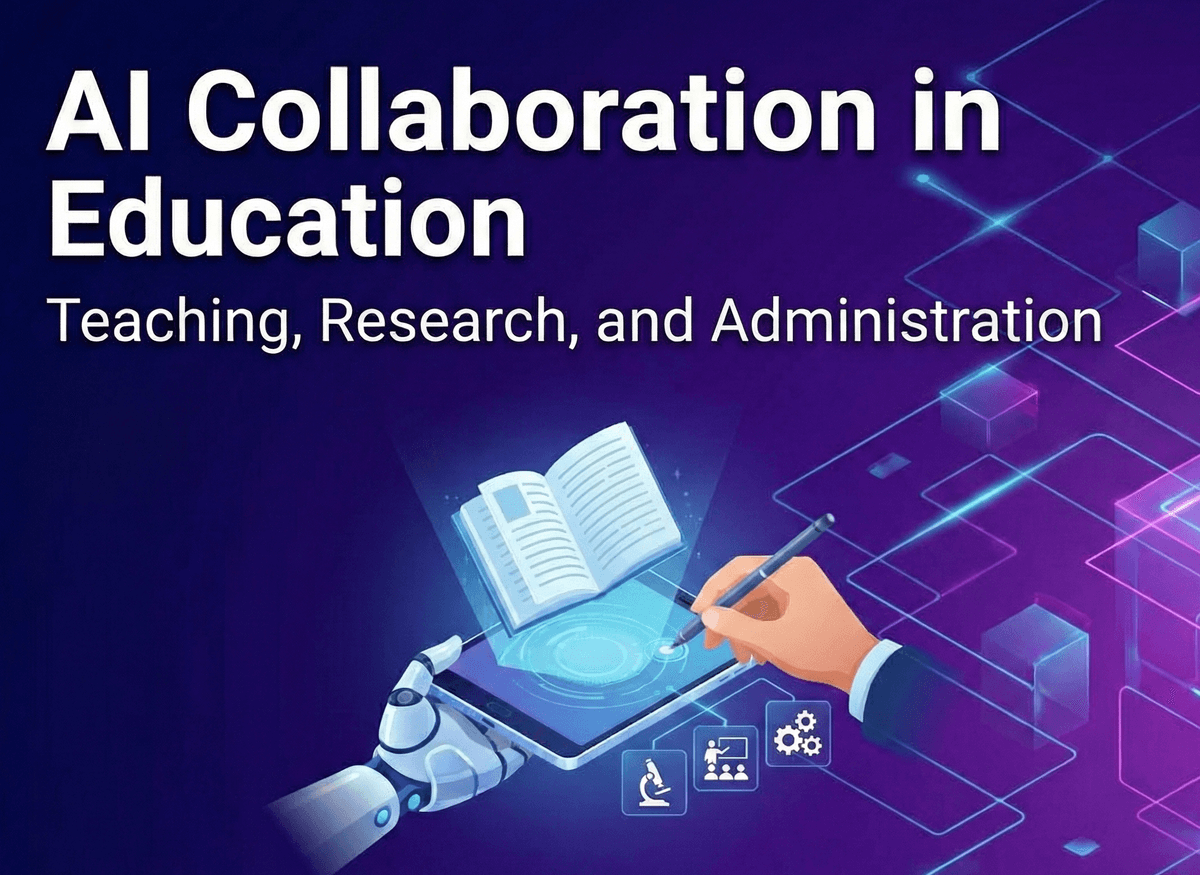
Education's AI Transformation
Education is experiencing a fundamental shift in how teaching, learning, and research happen. AI collaboration tools are reshaping everything from lesson planning to academic research to administrative workflows. For educators, the question isn't whether to engage with AI, it's how to do so effectively and ethically.
This guide provides practical frameworks for educators at all levels: K-12 teachers, higher education faculty, researchers, and administrators—seeking to leverage AI collaboration while maintaining academic integrity and educational quality.
Please note that this is not legal advice and you should always consult with your legal and compliance teams before implementing any AI collaboration practices.
Academic Integrity in the AI Era
Redefining the Conversation
The initial response to AI in education often focused on detection and prevention: How do we catch students using AI? But this framing misses the larger opportunity and challenge.
The Better Questions:
- How do we prepare students for a world where AI collaboration is normal?
- What skills remain uniquely human and worth developing?
- How do we assess learning when AI can produce polished outputs?
- What does academic integrity mean when AI is a legitimate tool?
Developing Clear AI Policies
Every educational institution needs clear, thoughtful AI policies. Effective policies address:
Transparency Requirements: When must students disclose AI use? What level of detail is required?
Permitted vs. Prohibited Uses: Which assignments allow AI assistance? Which require independent work? Why?
Attribution Standards: How should AI contributions be cited or acknowledged?
Consequences: What happens when policies are violated? How are edge cases handled?
Rationale: Why do these policies exist? What educational values do they protect?
Moving Beyond Detection
AI detection tools are unreliable and create adversarial dynamics. More effective approaches include:
Process-Based Assessment: Evaluate the learning process, not just final products. Require drafts, reflections, and demonstrations of understanding.
In-Class Components: Include supervised writing or problem-solving that demonstrates individual capability.
Oral Examinations: Have students explain and defend their work verbally.
Authentic Assessment: Design assignments that require personal experience, local knowledge, or real-time application.
Transparent Expectations: Be clear about what you're assessing and why AI assistance would undermine that assessment.
For more on establishing team standards, see our guide on creating team AI collaboration standards.
AI Collaboration for Teaching
Lesson Planning and Curriculum Development
AI can significantly accelerate instructional design work:
What Works Well:
- Generating initial lesson plan frameworks
- Creating differentiated materials for diverse learners
- Developing assessment questions and rubrics
- Adapting content for different grade levels or contexts
- Brainstorming engaging activities and examples
Best Practices:
- Use AI outputs as starting points, not final products
- Adapt generated materials to your specific students and context
- Verify accuracy of any factual content
- Maintain your pedagogical voice and approach
Creating Educational Materials
AI can help produce a wide range of educational content:
Effective Applications:
- Study guides and review materials
- Practice problems with worked solutions
- Reading comprehension questions
- Vocabulary lists and definitions
- Lab procedures and safety guidelines
- Parent communication templates
Quality Considerations:
- Review all materials for accuracy and appropriateness
- Ensure alignment with learning objectives
- Adapt language and complexity for your audience
- Add your expertise and context
Providing Feedback
AI can assist with the time-consuming work of providing student feedback:
Appropriate Uses:
- Generating initial feedback drafts for review
- Identifying common errors across student work
- Suggesting specific improvement strategies
- Creating personalized learning recommendations
Important Boundaries:
- Final feedback should reflect your professional judgment
- Maintain the personal connection that makes feedback meaningful
- Don't let AI replace the relationship-building aspect of teaching
- Be transparent with students about how feedback is generated
AI Collaboration for Research
Literature Review and Synthesis
AI can dramatically accelerate research workflows:
Effective Approaches:
- Summarizing large bodies of literature
- Identifying themes and patterns across sources
- Finding connections between disparate research areas
- Generating initial literature review drafts
- Explaining complex methodologies or findings
Critical Limitations:
- AI can fabricate citations and sources
- Every reference must be verified against actual sources
- AI may miss recent publications or niche research
- Synthesis requires human judgment about significance and quality
Writing and Editing Assistance
AI can support academic writing at various stages:
Appropriate Uses:
- Brainstorming and outlining
- Drafting initial sections for revision
- Improving clarity and readability
- Checking for consistency and completeness
- Generating alternative phrasings
Maintaining Integrity:
- The ideas and arguments must be your own
- Substantial AI-generated text should be disclosed per journal policies
- Your voice and expertise should be evident
- Verify all factual claims independently
Data Analysis Support
AI can assist with research data analysis:
Helpful Applications:
- Explaining statistical methods and when to use them
- Helping interpret results
- Suggesting visualization approaches
- Identifying potential issues in analysis plans
- Drafting methods sections
Essential Cautions:
- Verify all statistical recommendations
- Don't rely on AI for actual calculations without verification
- Understand the methods you're using
- Maintain full documentation of your analysis process
AI Collaboration for Administration
Streamlining Administrative Tasks
Educational administration involves substantial documentation and communication work where AI can help:
High-Value Applications:
- Drafting policy documents and handbooks
- Creating meeting agendas and summaries
- Generating reports and presentations
- Composing routine communications
- Developing forms and procedures
Efficiency Gains:
- Reduce time on routine documentation
- Improve consistency across communications
- Free up time for higher-value work
- Maintain quality while increasing output
Student Support Communications
AI can help with the volume of student and parent communications:
Appropriate Uses:
- Drafting initial responses to common inquiries
- Creating templates for routine communications
- Generating personalized progress updates
- Developing resource guides and FAQs
Important Considerations:
- Sensitive communications require human judgment
- Maintain authentic relationships with students and families
- Review all communications before sending
- Don't let efficiency undermine personal connection
Accreditation and Compliance
AI can assist with the documentation demands of accreditation:
Helpful Applications:
- Organizing evidence and documentation
- Drafting narrative sections
- Ensuring alignment with standards
- Identifying gaps in documentation
- Creating assessment reports
Quality Requirements:
- Accuracy is essential for compliance documents
- Verify all claims against actual evidence
- Maintain authentic representation of your institution
- Follow accreditor guidelines on AI use
Improving Learning Outcomes
Personalized Learning Support
AI offers new possibilities for individualized instruction:
Promising Applications:
- Adaptive practice and feedback
- Personalized learning pathways
- Just-in-time support and explanation
- Accessibility accommodations
- Language support for multilingual learners
Implementation Considerations:
- AI supplements, not replaces, teacher expertise
- Monitor for equity in AI-assisted learning
- Maintain human oversight of learning progress
- Protect student privacy in AI interactions
Developing AI Literacy
Preparing students to work effectively with AI is itself an educational goal:
Essential Skills:
- Understanding AI capabilities and limitations
- Crafting effective prompts and queries
- Evaluating AI outputs critically
- Knowing when AI assistance is appropriate
- Maintaining human judgment and creativity
Teaching Approaches:
- Model effective AI collaboration
- Create assignments that develop AI literacy
- Discuss AI ethics and implications
- Practice verification and critical evaluation
Ethical Considerations in Educational AI
Equity and Access
AI in education raises important equity questions:
Access Disparities: Not all students have equal access to AI tools. Consider how AI policies affect students with different resources.
Bias Concerns: AI systems may reflect biases that disadvantage certain student populations. Be aware of potential inequities.
Digital Divide: AI collaboration skills may become another dimension of educational inequality. Work to ensure all students develop these capabilities.
Privacy and Data Protection
Student data requires careful protection:
FERPA Considerations: Student educational records are protected. Be cautious about sharing student information with AI tools.
Age-Appropriate Use: K-12 settings require additional protections for minor students.
Institutional Policies: Follow your institution's data governance policies for AI tool use.
Transparency: Be clear with students and families about how AI is used in educational settings.
For more on ethical AI collaboration, see our guide on the ethics of AI collaboration.
Preserving Human Connection
Education is fundamentally relational. AI should enhance, not replace, human connection:
Maintain Relationships: Don't let AI efficiency undermine the mentoring relationships that make education meaningful.
Value Human Judgment: Some educational decisions require human wisdom, empathy, and understanding.
Preserve Authenticity: Students should experience genuine human engagement, not AI-mediated interactions.
Model Humanity: Show students what thoughtful, ethical AI collaboration looks like.
Building Your Educational AI Framework
For Individual Educators
-
Understand Your Context: Know your institution's policies and your students' needs.
-
Start Thoughtfully: Begin with low-stakes applications and build from there.
-
Develop Clear Expectations: Communicate AI policies clearly to students.
-
Model Good Practice: Demonstrate effective, ethical AI collaboration.
-
Reflect and Adapt: Continuously evaluate what's working and adjust.
For Educational Institutions
-
Develop Comprehensive Policies: Create clear, thoughtful guidelines for AI use.
-
Provide Professional Development: Help educators develop AI collaboration skills.
-
Address Equity: Ensure AI policies don't disadvantage certain students.
-
Protect Privacy: Implement appropriate data governance for AI tools.
-
Foster Dialogue: Create space for ongoing conversation about AI in education.
Assess Your Readiness
Understanding your current AI collaboration capabilities helps you develop effectively. The PAICE assessment evaluates skills across five dimensions relevant for educators:
- Prompting: Communicating effectively with AI tools
- Accuracy: Verifying AI outputs for educational use
- Iteration: Refining AI interactions for better results
- Context: Providing appropriate educational background
- Ethics: Understanding responsible AI use in education
The Educational Opportunity
AI collaboration in education isn't about replacing teachers or undermining learning—it's about enhancing both. The most effective educators will be those who learn to leverage AI tools while maintaining focus on what matters most: developing capable, thoughtful, ethical human beings.
The students in our classrooms today will work alongside AI throughout their careers. Helping them develop effective AI collaboration skills—while maintaining critical thinking, creativity, and human judgment—may be one of the most important things we can teach them.
Ready to assess your AI collaboration capabilities? Take the PAICE assessment to get personalized insights and recommendations for your educational practice.
Get Involved:
- Take the assessment (free, always)
- Explore the Founding Partner Program (for organizations)
- Read the whitepaper (comprehensive framework)
- Contact us about your specific requirements
Related Reading
Curious but short on time?
Take the 3-minute PAICE Pulse — a quick confidence check that maps how you see your own AI collaboration posture. No login required.