Privacy & Security Whitepaper Released at NEARCON 2026
Verifiable People+AI Collaboration with Cryptographic Integrity
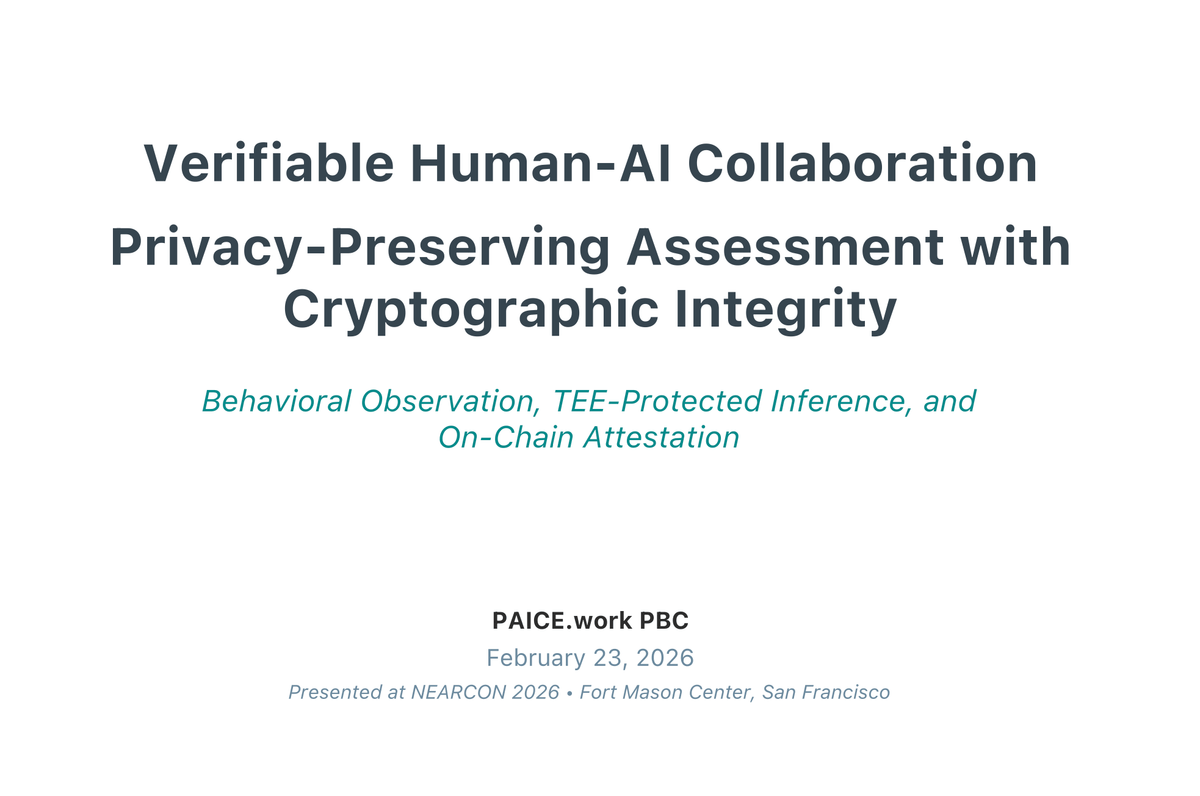
February 24, 2026 — Today from NEARCON 2026 at Fort Mason Center in San Francisco, we're releasing the PAICE Privacy & Security Whitepaper, a comprehensive technical document detailing how PAICE achieves verifiable People+AI collaboration assessment while maintaining the strongest possible privacy guarantees. Read and download here.
What's Inside
This whitepaper documents a fundamental shift in how AI collaboration assessment handles privacy: from "trust us" to "verify it yourself." Designed for security teams, compliance officers, and procurement evaluators in regulated industries, it provides comprehensive technical detail on three protection layers:
- Privacy by Architecture — How PAICE eliminates conversation data rather than protecting data that exists
- TEE-Protected Inference — Hardware-level privacy using Trusted Execution Environments on NEAR AI Cloud
- On-Chain Score Attestation — Immutable, tamper-proof records via the NEAR blockchain
Key Sections Include:
The Observation Problem — Why measuring People+AI collaboration quality creates sensitive data, and how traditional policy-based protections (encryption, access controls, retention schedules) share a structural limitation: they protect data that exists.
What PAICE Measures — The five behavioral dimensions (Performance, Accountability, Integrity, Collaboration, Evolution) with adaptive testing and the evidence hierarchy that prioritizes behavioral ground truth over stated perception.
Privacy by Architecture — Technical detail on conversation non-storage, PII redaction before AI processing, identity minimization via SHA-256 hashing, and the seven production data stores (five containing zero PII).
Confidential Mode: TEE-Protected Inference — The dual cascade architecture in v6.0.0, how hardware-isolated enclaves prevent access during computation, and the model configurations for both Standard and Confidential modes.
On-Chain Score Attestation — Deterministic SHA-256 hashing, the smart contract at paice.near, and how immutable blockchain records make post-hoc tampering detectable with mathematical certainty.
Regulatory & Framework Reference — Detailed appendix mapping PAICE controls to GDPR articles, CCPA/CPRA rights, the Cavoukian Privacy by Design principles, and NIST Privacy Framework functions.
Why This Matters Now
The conventional assumption in AI behavioral assessment is that rich observational data requires rich data storage. This whitepaper demonstrates that this is a false equivalence. PAICE extracts the behavioral signals needed for comprehensive scoring, produces actionable results, and does so without retaining the conversational data that would create regulatory exposure.
For regulated industries — healthcare, finance, legal, government — this addresses a concrete procurement concern: how do you verify that an assessment vendor's privacy claims are actually enforced?
Traditional approach: Trust the vendor's policy. Hope the access controls work. Accept that a misconfigured database, compromised credential, or subpoena could expose everything.
PAICE approach:
- Privacy by architecture eliminates the data
- TEE hardware prevents access during processing
- Blockchain attestation proves results weren't tampered with
The mathematics does the convincing, not the marketing.
Three Protection Layers
| Data Lifecycle Phase | Protection Layer | Guarantee |
|---|---|---|
| At rest | Privacy by architecture | Conversation data not stored. PII redacted. Identity reduced to irreversible hashes. |
| In transit / processing | TEE-protected inference | Hardware prevents access during computation. Cryptographic attestation proves enclave execution. |
| After creation | On-chain attestation | SHA-256 hash on NEAR blockchain. Deterministic, immutable, independently verifiable. |
Privacy without verifiability is a promise. Verifiability without privacy is exposure. PAICE achieves both: provable privacy with verifiable integrity.
Confidential Mode Technical Details
PAICE v6.0.0 implements a dual cascade architecture:
Standard Mode uses leading commercial AI providers (Anthropic, Google, OpenAI) optimized for the highest-quality assessment experience.
Confidential Mode routes all inference through NEAR AI Cloud, where every model runs inside a TEE. As in the Standard Mode, the system cascade automatically falls back to the next available model if the primary TEE model is unavailable.
| Layer | Standard Mode | Confidential Mode (TEE) | Fallback (TEE) |
|---|---|---|---|
| Chat | Claude Haiku 4.5 | gpt-oss-120b | DeepSeek-V3.1 |
| QA | Gemini 3 Flash | Qwen3-30B (262K ctx) | DeepSeek-V3.1 |
| Evaluation | Claude Opus 4.6 | GLM-5 (131K ctx) | gpt-oss-120b |
Confidential Mode is session-scoped and non-reversible — once the privacy guarantee is activated, it cannot be weakened. The feature is entirely additive: when disabled, no NEAR modules are loaded and the system has zero runtime overhead.
On-Chain Attestation
When a PAICE assessment completes with Confidential Mode enabled:
- The scoring payload (session ID, overall score, tier, five-dimensional scores, timestamp) is serialized canonically
- SHA-256 hashed with deterministic formatting
- Committed to the smart contract at
paice.nearon NEAR mainnet - Displayed on the results page with verification badge and NearBlocks explorer link
The architectural consequence: even PAICE cannot retroactively alter a committed score. Once a hash is written to the NEAR blockchain, it is immutable. Users, employers, and auditors can verify at any time that scores match the on-chain record.
Open Source Transparency
The NEAR integration has been open-sourced for inspection:
- Smart Contract: github.com/snapsynapse/paice-near-integration
- Contract Language: Rust using NEAR SDK 5.6.0
- Mainnet Address: paice.near
- Deployment Transaction: 3dG2Qr8KRgLedeZctz8TPe2KwRinWXPCzLkvX37yoRFY
Read the Full Whitepaper
The complete whitepaper is available now at paice.work/whitepaper.
Whether you're:
- A security or compliance officer evaluating AI assessment vendors for regulated environments
- A procurement team needing technical documentation for due diligence
- A privacy advocate interested in privacy-by-architecture implementations
- A researcher studying verifiable AI systems and on-chain attestation
- An enterprise buyer requiring defensible privacy and integrity guarantees
...the whitepaper provides the technical depth, regulatory mappings, and transparent limitations you need to make informed decisions.
Try Confidential Mode
Ready to experience TEE-protected assessment? Take the PAICE assessment with Confidential Mode enabled by using the ?s=confidential URL parameter.
Join Us at NEARCON
We're presenting this whitepaper at NEARCON 2026 as part of the Innovation Sandbox program. Please contact us to see the demo and discuss how verifiable privacy can transform AI assessment for regulated industries.
Related Reading
📖 Privacy & Security:
- Introducing Confidential Mode — Hardware-level privacy for your assessment
- Privacy by Design — Technical deep dive into PAICE's privacy architecture
- Your Data, Your Privacy — What data PAICE collects and how it's protected
📖 PAICE Framework:
- PAICE.work Vision Whitepaper — Original framework documentation
- The PAICE Framework: Five Dimensions — Framework deep dive
- Introducing the PAICE Founding Partner Program — For organizations
📖 For Regulated Industries:
- Can PAICE Work in Regulated Industries? — Healthcare, finance, legal
- AI Collaboration in Healthcare — HIPAA and patient safety
- AI Collaboration for Legal Professionals — Professional standards and ethics
Curious but short on time?
Take the 3-minute PAICE Pulse — a quick confidence check that maps how you see your own AI collaboration posture. No login required.