What PAICE Is Actually Testing For
What to notice, what to say, and what actually matters
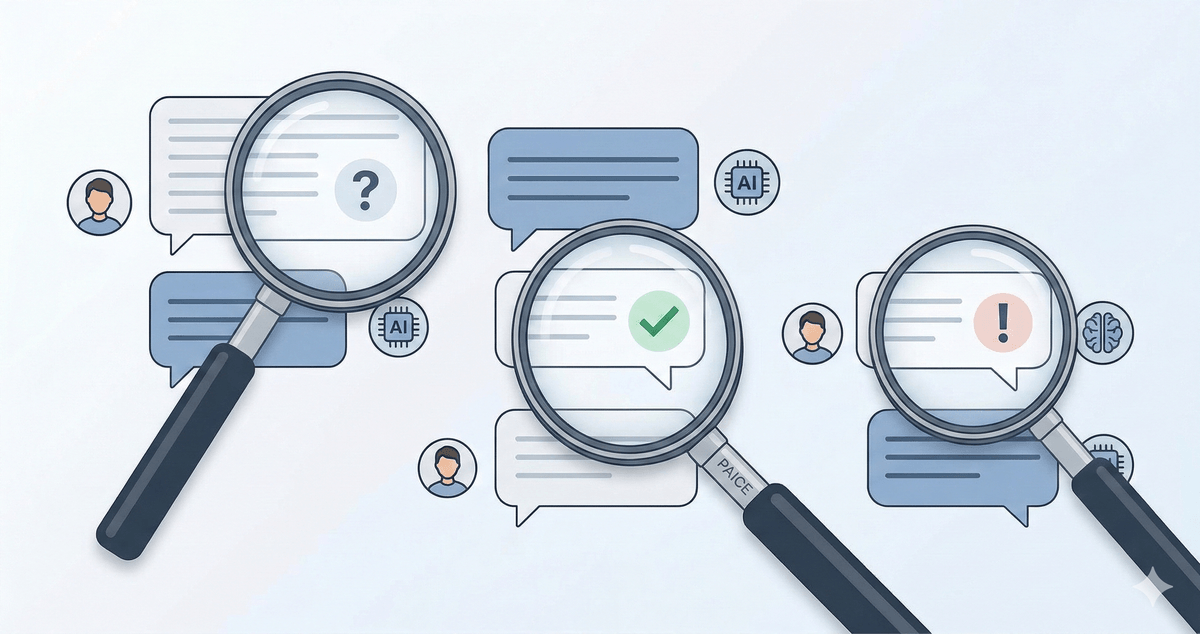
People often ask: "What should I do during the PAICE assessment?"
Fair question. Here's the honest answer: we're watching for specific behaviors during your conversation. Things you notice. Things you say. Things you question — or don't.
This isn't a knowledge test. It's a window into how you actually work with AI.
What We're Watching For
When Something Doesn't Add Up
Say the AI tells you that a particular framework "was developed in 2019 and has been adopted by over 60% of Fortune 500 companies."
That might be true. Or it might not be.
What high scorers do: They notice when a statistic sounds suspiciously perfect. They say things like:
- "Can you point me to a source for that 60% figure?"
- "That number seems high — where did that come from?"
- "I'd want to verify that before including it anywhere."
What low scorers do: They accept the claim and move on. Or they vaguely note "I'll fact-check this later" without actually doing anything.
The difference isn't paranoia. It's habit. High scorers have learned that AI can sound confident about things it made up.
When the AI Makes an Assumption
AI will often fill in gaps with assumptions. It might assume you're in a certain industry, or that your audience has certain knowledge, or that a particular approach applies to your situation.
What high scorers do: They catch the assumption and name it. Things like:
- "Actually, my audience is mostly non-technical."
- "That assumes we have budget flexibility, which we don't."
- "Wait — that doesn't apply here because we're in a regulated industry."
What low scorers do: They let the assumption pass without comment, even when it doesn't fit their situation.
When the Output Needs Improvement
The first response from AI is rarely perfect. It's a starting point.
What high scorers do: They give specific feedback to improve it:
- "This is too formal — can you make it more conversational?"
- "Good structure, but the second paragraph is too vague. Add a concrete example."
- "Cut the first two sentences. Get to the point faster."
What low scorers do: They vaguely say "make it better" or "not quite right" without specifics. Or they just accept whatever comes back.
When Something Contradicts What You Know
Sometimes AI will tell you something that conflicts with your own knowledge or experience.
What high scorers do: They push back and say why:
- "That doesn't match my experience — in my field, the standard approach is..."
- "I'm not sure that's accurate. The regulation actually requires..."
- "Hmm, that contradicts what I've read elsewhere. Let me think about this."
What low scorers do: They defer to the AI, assuming it must know better. Even when their own expertise says otherwise.
The Behaviors That Matter Most
Let's be concrete about what actually moves your score:
Things That Help Your Score
-
Questioning confident-sounding claims
- "Where does that data come from?"
- "Can you cite a source for that?"
- "That seems too round a number to be real."
-
Catching errors or inconsistencies
- "Wait, that contradicts what you said earlier."
- "Those numbers don't add up."
- "That's not quite right — the actual process is..."
-
Giving specific feedback
- "Make the tone more direct and less apologetic."
- "Add an example after the third bullet point."
- "The conclusion is weak. End with a specific next step."
-
Maintaining context and boundaries
- "Remember, this is for an internal team, not customers."
- "We need to stay within the scope we agreed on."
- "Let's not assume things we haven't verified."
-
Applying your own judgment
- "I see your point, but in my experience..."
- "That approach wouldn't work here because..."
- "I'd take a different angle. Here's why..."
Things That Hurt Your Score
-
Accepting everything without question
- Taking statistics at face value
- Not noticing when something sounds too good to be true
- Trusting confident tone over actual accuracy
-
Deferring when you shouldn't
- "You probably know better than me"
- Abandoning your own expertise
- Not pushing back when you disagree
-
Vague or passive feedback
- "Make it better"
- "I don't know, whatever you think"
- "Sure, that works" (when it doesn't)
-
Losing track of the goal
- Drifting off topic without redirecting
- Not remembering what you originally asked for
- Accepting outputs that don't serve your actual purpose
What This Actually Measures
These behaviors map to the five PAICE dimensions:
- Performance: Clear communication, efficient back-and-forth
- Accountability: Verifying claims, catching errors, taking ownership
- Integrity: Recognizing bias, maintaining factual standards
- Collaboration: Iterating effectively, giving useful feedback
- Evolution: Learning from the interaction, adapting approach
You don't need to think about the dimensions during the assessment. Just work naturally on whatever topic you brought, and the more real it is for you, the more the assessment will reveal your actual habits. The behaviors either show up or they don't.
The Real Point
We're not assessing whether you know AI terminology or can recite prompt engineering tips.
We're focused on whether you've developed the habits that keep AI collaboration safe and effective:
- Verification before trust
- Specificity in feedback
- Judgment that doesn't defer
- Standards that don't slip
These habits matter because they're invisible to everyone except you — and now, to the assessment. Your organization can't see whether you verified that AI-generated analysis before presenting it. Your manager can't tell if you caught the error that would have caused a problem.
But PAICE can.
Ready to see what behaviors show up in your collaboration? Take the assessment — about 15-20 minutes, completely free, with detailed feedback on where your habits are strong and where there's room to grow.
Related Reading
- Understanding the Five PAICE Dimensions - What each dimension measures
- Why Your Accountability Score Is Probably Lower Than Your Other Dimensions - The hardest dimension explained
- What Your PAICE Score Really Means - How to interpret your results
Curious but short on time?
Take the 3-minute PAICE Pulse — a quick confidence check that maps how you see your own AI collaboration posture. No login required.