AI Collaboration for Clinical Documentation
EHR Notes, Discharge Summaries, and Patient Safety
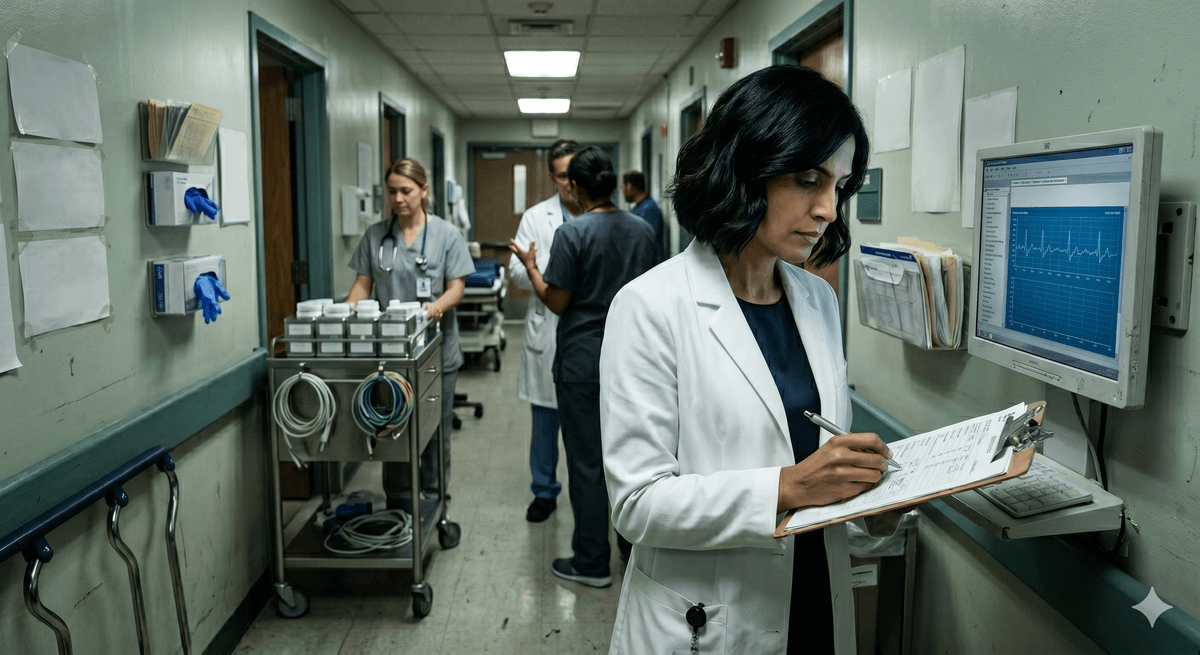
When the Note Looks Right but Isn't
Dr. Patel finishes a complex patient encounter and opens the AI-generated clinical note. The ambient documentation tool has captured the chief complaint, structured the history of present illness, and organized the physical exam findings into a clean SOAP format. On first read, it looks accurate. Thorough, even.
Then she catches two problems.
The system has suggested a diagnosis code for Type 2 diabetes with peripheral neuropathy. Her patient has Type 2 diabetes, yes, but the neuropathy workup is still pending. That code implies a confirmed diagnosis she hasn't made. And buried in the medication section, the note lists lisinopril among current medications but omits the ACE inhibitor allergy the patient mentioned when describing a previous adverse reaction.
One is a coding error that could trigger an audit. The other is a safety gap that could harm the patient.
This is the daily reality of AI-assisted clinical documentation. The tools are genuinely useful. The documentation burden is real and crushing. But the verification requirements are different from virtually any other profession, because errors in clinical notes don't just affect the clinician who writes them. They propagate downstream to every provider who reads them.
This article is for educational purposes only. It is not medical or legal advice. Consult with your compliance and clinical leadership teams before implementing AI collaboration practices in your organization.
Why Clinical Documentation Is Different
Every profession that uses AI needs verification habits. But clinical documentation occupies a unique position because the same document serves multiple critical functions simultaneously.
A clinical note is a communication tool. The next provider who sees your patient will read it to understand what happened, what was found, and what the plan is. If AI-generated content introduces inaccuracies, those errors become part of the clinical narrative that informs future care decisions.
A clinical note is a legal document. It establishes what was observed, what was assessed, and what was decided. In malpractice litigation, the note is often the primary evidence of what occurred during the encounter. An AI-generated note that a clinician signs without thorough review carries the same legal weight as one written entirely by hand.
A clinical note is a billing instrument. Diagnosis and procedure codes drive reimbursement, and they also create a longitudinal record that follows the patient. An AI-suggested code that doesn't match the clinical encounter can trigger compliance investigations, audit recoveries, or worse, establish a false diagnostic history that affects the patient's future insurance coverage.
And a clinical note is a patient safety tool. Allergy documentation, medication lists, problem lists, and clinical assessments all inform downstream decisions by pharmacists, nurses, specialists, and the patients themselves. When AI generates this content, the accuracy requirements aren't aspirational. They are foundational.
The documentation burden is real. Studies consistently show that clinicians spend significant portions of their working hours on documentation rather than direct patient care. AI can genuinely reduce that burden. But the approach to verification must match the stakes.
EHR Note Generation
Ambient Clinical Documentation
Ambient documentation tools that listen to patient encounters and generate structured notes represent one of the most promising applications of AI in healthcare. They capture conversation in real time, extract clinical information, and produce draft notes that clinicians can review and finalize.
Where ambient documentation adds genuine value:
- Conversation capture. The AI listens so the clinician can focus on the patient rather than the keyboard. This alone can transform the patient experience.
- Structural formatting. Converting a free-flowing conversation into a structured SOAP note, history and physical, or procedure note saves significant time.
- Detail retention. AI can capture details from lengthy encounters that a clinician writing from memory might omit or compress.
Where verification is critical:
- Clinical accuracy. Did the AI correctly interpret medical terminology spoken during the encounter? Homophones, abbreviations, and context-dependent terms are common sources of error.
- Assessment and plan alignment. Does the AI-generated assessment actually reflect your clinical reasoning, or has it inferred a diagnosis you haven't made?
- Medication and allergy lists. These are safety-critical data elements. AI may capture medications discussed but misattribute them, listing a medication the patient stopped taking as a current medication, or missing an allergy mentioned in passing.
- Attributed statements. When the note attributes specific statements to the patient, verify that the attribution is accurate. Misattributed clinical history can mislead downstream providers.
AI-Assisted SOAP Notes and History Drafts
Beyond ambient documentation, many clinicians use AI to draft notes from structured inputs, dictated summaries, or templated prompts. The verification principles are the same, but the failure modes differ.
AI drafting from structured input tends to be more reliable for data it's given explicitly but can hallucinate details to "fill in" sections that weren't addressed. A review of systems that appears comprehensive but includes systems you didn't actually review is a documentation integrity problem.
The practical verification workflow:
- Read the entire note. Not skim. Read.
- Verify every medication, allergy, and problem list entry against your clinical knowledge of the patient.
- Confirm that the assessment reflects your actual clinical impression, not an AI inference.
- Check that suggested diagnosis codes match documented findings.
- Ensure that nothing is fabricated, especially in the review of systems and past medical history sections.
This takes time. Less time than writing the note from scratch, which is the point. But it is not zero time, and treating it as zero time is where clinical risk enters.
Discharge Summaries and Care Transitions
Discharge documentation is where AI errors have their longest reach. A discharge summary follows the patient out of the hospital and into the hands of primary care providers, specialists, home health agencies, and the patients and families themselves.
Where AI Helps With Discharge Documentation
Synthesizing the hospital course. For a patient with a multi-day admission involving consultations from several services, AI can compile a coherent narrative from the daily notes. This synthesis function is genuinely valuable and time-saving.
Drafting patient-facing instructions. AI can translate clinical recommendations into language that patients and families can understand. Medication schedules, activity restrictions, warning signs to watch for, and follow-up appointments can all be structured for readability.
Medication reconciliation summaries. Comparing admission medications, inpatient changes, and discharge medications is a complex task that AI can help organize. The reconciliation itself still requires clinical judgment, but the organizational work is a legitimate AI contribution.
Where Verification Is Non-Negotiable
Discharge medication lists. Errors in discharge medication lists are among the most common and most dangerous documentation failures. AI may not correctly reconcile medications that were held, changed, or discontinued during the admission. Every medication on a discharge summary must be verified by the discharging clinician.
Follow-up instructions. AI-generated follow-up plans may include reasonable-sounding but incorrect timeframes, wrong specialist referrals, or follow-up tests that weren't actually ordered. The downstream provider and the patient will act on these instructions.
Condition-specific discharge criteria. AI may generate discharge instructions that are generically appropriate for a diagnosis but don't reflect the specific clinical situation. A heart failure discharge summary that includes standard heart failure instructions but misses the patient's specific volume management plan creates a care gap.
The principle here is straightforward: discharge documents are handoff documents. They exist to ensure continuity of care. An error in a discharge summary doesn't stay in the hospital. It travels with the patient.
Coding and Billing Documentation
AI-assisted coding represents both a significant efficiency opportunity and a significant compliance risk. The tools are getting better at suggesting diagnosis and procedure codes based on clinical documentation. But the responsibility for code accuracy rests entirely with the clinician who signs the note.
Common AI Coding Errors
Upcoding through inference. AI may suggest a higher-specificity code based on clinical details that are documented but not confirmed. A note describing symptoms consistent with a condition is not the same as a confirmed diagnosis, but AI may select the code for the confirmed condition.
Code mismatch. AI-suggested codes may not align with the documented assessment. If your clinical impression differs from what the AI infers from the history and exam, the code must reflect your assessment, not the AI's.
Unbundling or incorrect bundling. AI may suggest separate codes for components that should be billed together, or bundle procedures that should be reported separately. Coding rules are complex and change frequently.
Carrying forward resolved conditions. AI pulling from the problem list may suggest codes for conditions that have resolved or are no longer clinically relevant to the current encounter.
The Compliance Imperative
False Claims Act liability, OIG investigations, and payer audits all examine whether billed codes accurately represent the clinical encounter. The fact that an AI suggested the code is not a defense. The clinician who signs the note attests that the documentation and coding are accurate.
This doesn't mean AI coding suggestions aren't useful. They are. They can catch missed diagnoses, suggest specificity improvements, and identify documentation gaps. But they are suggestions, and the clinician must verify each one against the documented clinical findings before the note is signed.
Common Mistakes in AI-Assisted Clinical Documentation
Signing Without Reading
The most dangerous pattern is also the most common. When AI generates a note that looks right at a glance, and the clinician is running behind, and there are 15 more patients to see, the temptation to sign without a thorough read is real. This is where clinical risk lives.
A signed note is an attested document. It carries your professional attestation that the contents are accurate. AI-generated content that you sign without verifying becomes your clinical record, your liability, and potentially your patient's problem.
Assuming the AI Got Allergies and Medications Right
Allergy documentation and medication lists are the highest-stakes data elements in a clinical note. They directly inform prescribing decisions, surgical planning, and emergency care. AI tools that generate these lists from conversation, prior records, or other sources should never be trusted without verification.
Specific patterns to watch for:
- Medications discussed during the visit listed as current medications when they were actually discontinued
- Drug allergies mentioned by the patient but omitted from the allergy section
- Intolerances (nausea with a medication) listed as true allergies (anaphylaxis)
- Over-the-counter medications and supplements missed entirely
Using AI-Suggested Codes Without Clinical Verification
When AI suggests a diagnosis code, it is making an inference. That inference may be correct, but it may also reflect a condition you considered and ruled out, a condition that is suspected but unconfirmed, or a condition from the patient's history that isn't relevant to the current encounter. Every suggested code requires a moment of clinical judgment: does this code accurately represent what I found and what I assessed?
Letting AI Hallucinations Enter the Medical Record
AI can generate plausible clinical details that didn't occur. A physical exam finding that sounds appropriate for the presentation but wasn't actually observed. A family history detail that seems reasonable but was never discussed. A prior test result that is fabricated entirely.
Once these hallucinations enter the medical record, they become part of the patient's documented history. Future providers may rely on them. They are difficult to identify after the fact and even more difficult to correct across interconnected systems.
Getting Started With AI-Assisted Documentation
For Individual Clinicians
Build your verification workflow before you rely on the tool. Decide in advance which elements of every AI-generated note you will check. At minimum: medications, allergies, assessment, plan, and coding suggestions. Make this a habit before the time pressure of a busy clinic day overrides your intentions.
Start with low-stakes documents. Use AI for patient education materials, referral letters, or prior authorization requests before relying on it for clinical notes. Build familiarity with how the tool performs, where it makes errors, and what your verification process needs to catch.
Compare AI output to your clinical impression before reading the note in detail. Before reviewing the AI-generated note, take 10 seconds to articulate your own impression: what was the chief complaint, what did you find, what is your assessment, what is the plan. Then read the AI version. Discrepancies between your impression and the AI's version are the highest-priority items to investigate.
Document your verification. Some institutions are beginning to require documentation of the AI review process. Even if yours doesn't yet, establishing a practice of noting that AI-generated content was reviewed and verified protects you professionally.
For Health System Rollout
Establish clear policies before deployment. Clinicians need to know what is expected of them. Which elements must be verified? What constitutes adequate review? What documentation of the review process is required? Ambiguity in these expectations creates risk for both the clinician and the organization.
Train verification, not just tool use. Most AI documentation tool training focuses on how to use the tool. Equal emphasis should be placed on how to verify AI output. These are different skills, and the second one is harder to develop because it requires clinicians to maintain critical attention to content that appears polished and complete.
Monitor for verification erosion over time. Initial verification habits tend to be strong. Over weeks and months, as clinicians become comfortable with the tool and experience time pressure, verification rigor can erode. Building systematic checks, peer review processes, and audit mechanisms helps maintain the standard.
Measure what matters. Track not just documentation efficiency (time saved) but documentation accuracy (errors caught, errors missed, coding accuracy). If you are only measuring speed, you are optimizing for the wrong outcome.
Assessing Your Readiness
Understanding your current AI collaboration capabilities matters, especially in clinical settings where the stakes are highest. PAICE (People + AI Collaboration Effectiveness) measures how professionals actually behave when working with AI, not what they know about AI in theory.
For clinicians, the Accountability dimension is particularly relevant. It measures whether you catch errors in AI output, whether you maintain verification discipline under time pressure, and whether you take ownership of AI-assisted work rather than deferring to the tool. This is exactly the skill that clinical documentation demands.
Want to understand how you actually collaborate with AI, not how you think you do? Take the PAICE assessment to discover your strengths and identify where verification habits may need development.
Get Involved:
- Take the assessment (free, always)
- Establish your organization's baseline (for teams)
- Read the whitepaper (comprehensive framework)
- Contact us about healthcare-specific requirements
Recommended Reading
- AI Collaboration in Healthcare: Balancing Innovation with Patient Safety - The comprehensive guide for healthcare professionals
- Common AI Collaboration Mistakes and How to Avoid Them - Patterns that undermine effective AI collaboration
- What PAICE Tests For - Understanding what the assessment actually measures
- The Five Dimensions of AI Collaboration - How Accountability, Integrity, and the other dimensions work together
- Can PAICE Work in Regulated Industries? - Why regulated professionals need behavioral assessment
- Improving Your PAICE Score - Practical strategies for developing stronger AI collaboration skills
Curious but short on time?
Take the 3-minute PAICE Pulse — a quick confidence check that maps how you see your own AI collaboration posture. No login required.