PAICE vs. AI Literacy Tests
Why Behavior Beats Knowledge
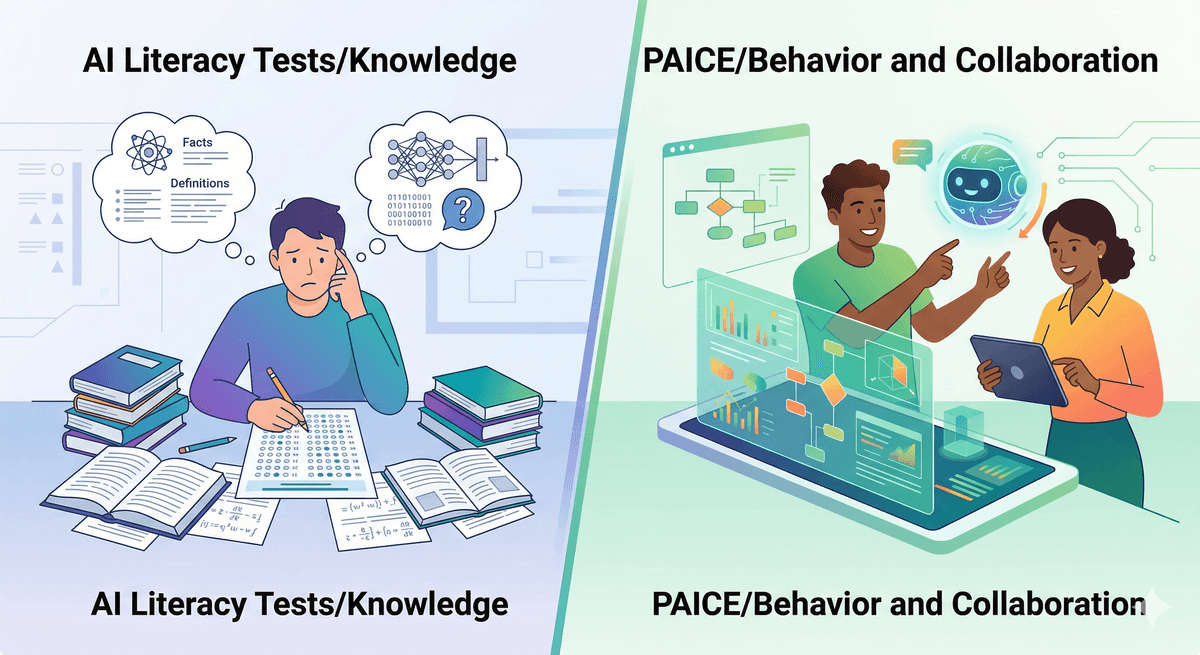
Every organization adopting AI faces the same question: are our people ready?
The default answer has been to train them. Roll out an AI literacy program. Administer a quiz. Check the box. And for a while, that feels like progress. People can define "hallucination." They can list the limitations of large language models. They can select the correct answer about when to verify AI output.
But here is the uncomfortable reality: none of that tells you whether they actually verify AI output when it matters.
What AI Literacy Tests Actually Measure
AI literacy assessments follow a familiar pattern. They present questions about AI concepts and ask participants to demonstrate knowledge: definitions, best practices, risk categories, ethical frameworks.
A typical AI literacy test might ask:
- "Which of the following is an example of AI hallucination?"
- "When should you verify AI-generated content before sharing it?" (Always / Sometimes / Rarely)
- "What are the key risks of using AI for client-facing work?"
These are reasonable questions. The problem is that getting the right answer is easy. Almost everyone who has been through an AI training program can identify a hallucination in a multiple-choice format. Almost everyone will select "Always" when asked about verification. Almost everyone can articulate the risks.
The questions test recall. They test whether someone absorbed the training materials. They do not test whether that knowledge translates into behavior during actual AI collaboration.
This is not a minor gap. It is the central problem.
What PAICE Measures Instead
PAICE (People + AI Collaboration Effectiveness) takes a fundamentally different approach. Instead of asking people what they know about AI collaboration, it observes what they do during AI collaboration.
During a PAICE assessment, the participant works with an AI on a real task relevant to their professional context. The interaction is a genuine conversation, not a scripted scenario with predetermined correct answers. But within that interaction, the system introduces deliberate challenges: subtle errors in the AI's output, overconfident claims, plausible-sounding but incorrect information.
The assessment then measures what happens next.
Does the participant catch the error? Do they challenge the AI's overconfidence? Do they verify the claim before accepting it? Or do they accept a fluent, confident-sounding response at face value and move on?
This is behavioral observation. Conversation is the medium through which it happens, but conversation is not what is being measured. What is being measured is a set of specific, observable behaviors that predict whether someone will use AI responsibly in professional practice.
PAICE evaluates five dimensions of People+AI collaboration:
- Accountability (weighted highest) -- Does the person take ownership of AI output quality? Do they verify before acting on AI-generated content?
- Integrity -- Do they maintain professional standards when AI makes it easy to cut corners?
- Collaboration -- Do they work with AI effectively, providing appropriate context and direction?
- Evolution -- Do they adapt their approach based on what works and what does not?
- Performance -- Do they use AI to accomplish meaningful work, not just generate output?
Accountability carries the highest weight in the PAICE scoring model because it is the most critical skill and the most commonly underdeveloped one. Knowing that you should verify AI output is table stakes. Actually doing it, consistently, under time pressure, when the output sounds perfectly plausible -- that is the skill that matters.
The Gap Between Knowing and Doing
Consider two professionals taking both an AI literacy test and a PAICE assessment.
Professional A scores perfectly on the literacy test. They can explain prompt engineering techniques, describe the transformer architecture at a high level, and articulate a clear framework for responsible AI use. They sound fluent and knowledgeable in conversation with the AI during the PAICE assessment. But when the AI introduces a subtly incorrect data point midway through the session, they accept it without question. When the AI presents an overconfident summary with a buried factual error, they incorporate it into their work product. They catch zero of the injected challenges.
Professional B struggles with some of the literacy test questions. They cannot explain how large language models work at a technical level. Their vocabulary for AI concepts is limited. But during the PAICE assessment, when the AI presents a claim that does not match their professional experience, they push back. When the AI generates a confident-sounding analysis, they check the key assertions before accepting them. They catch most of the injected challenges.
Under a knowledge-based assessment, Professional A looks like the stronger AI collaborator. Under behavioral observation, Professional B is clearly more effective, and more safe, in practice.
This pattern is not hypothetical. It reflects a well-documented phenomenon: the gap between declarative knowledge (knowing what to do) and procedural skill (actually doing it under real conditions). AI literacy tests measure the former. PAICE measures the latter.
The reverse pattern also reveals something important. A participant who challenges every AI response indiscriminately (flagging correct outputs as errors, treating all AI-generated content as suspect regardless of quality, etc.) is not demonstrating strong accountability. They are demonstrating a different failure mode: an inability to calibrate trust appropriately. PAICE recognizes this distinction. Excessive false positives are treated as a collaboration weakness, not a strength.
Why the Difference Matters for Regulated Industries
For professionals in regulated industries such as law, insurance, healthcare, finance, cybersecurity, and the like, the gap between knowing and doing carries direct personal consequences.
A lawyer who can define AI hallucination on a quiz but does not catch a fabricated case citation in an AI-drafted brief risks sanctions, malpractice claims, and their license. A financial advisor who scores well on AI training modules but accepts an AI-generated risk assessment without verification exposes their clients and themselves to regulatory action.
These professionals are individually licensed. They carry personal liability. The question their regulators and professional bodies will eventually ask is not "did you complete AI training?" but "did you exercise appropriate professional judgment when using AI tools?"
Training completion certificates and literacy test scores do not answer that question. Behavioral evidence does.
This is why PAICE was built for regulated industries first. The stakes are highest here, and the gap between knowledge and behavior has the most concrete consequences. When your license is on the line, the relevant question is not whether you can identify the right answer on a quiz. It is whether you catch the error in the room.
The Evidence Hierarchy
PAICE's scoring is built on a clear evidence hierarchy: behavioral evidence outweighs conversational evidence. Always.
When the system introduces a deliberate challenge like a factual error embedded in otherwise accurate output, an overconfident claim that contradicts established knowledge, or a response that violates professional norms, and the participant catches it, that is ground truth. It is an observable, unambiguous demonstration of the skill that matters. No amount of articulate conversation about the importance of verification outweighs a missed error.
Conversely, when a participant catches every challenge, that behavioral evidence carries more weight than any conversational shortcoming. A person who is terse, direct, and catches everything scores higher than a person who is eloquent, thoughtful, and catches nothing. The scoring model reflects this intentionally.
This hierarchy exists because of a pattern that is pervasive in AI interaction: AI systems have historically told people they are doing well. They are agreeable, encouraging, and non-confrontational by default. This creates a feedback loop where people develop high confidence in their AI collaboration skills without ever having those skills tested. PAICE breaks that loop by introducing objective behavioral measures into the assessment.
What This Means for Organizations
For L&D leaders and risk managers evaluating AI assessment tools, the distinction between knowledge testing and behavioral observation has practical implications.
Training completion is not behavioral change. An employee can complete every module of an AI literacy program, pass the final quiz, and return to their desk still accepting AI output uncritically. The training gave them knowledge. It did not change their behavior. If your assessment tool only measures knowledge, you are measuring training effectiveness, not risk reduction.
Self-reported surveys compound the problem. When you ask employees how often they verify AI output, they will tell you what they believe you want to hear. This is not dishonesty, it is a well-known limitation of self-report measurement. People genuinely believe they verify more than they do. Behavioral observation removes this bias entirely.
Cohort-level behavioral data is what regulators will want. As regulatory frameworks for AI use mature, organizations will need to demonstrate that their people use AI responsibly, not that they completed a training program. Behavioral assessment data, aggregated at the cohort level, provides this evidence. Knowledge test scores do not.
PAICE is designed to serve as this measurement layer. It does not replace training. It tells you whether training worked. An organization that deploys AI literacy training and follows it with PAICE assessment can see whether the training translated into behavioral change, and where it did not.
PAICE's privacy architecture supports this at scale. Individual assessment scores are never disclosed to employers. Organizations receive cohort-level data only: distributions, percentiles, trend lines. This means employees can be assessed honestly without fear that a low score becomes a performance issue. The result is better data, because people behave naturally when they are not performing for an audience.
The Right Question
The AI assessment landscape is growing. More tools, more quizzes, more certification programs. Most of them test knowledge. Some test prompt engineering skill. A few test whether you can write a good query.
None of that answers the question that actually matters: when the AI is wrong and sounds right, does this person catch it?
That is a behavioral question. It cannot be answered with a multiple-choice test. It can only be answered by watching what someone does when it happens.
PAICE is built to answer that question.
Ready to assess your AI collaboration capabilities? Take the PAICE assessment to get personalized insights and recommendations.
Get Involved:
- Take the assessment (free, always)
- Explore our Baseline offerings (for organizations)
- Read the whitepaper (comprehensive framework)
- Contact us about your specific requirements
Recommended Reading
📖 Understanding PAICE:
- What PAICE Is Actually Testing For - The behavioral observation model behind the assessment
- The PAICE Framework - Five dimensions of AI collaboration readiness
- How Is My PAICE Score Calculated? - Scoring methodology explained
📖 Organizational Readiness:
- How Does PAICE Support Enterprise Risk Reduction? - Cohort-level data for risk management
- Creating Team AI Collaboration Standards - Building organizational AI practices
Curious but short on time?
Take the 3-minute PAICE Pulse — a quick confidence check that maps how you see your own AI collaboration posture. No login required.