Regulatory Readiness Is Not AI Literacy
What CISOs and GRC teams actually need to demonstrate
Picture the board meeting. The CISO is presenting the AI governance update. A director asks: "Are our people ready for the EU AI Act requirements by August?"
The CISO pulls up the dashboard. Ninety-two percent training completion. Policy acknowledgment rate: 98%. AI literacy quiz average: 87%. The numbers look strong. The director nods.
But the honest answer, the one the CISO knows but the dashboard cannot display, is: "I have no idea." Because none of those numbers answer the question that was actually asked. Training completion proves instruction happened. It does not prove readiness exists.
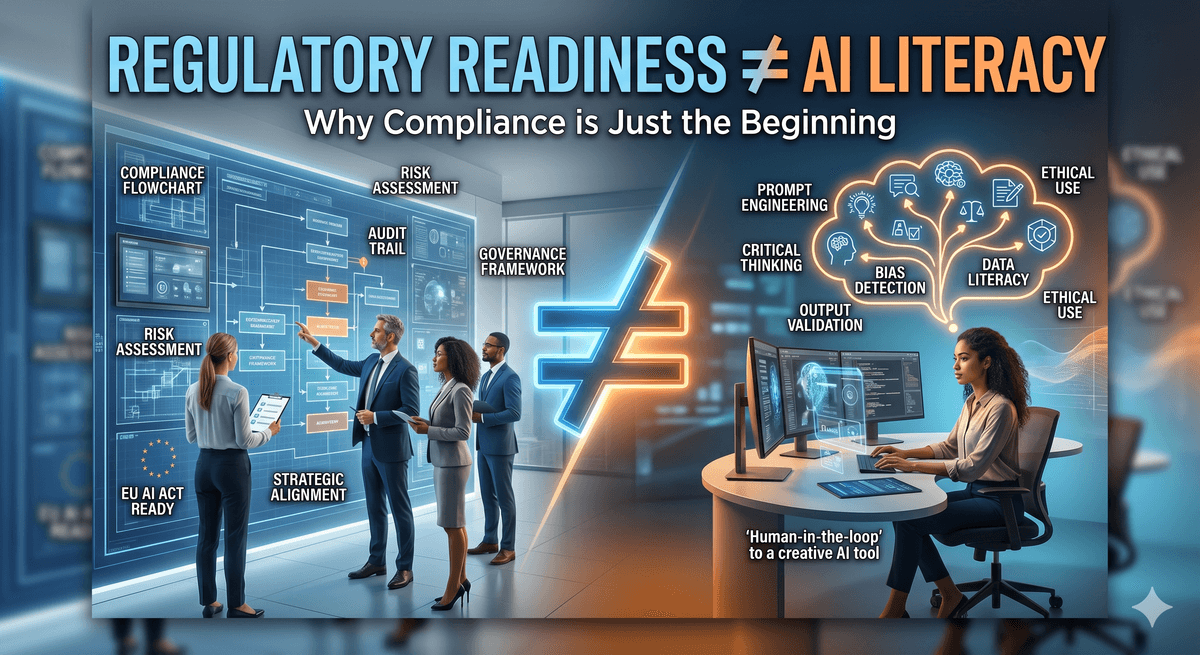
Regulatory readiness and AI literacy are not the same thing. Understanding why is the difference between a defensible compliance position and an expensive discovery during your first audit.
What Regulators Actually Require
The regulatory landscape for AI is moving fast. The EU AI Act takes effect August 1, 2026. California AB 3030 and Texas TRAIGA already in force. NYC Local Law 144 has been enforced since 2023. New state-level AI bills are advancing in Colorado, Connecticut, and Illinois.
Read the actual regulatory text across jurisdictions, and a pattern emerges. Regulators are not asking whether your people completed training. They are asking whether your organization can demonstrate specific capabilities:
Demonstrated competence. The EU AI Act requires that personnel involved in AI system deployment have "the necessary competence, training and authority." Competence is the operative word. It is a behavioral standard, not a credential.
Risk documentation. Colorado SB24-205 requires deployers to document their risk management practices, including how they ensure people interacting with AI systems understand the system's limitations. Documentation of understanding requires evidence beyond a signed policy.
Behavioral evidence. Across frameworks, the recurring requirement is evidence that people can identify AI errors, understand system limitations, and exercise appropriate judgment. The verb is "can," not "were told to."
Ongoing assessment. No major AI regulation treats compliance as a one-time certification. They require ongoing monitoring, reassessment, and improvement documentation. Quarterly or annual recertification is becoming the standard expectation.
The thread connecting all of these requirements is the same: regulators want proof of behavior, not proof of instruction. A training certificate proves someone sat through a program. It does not prove they can identify a hallucinated regulatory citation in a compliance memo generated by an AI assistant.
What Most Organizations Actually Have
Most organizations responding to AI regulatory requirements have assembled some combination of the following:
Training completion dashboards. Percentage of employees who finished the AI awareness module. This is the most common metric and the least useful one. Completion rates tell you about logistics, not capability.
Policy acknowledgment records. Signed acceptable-use policies. These prove the employee was informed about the rules. They do not prove the employee follows them. Every compliance professional knows the difference between a signed policy and actual compliance.
Knowledge test scores. Quiz results from training modules. These prove short-term recall of declarative knowledge. A professional who scores 95% on a quiz about AI hallucination risks can still accept a hallucinated statistic in a client deliverable three hours later.
Usage analytics. Adoption rates, query volumes, tool utilization. These prove people are using AI. They prove nothing about whether they are using it well. An organization with 95% AI adoption and zero verification culture has a larger risk exposure than one with 30% adoption and strong review habits.
Vendor certifications. SOC 2 reports, security assessments, data processing agreements for AI tool providers. These address system-level risk. They say nothing about how your people interact with those systems.
Every item on this list is necessary. None of them, individually or combined, constitute the behavioral evidence that regulators are increasingly requiring. The gap between what organizations have and what regulations demand is not a training gap. It is an evidence gap.
The Evidence Hierarchy for GRC
Not all evidence of AI readiness is equal. For GRC professionals evaluating their compliance posture, it helps to think in terms of an evidence hierarchy, ordered from weakest to strongest:
Level 1: Training completion. Evidence that instruction occurred. Weakest because it proves exposure, not competence. Analogous to proving someone attended a defensive driving course, not that they drive safely.
Level 2: Knowledge test scores. Evidence that declarative knowledge was retained at the time of testing. Stronger than completion, but still measures recall under test conditions, not behavior under work conditions.
Level 3: Self-reported surveys. Evidence of how people believe they use AI. Useful for identifying attitudes and perceptions, but subject to the same social desirability bias and overconfidence effects that make self-assessment unreliable in every other domain.
Level 4: Usage analytics. Evidence of what AI interactions occurred. Tells you volume and frequency, but not quality. Cannot distinguish between a verified output and a blindly accepted one.
Level 5: Behavioral observation under realistic conditions. Evidence of what people actually do when collaborating with AI, including how they respond to errors, overconfidence, and hallucination. Strongest because it measures the thing regulators are actually asking about: competence in practice.
Most organizations stop at levels 1 and 2. The most sophisticated add level 4. Almost none operate at level 5.
PAICE (People + AI Collaboration Effectiveness) operates at level 5. The assessment places professionals in a realistic AI collaboration scenario (their own), introduces strategic failure conditions, and observes their behavioral response. The output is a dimensional score that captures verification rates, error detection patterns, accountability habits, and adaptation behavior. This is the evidence that maps to what regulators are requiring.
Why AI Literacy Programs Don't Satisfy Regulatory Requirements
The gap between AI literacy and regulatory readiness is best understood as a verb mismatch.
Regulators ask: "Can your people identify AI errors in their professional domain?"
Training programs answer: "Our people completed a module about AI errors."
Regulators ask: "Can your workforce demonstrate appropriate judgment when AI output is unreliable?"
Training programs answer: "Our workforce was instructed on when AI output may be unreliable."
Regulators ask: "Does your organization maintain ongoing evidence of competence?"
Training programs answer: "Our organization administered an annual certification."
In every case, the regulatory verb is active and behavioral (identify, demonstrate, maintain). The training verb is passive and administrative (completed, was instructed, administered). The gap is structural. No amount of better training content closes it, because the problem is not what people are taught. It is that teaching, by itself, does not produce the evidence regulators require.
This is not a criticism of AI literacy programs. They serve a real and important purpose. People need foundational knowledge before they can develop behavioral competence. But literacy is a prerequisite, not a substitute. An organization that treats AI literacy certification as regulatory compliance has the same problem as an organization that treats a food safety training certificate as proof that its kitchen is clean.
The certificate is necessary. The inspection is what matters.
What Behavioral Evidence Looks Like
When an organization runs a PAICE AI Capability Baseline, the output is the kind of evidence that maps directly to regulatory language.
Individual dimensional scores. Each participant receives a 0-1000 score across five dimensions: Performance (P), Accountability (A), Integrity (I), Collaboration (C), and Evolution (E). The Integrity dimension specifically captures error detection rates. The Accountability dimension captures verification discipline. These are the behavioral metrics that regulatory "competence" language refers to.
Cohort-level distributions. The Baseline produces aggregate data showing how the organization's workforce performs across dimensions. A compliance team can present this data during an audit: "Here is the dimensional distribution of our workforce's AI collaboration competence. Here are the areas of strength. Here are the gaps we identified. Here is what we are doing about them."
Trend data over time. Quarterly reassessment produces longitudinal evidence of improvement or regression. This directly addresses the "ongoing assessment" requirement that appears across regulatory frameworks. The trajectory matters as much as the current score.
Gap analysis by dimension. The Baseline identifies specific behavioral gaps rather than generic weaknesses. "Our team has strong Performance and Collaboration scores but below-average Integrity scores" is actionable. "Our team needs more AI training" is not.
Privacy-preserving architecture. Individual scores are never disclosed to employers. Organizational insights are aggregated and anonymized. This means the evidence is both defensible and ethically collected, which matters when regulators evaluate not just what you measured but how you measured it.
None of this requires the organization to know what any individual scored. The aggregate evidence is what compliance requires. The individual privacy is what participation requires. PAICE's architecture satisfies both simultaneously.
Building a Defensible Position
For CISOs and GRC teams who recognize the evidence gap in their current posture, here is a practical three-step approach:
Step 1: Baseline Your Workforce
Run an AI Capability Baseline across a representative cohort. This produces the initial behavioral evidence: where your organization stands today across all five dimensions of People+AI collaboration. The Baseline replaces assumption with data. Instead of "we think our people are ready," you have "here is our dimensional profile with confidence intervals."
The Baseline engagement is structured as a 2-4 week program depending on cohort size, with privacy guarantees that enable authentic participation. Each participant takes the assessment in their own professional domain, producing evidence that is specific to how your people actually work with AI, not generic benchmarks from other organizations.
Step 2: Identify Dimensional Gaps
Use the Baseline results to identify which dimensions need attention. A team with strong Performance but weak Integrity scores needs targeted intervention around verification habits, not more general AI training. A team with weak Accountability scores needs clarity around decision ownership, not prompt engineering workshops.
This is where the evidence hierarchy matters most. At levels 1-2, you cannot distinguish between these gaps. A team that scores 87% on an AI literacy quiz might have excellent knowledge and terrible verification habits. Only level 5 evidence reveals the specific behavioral gaps that targeted intervention can address.
Step 3: Reassess Quarterly
Establish a quarterly Baseline cadence. This produces the trend data that regulators increasingly expect: evidence not just of current competence, but of an improvement trajectory over time.
The quarterly cycle also creates organizational accountability. When departments know they will be reassessed, the behavioral standards become embedded in practice rather than confined to training events. The reassessment itself is instructionally valuable (as we explored in our post on Merrill's First Principles), creating a virtuous cycle where measurement drives improvement.
For jurisdiction-specific requirements, EveryAILaw.com (also in the PAICE Portfolio) provides structured, current reference data on what each regulation requires, organized by jurisdiction and mapped to implementation timelines. Cross-referencing your Baseline results with jurisdiction-specific requirements lets you build a compliance roadmap that is both evidence-based and regulation-specific.
The Clock Is Running
The EU AI Act's August 1, 2026 effective date is 100 days away as of this publication. Many US State laws are already in force. New AI legislation is advancing across the globe. Organizations that are still relying on training completion dashboards as their primary evidence of AI readiness are building on a foundation that regulators have already indicated is insufficient.
The question is not whether your people have been trained. The question is whether you can prove they are competent. The difference between those two questions is the difference between a training dashboard and a behavioral Baseline. Between AI literacy and regulatory readiness. Between what you hope is true and what you can demonstrate under audit.
Want to assess your team's AI collaboration readiness? Learn about PAICE for organizations or take an individual assessment to see it firsthand.
Get Involved:
- Take the assessment (free, always)
- Explore our Baseline offerings (for organizations)
- Read the whitepapers (comprehensive framework)
- Contact us about your specific requirements
Recommended Reading
📖 Governance and Compliance:
- Your AI Policy Is Not Enough - Five uncomfortable truths about what really keeps AI safe
- The Age of AI Accountability - Why governance frameworks need behavioral evidence
- The Regulation Gap - Video on the distance between regulatory awareness and defensible compliance
📖 Behavioral Measurement:
- PAICE vs. AI Literacy Tests - Why behavior beats knowledge in assessment
- How Does PAICE Support Enterprise Risk Reduction? - FAQ on the behavioral risk layer
- Why AI Training Programs Aren't Working - The gap between completion rates and behavioral change
📖 Getting Started:
- How to Prepare Your Organization for a PAICE Cohort Assessment - Rollout guide for L&D leads and compliance officers
- Introducing the AI Capability Baseline - Why organizations need measurable starting points
Curious but short on time?
Take the 3-minute PAICE Pulse — a quick confidence check that maps how you see your own AI collaboration posture. No login required.