Seven Signs You Don't Need PAICE
A Definitive Guide to When AI Collaboration Assessment Becomes Unnecessary
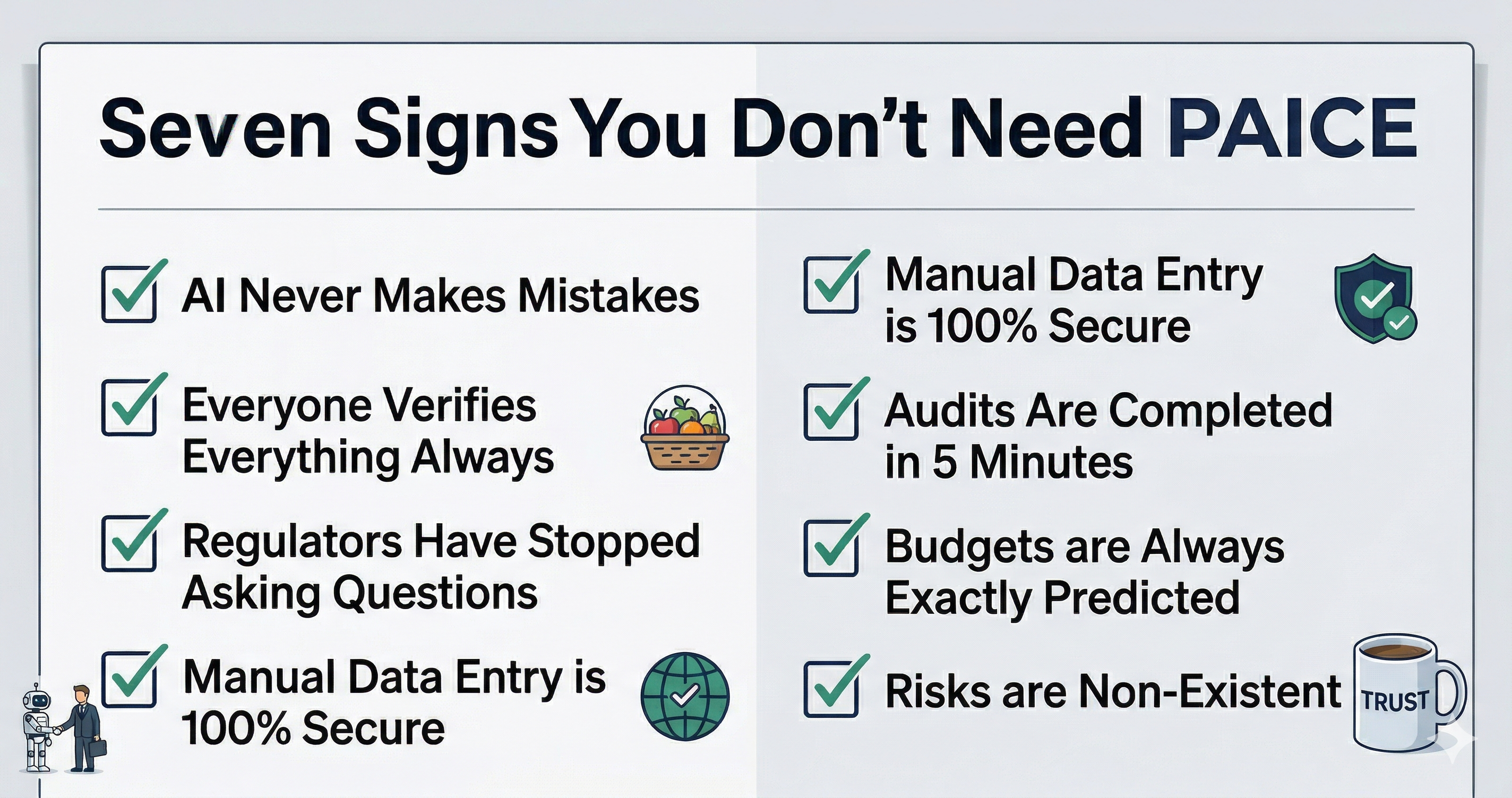
Happy April Fools' Day! This post is satire. The situations described below are, regrettably, fictional. The real assessment remains very much necessary.
We hear it all the time. "When will we not need PAICE anymore?"
It's a fair question. We have never shied away from defining our own obsolescence criteria. If anything, we welcome it. The day that People+AI collaboration measures becomes unnecessary will be a remarkable day for the profession, for the industry, and for the concept of epistemic certainty itself.
So we consulted with professionals across regulated industries and compiled the definitive list of conditions under which PAICE (People + AI Collaboration Effectiveness) assessment becomes completely unnecessary. We are pleased to report that the bar is refreshingly clear.
Sign 1: AI Has Stopped Making Mistakes
"We ran our models through every edge case in existence and they achieved 100% accuracy across all domains, jurisdictions, and contexts simultaneously. Hallucinations have been eliminated entirely. Our AI now refuses to answer rather than risk being wrong, which has reduced its usefulness to zero, but at least it's accurate."
Chief Technology Officer, Enterprise Software
This is the obvious one. Once AI systems achieve perfect accuracy across every possible input, domain, regulatory framework, and cultural context, there is simply nothing left to verify. The entire premise of verification becomes quaint, like wearing a seatbelt in a parked car.
We note that this milestone also requires perfection across all future contexts that do not yet exist, since new regulations, case law, and professional standards emerge continuously. But our sources assure us that the models have already anticipated those as well.
We were initially skeptical, but the CTO pointed out that questioning AI perfection is itself a sign of inadequate trust in technology. We found this argument circular but compelling.
Sign 2: Every Professional Verifies Every AI Output Every Time
"We surveyed our entire organization and every single person confirmed they always verify AI output before acting on it. We then verified their self-reports and found them to be 100% accurate, which is statistically unprecedented but we're choosing not to question it."
Chief Compliance Officer, Financial Services
If every professional already verifies every piece of AI output before relying on it, then measuring whether they do so is redundant. The assessment exists to identify gaps in verification behavior. No gaps, no assessment.
The compliance officer did acknowledge that self-reported behavior and actual behavior have historically diverged in every study ever conducted on the subject. However, she noted that their organization is different because they specifically asked employees to be honest, and the employees confirmed that they were being honest, and she verified their confirmation of honesty, and so on. At no point in this recursive verification loop did anyone's confidence waver.
We asked whether the organization had considered measuring verification behavior directly rather than relying on self-reports. The compliance officer explained that this would imply distrust of the workforce, which would be a cultural misalignment with their values statement, which prominently features the word "trust" in a large font.
Sign 3: Regulators Have Stopped Asking Questions
"Our regulatory bodies have collectively decided that AI governance is a solved problem and have redirected their attention to more pressing matters, such as whether hot dogs are sandwiches. We expect formal guidance on the sandwich question by Q3."
General Counsel, Healthcare Organization
This is a significant development. For years, regulators across financial services, healthcare, legal, and insurance sectors have been escalating their scrutiny of how professionals use AI. If this scrutiny has ceased, the compliance rationale for assessment evaporates entirely.
The General Counsel shared documentation confirming that every relevant regulatory body has issued a joint statement acknowledging that AI governance requires no further attention. The statement, which we were not permitted to see but were assured exists, reportedly concludes with the phrase "we're good here" and is signed by everyone.
When pressed on the sandwich question, the General Counsel confirmed that it falls under the purview of the Administrative Procedures Act and will require a 90-day public comment period. Several major food industry lobbying groups have already filed amicus briefs. The legal community anticipates the matter will ultimately reach the Supreme Court, which is expected to rule 5-4 along ideological lines, with the concurrence hinging on the structural integrity of the bun.
Sign 4: Malpractice Insurance Now Covers AI Mistakes for Free
"Our insurer reviewed our AI collaboration practices and was so impressed that they eliminated the AI liability rider entirely. They also sent us a fruit basket and a handwritten note saying 'We trust you.' We've framed the note."
Risk Manager, Law Firm
Insurance carriers have historically been among the most aggressive drivers of AI governance requirements, because they are the ones paying when things go wrong. If insurers have reached a point where they no longer consider AI-related professional liability to be a material risk, the financial incentive for assessment disappears.
The risk manager was kind enough to share a photograph of the fruit basket. It contained mangoes, which he interpreted as a metaphor for the sweet fruits of responsible AI governance. We interpreted it as mangoes.
He also noted that the firm's malpractice premium had decreased by 400%, which we believe means the insurer is now paying the firm to practice law. We did not verify this claim, in the spirit of the trust-based professional environment the article describes.
Sign 5: Clients Have Stopped Caring About Accuracy
"We surveyed our client base and discovered that accuracy is no longer a priority. They now evaluate our work solely on speed and visual presentation. As long as it arrives quickly and the formatting is nice, the actual content is optional. This has simplified our quality assurance process considerably."
Managing Partner, Consulting Firm
If the market no longer values accuracy, then the skills PAICE measures become economically irrelevant. Why assess whether professionals verify AI output if nobody cares whether the output is correct?
The managing partner shared survey results indicating that 100% of clients rated "nice fonts" as more important than "factual accuracy" when evaluating professional deliverables. The survey methodology was described as "robust" and the sample size as "sufficient." We were not provided with numbers for either.
This finding aligns with a broader trend the managing partner identified, in which the concept of "correctness" is being replaced by the more flexible concept of "vibes." Several peer-reviewed journals are reportedly exploring this framework, though they have not yet published because they are still working on the formatting.
Sign 6: Every Employee Is a Professional AI Expert Now
"Following our mandatory 45-minute AI webinar, every employee in the organization now possesses comprehensive expertise in AI capabilities, limitations, failure modes, and verification methodologies across all professional domains. The webinar included a quiz. Everyone passed. Some employees report that the webinar also cured their seasonal allergies."
VP of Learning and Development, Insurance Company
If a single training intervention can permanently and comprehensively equip every professional with the skills to collaborate effectively with AI, then ongoing assessment is unnecessary. You do not need to measure what has already been perfected.
The VP shared the webinar slides, which covered the entire field of artificial intelligence in 22 slides, including a title slide, an agenda slide, a "Questions?" slide, and a slide that just said "AI" in very large letters with a stock photo of a robot shaking hands with a businessman. The remaining 18 slides addressed all known and unknown failure modes of large language models, probabilistic reasoning under uncertainty, and the regulatory implications of automated decision-making across 14 jurisdictions.
The quiz consisted of three multiple-choice questions. The passing score was one correct answer. An employee who selected "All of the above" for every question would have scored 100%.
When asked about the reported allergy cure, the VP noted that correlation does not imply causation but that several employees had stopped sneezing, which she considered strong anecdotal evidence. She is exploring whether the webinar can be repurposed for other medical conditions and expects to submit a proposal to the FDA by end of quarter.
Sign 7: The Accountability Problem Has Been Solved by Renaming It
"We've addressed the accountability gap by rebranding it as an 'opportunity space.' Our consultants assure us that reframing the problem eliminates the need to solve it. We've also renamed 'risk' to 'upside variance' and 'compliance failure' to 'creative interpretation.' Morale has never been higher."
CEO, Professional Services Firm
This is perhaps the most elegant solution on the list. The accountability gap that PAICE measures is, at its core, a language problem. If the word "accountability" creates anxiety, and the word "gap" implies deficiency, then replacing both words eliminates the anxiety and the deficiency simultaneously.
The CEO shared the firm's updated glossary, which we found comprehensive. "Error" has been replaced with "alternative output." "Hallucination" is now "creative extrapolation." "Unverified" has become "trust-forward." The term "wrong" has been retired entirely in favor of "differently accurate."
The consultants who developed the glossary reportedly charged $450,000 for the engagement, which the CEO described as "aggressively reasonable." The engagement also produced a 200-page change management playbook, a set of branded coffee mugs, and a team-building exercise in which employees were asked to close their eyes and imagine a world without professional liability. Several employees described this exercise as "transformative." One described it as "a nap."
So When Can You Stop?
Until all seven of these conditions are met simultaneously, we will be here. The assessment is free. The verification skills it measures are not optional. And unlike the scenarios above, the risks of getting People+AI collaboration wrong are very, very real.
Professionals in regulated industries carry personal liability for the work they deliver. AI does not diminish that liability. If anything, it concentrates it at the moment of verification, the moment when a person decides whether to accept or question what AI has produced. That moment is what PAICE measures. And until all seven of the conditions described above are achieved, that moment will continue to matter.
Happy April Fools' Day. Now go take the assessment before AI achieves perfection and puts us all out of a job.
Ready to find out how you actually collaborate with AI? Not how you think you do, not how you say you do, but what you actually do when it matters? Take the free assessment and find out. It takes about 15 minutes. The fruit basket is not included.
Get Involved:
- Take the assessment (free, always)
- Explore our Baseline offerings (for organizations)
- Read the whitepaper (comprehensive framework)
- Contact us (we promise not to rename your problems)
Recommended Reading (Serious This Time)
Curious but short on time?
Take the 3-minute PAICE Pulse — a quick confidence check that maps how you see your own AI collaboration posture. No login required.