The Input Obsession
Why Prompt Training Without Measurement Is Like Safety Training Without Incident Reporting
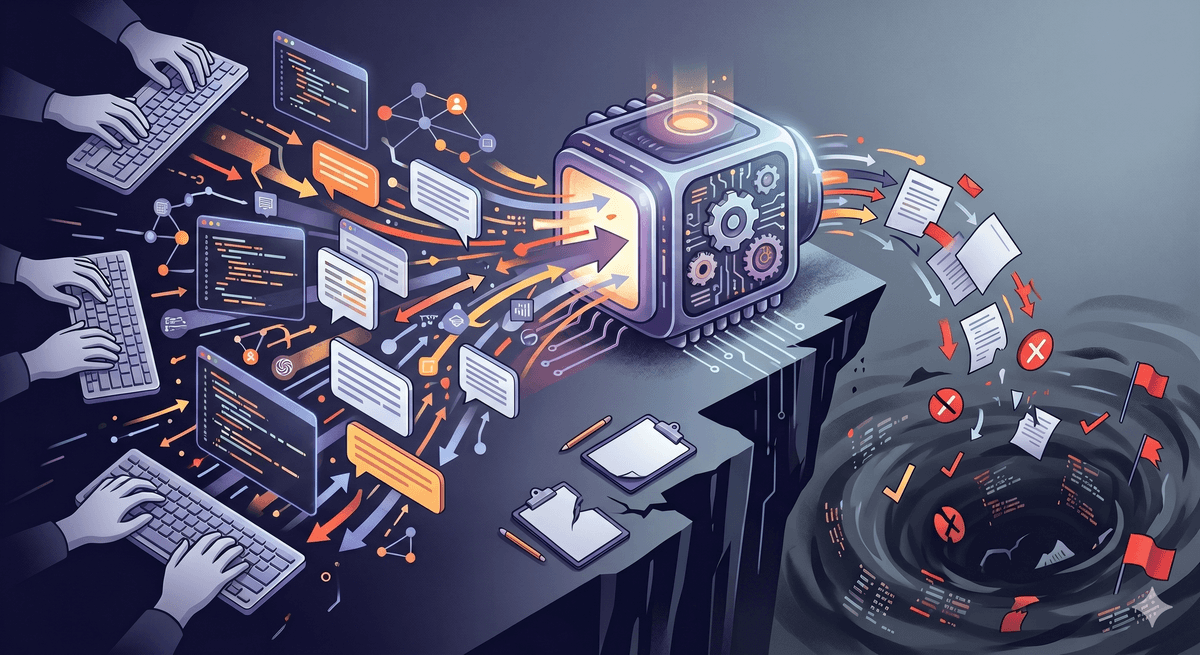
Search "AI training" and you'll find thousands of results. Prompt engineering courses. AI literacy certifications. Responsible use workshops. "How to talk to ChatGPT" boot camps. The market is thriving, well-funded, and growing fast.
Now search "AI collaboration measurement." The category barely exists.
That asymmetry tells you everything about where the market is focused. It also tells you where the risk actually lives.
The Input Side Is Thriving
The AI training market has settled on a core thesis: if you teach people to use AI better, they will get better results. The investments follow logically from there.
Prompt engineering courses teach you how to structure requests. AI literacy certifications test whether you understand how large language models work. Responsible use training covers ethics, bias, and organizational policy. Communication workshops help you "get more out of" your AI tools.
These are valuable. They teach people what to put into AI systems. Better inputs do tend to produce better outputs. Nobody is arguing otherwise.
But they share a critical assumption that almost nobody examines: that better inputs automatically produce better outcomes. That if you teach someone to write a good prompt, they will naturally verify what comes back. That awareness of AI limitations translates into behavioral vigilance when working under deadline pressure.
That assumption is wrong. And the gap it creates is where organizational risk accumulates silently.
The Missing Output Side
Here is what almost nobody measures: what happens after the AI produces its response.
Did the person verify the output? Did they catch the errors? Did they apply professional judgment to the claims, the citations, the recommendations? Did they maintain information quality, or did they accept a confident-sounding answer because checking felt redundant?
The entire output side of the People+AI collaboration loop is unmeasured in most organizations. The implicit belief is that training creates competence. That if you complete the course and pass the quiz, you will behave differently in practice.
Any safety professional will tell you why that belief is dangerous. Training creates awareness. It tells people what the right behavior looks like. But awareness and behavior are not the same thing, especially under time pressure, cognitive load, and the steady persuasion of an AI system that always sounds sure of itself.
Measurement creates accountability. It tells the organization whether the right behavior is actually happening.
The Safety Training Analogy
Every regulated industry understands this distinction. They learned it the hard way.
You don't just train people on safety procedures and assume compliance. You measure incident rates. You track near-misses. You monitor compliance behavior. You audit outcomes. The training tells people what to do. The measurement tells the organization whether they're doing it.
Safety training without incident reporting would be considered negligent in any serious industry. No regulator would accept "we trained everyone" as evidence of a functioning safety program. The question is always: what happened after the training? Did behavior change? Can you demonstrate it?
Yet that is exactly what the AI training market is doing. Organizations invest in prompt engineering courses and AI literacy programs, check the "training completed" box, and move on. Nobody goes back to measure whether the trained professionals actually verify AI output in their daily work.
The Engineering Trust series that I co-wrote for Snap Synapse with Dr. Markus Bernhardt diagnosed this pattern precisely: prompt training without measurement is like safety training without incident reporting. It feels responsible. It looks like due diligence. But it produces no evidence that the risk has actually been reduced.
Where the Risk Actually Lives
The risk in People+AI collaboration is not that people can't write good prompts. Most professionals figure out prompting quickly enough. The tools are designed to be easy to use. That problem is largely solved.
The risk is what happens next.
A lawyer uses AI to draft a brief. The prose is polished, the citations look correct, and the analysis is coherent. Did the lawyer verify each citation against the actual case law? Or did they skim it, conclude it looked right, and file?
An analyst uses AI to summarize a dataset. The summary is clean, well-structured, and plausible. Did the analyst check the summary against the underlying data? Or did they forward it to leadership because the deadline was tight and the output looked professional?
A compliance officer uses AI to review policy language. The AI identifies relevant provisions, highlights potential conflicts, and suggests revisions. Did the officer verify the AI's interpretation against current regulatory guidance? Or did they trust the tool because it cited the right statutes?
In every case, the input was fine. The prompt was reasonable. The AI did what it was asked to do. The failure, when it happens, lives entirely on the output side. It lives in the moment where a professional decides whether to verify or to trust.
That moment is invisible to every input-side training program in the market today.
What Output-Side Measurement Looks Like
PAICE (People + AI Collaboration Effectiveness) measures behavioral responses to AI output. Not what people say they would do. Not what they learned in a course. What they actually do when working with AI in real time.
Does the person verify claims? PAICE introduces the kinds of errors that AI actually produces: subtle, confident, plausible-sounding mistakes. Not obvious blunders, but the kind of output that looks right unless you check. Then it observes whether the person checks.
Do they catch injected errors? This is behavioral ground truth. A person can articulate every principle of responsible AI use and still miss an error that's sitting right in front of them. The catch-or-miss moment tells you more about operational risk than any self-assessment survey ever will.
Do they maintain information integrity? When AI output contradicts their professional knowledge, do they flag it? Do they push back? Or do they defer to the tool's confidence?
Do they adapt their verification approach? When they discover one error, do they recalibrate their trust and check more carefully? Or do they treat it as an isolated incident and continue as before?
These are output-side behaviors. They are the behaviors that determine whether People+AI collaboration creates value or creates risk. And they are exactly what the training market does not measure.
Completing the Picture
Input training and output measurement are not competitors. They are two halves of a complete capability program, and right now, almost every organization is running on only one half.
Training tells people what to do. It builds awareness of best practices, establishes expectations, and creates a shared vocabulary for how the organization thinks about AI collaboration. That foundation matters.
Measurement tells the organization whether the training worked. It surfaces the gap between stated intent and actual behavior. It identifies who is verification-strong and who needs development. It produces the evidence that regulators, auditors, and boards are starting to ask for: not "did you train your people?" but "can you demonstrate that your people collaborate with AI responsibly?"
PAICE doesn't replace training. It completes the loop that training opens. The prompt engineering course teaches people how to ask better questions. PAICE measures whether they verify the answers.
For organizations in regulated industries, this is not an abstract distinction. Lawyers, financial advisors, healthcare professionals, and insurers carry personal liability for their professional judgments. When those judgments are informed by AI output that was accepted without verification, the liability doesn't shift to the AI. It stays with the professional.
The input side helps those professionals use AI effectively. The output side tells you whether they're using it safely. Both matter. Only one is being measured.
The Market Will Catch Up
The asymmetry between input training and output measurement will not last forever. As AI-related incidents accumulate and regulators sharpen their expectations, the market will recognize what safety professionals have known for decades: training without measurement is not a program. It is a hope.
The organizations that close this gap first will have a structural advantage. Not because they trained their people better, but because they can demonstrate that their people actually collaborate with AI the way they were trained to. That demonstration, grounded in behavioral evidence rather than course completion certificates, is the difference between a compliance checkbox and a genuine risk management capability.
The input obsession served a purpose. It got organizations started. But starting is not the same as finishing. And the finish line is on the output side.
Ready to assess your AI collaboration capabilities? Take the PAICE assessment to get personalized insights and recommendations.
Get Involved:
- Take the assessment (free, always)
- Explore our Baseline offerings (for organizations)
- Read the whitepaper (comprehensive framework)
- Contact us about your specific requirements
Recommended Reading
📖 Understanding PAICE:
- What PAICE Actually Tests For - The behavioral signals behind the score
- The Five Dimensions of AI Collaboration - How PAICE organizes what it measures
- What Makes PAICE Different - Behavioral observation vs. self-reporting
📖 Building Your Practice:
- Common AI Collaboration Mistakes and How to Avoid Them - The patterns that cost professionals the most
- AI Collaboration as a Master Skill - Why this capability matters more than any single tool
📖 Organizational Readiness:
- Enterprise Risk Reduction FAQ - How organizations use PAICE for governance
Curious but short on time?
Take the 3-minute PAICE Pulse — a quick confidence check that maps how you see your own AI collaboration posture. No login required.