AI Collaboration Under Pressure
Maintaining Judgment When Deadlines Don't Wait
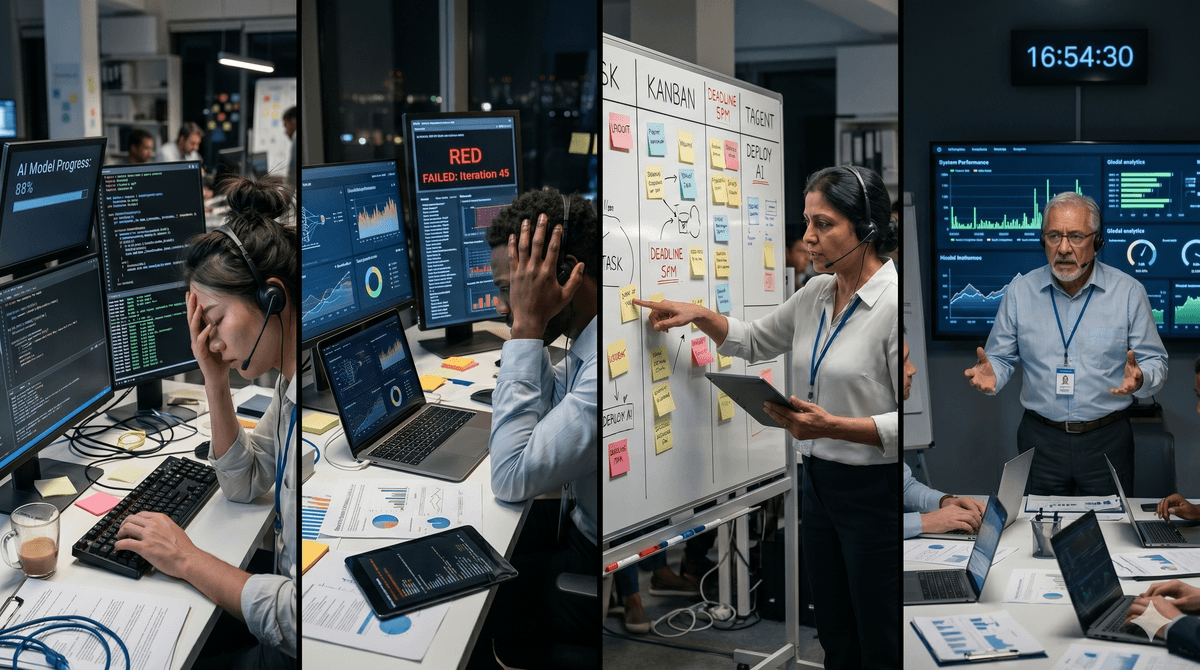
It is 11 PM. The filing deadline is 8 AM. The AI has produced a draft that looks good. You are tired. Do you verify, or do you trust it?
This is where AI collaboration skills are actually tested. Not in calm afternoon sessions with a fresh cup of coffee and no pressure. Not in training exercises where the stakes are low and the timeline is generous. In the real world, the moments that matter most are the ones where time is short, fatigue is high, and the AI's output looks plausible enough to accept.
Every AI collaboration guide assumes deliberation. Read carefully. Verify systematically. Cross-reference against authoritative sources. That is all correct advice. It is also advice written for conditions that rarely exist when the stakes are highest.
The case studies below are anonymized composites drawn from widely reported patterns across regulated industries. They illustrate what happens when time pressure meets verification shortcuts, and they reveal something important about what PAICE (People + AI Collaboration Effectiveness) actually measures.
Case 1: The Overnight Brief
A litigation associate received an assignment at 6 PM. A motion needed to be filed by 9 AM the next morning. The issue was complex but not unfamiliar. The associate used AI to draft the motion and research supporting case law.
The AI produced a well-structured brief citing three cases that supported the argument convincingly. The reasoning was tight. The citations were properly formatted. The language was persuasive.
Under normal circumstances, the associate would have verified every citation in a legal database. But it was past midnight. The brief was nearly done. The associate spot-checked the first citation. It was real. The case existed, the holding was accurately characterized, and the quoted language appeared in the opinion.
The associate submitted the brief with all three citations, having verified one.
The other two cases did not exist.
Opposing counsel identified the fabricated citations within hours. The judge issued an order to show cause. The associate faced potential sanctions. The client's position was undermined not by weak legal arguments but by the attorney's failure to verify AI-generated authorities.
The PAICE Lens
This is a failure across two dimensions. Accountability, which carries the highest weight in the PAICE model at 30%, measures whether a professional verifies AI output before acting on it. Integrity, weighted at 25%, measures whether a professional maintains information quality standards regardless of circumstances.
The associate's decision to spot-check one citation and extrapolate trustworthiness to the remaining two is a specific behavioral pattern that PAICE is designed to detect. During an assessment, this maps directly to selective verification: checking one element, finding it satisfactory, and assuming the rest is equally reliable.
Time pressure did not create this pattern. It revealed it. The associate's baseline verification habits were already calibrated to a level that broke down under pressure. A stronger baseline would have treated each citation as an independent claim requiring independent verification.
Case 2: The Quarter-End Close
A controller at a mid-sized firm was managing the quarter-end close. The timeline was compressed due to a system migration earlier in the quarter. Multiple accounts needed reconciliation, and the team was already stretched thin.
The controller used AI to generate variance analyses for several accounts. The AI produced plausible explanations for every discrepancy. Revenue recognition timing differences. Accrual adjustments. Foreign currency translation effects. Each explanation was internally consistent and used appropriate accounting terminology.
The controller reviewed the explanations and found them reasonable. They matched the types of variances the controller expected to see. Under the time pressure of the close, the controller accepted the AI's explanations without tracing each one back to the underlying transaction data.
Two of the explanations were wrong. The AI had generated plausible narratives for variances whose actual causes were different. One involved an unrecorded liability. The other involved a revenue recognition error. Both were material.
The misstatements reached the financial statements. They were caught during the external audit weeks later, triggering a restatement discussion and raising questions about internal controls.
The PAICE Lens
This case illustrates the same two dimensions but in a different context. The Accountability failure was not verifying AI explanations against source data. The Integrity failure was allowing time pressure to lower the evidentiary standard for accepting AI output.
The controller did review the AI's work. But reviewing for plausibility is not the same as verifying for accuracy. The AI's explanations sounded right because they used the right language and matched general expectations. The controller's verification was superficial not because they lacked skill but because the pressure of the close compressed their verification process to its weakest form.
In a PAICE assessment, this maps to the distinction between stated verification intent and actual verification behavior. A professional who articulates strong verification principles but accepts plausible AI output without checking during the assessment has demonstrated the pattern this case study illustrates.
Case 3: The Emergency Triage
A clinician during a busy overnight shift was managing multiple patients simultaneously. One patient presented with a complex medication regimen that required checking for drug interactions before adding a new prescription.
The clinician used AI to cross-reference the patient's current medications against the proposed addition. The AI reported no significant interactions. The response was detailed, listing each medication pair and noting the absence of known contraindications.
Under less pressured circumstances, the clinician would have cross-referenced the AI's analysis against the hospital's drug interaction database. But the shift was busy. Multiple patients needed attention. The AI's response was thorough and specific. The clinician proceeded with the prescription.
The AI had missed a recently updated contraindication. The interaction database had been updated three months earlier with new safety data from post-market surveillance. The AI's training data predated the update. The interaction it missed was not life-threatening in this case, but it caused an adverse reaction that required additional treatment and extended the patient's stay.
The PAICE Lens
This case involves Accountability and Performance. The Performance dimension, weighted at 10%, directly assesses task completion quality. The clinician's task was to ensure safe prescribing. The AI was a tool in that task. The outcome fell short because the verification step was skipped.
But the deeper issue is Accountability. The clinician did not fail because they lacked knowledge about the interaction. They failed because they delegated a safety-critical verification to a tool without confirming it against an authoritative source. Time pressure made this shortcut feel reasonable in the moment. The AI's detailed, confident response reinforced that feeling.
This is a pattern PAICE specifically tests for. AI systems present all information with equal confidence regardless of its reliability. Professionals who calibrate their trust based on the AI's presentation rather than independent verification are vulnerable to exactly this failure mode.
Case 4: The Incident Response
A security analyst received an alert at 3 AM about suspicious network traffic. The pattern was ambiguous. It could be a routine scan, a misconfigured service, or the early stages of a breach.
The analyst used AI to analyze the traffic patterns. The AI classified the activity as a false positive with high confidence. It noted similarities to known benign scanning patterns, identified the source IP as belonging to a legitimate cloud service, and concluded that the traffic was consistent with automated service discovery.
The analyst was eight hours into a twelve-hour shift. The AI's analysis was thorough and well-reasoned. The classification aligned with the analyst's initial impression. The analyst closed the ticket.
It was not a false positive. The traffic was the reconnaissance phase of an actual intrusion. The attacker had routed traffic through a legitimate cloud service to obscure the source. The scanning patterns were deliberately designed to mimic benign activity. By the time the breach was detected through other means days later, the attacker had established persistent access.
The PAICE Lens
This case maps to Accountability and Integrity. The analyst's Accountability failure was accepting the AI's classification without independent verification. The Integrity failure was allowing the AI's confidence level to substitute for analytical rigor.
The AI was not wrong about the surface-level facts. The traffic did resemble benign patterns. The source IP was associated with a legitimate service. But the AI could not account for adversarial intent, and the analyst did not push beyond the AI's analysis to consider that possibility.
In a PAICE assessment, this maps to a specific behavioral indicator: does the professional question AI conclusions, or does the professional accept them when they align with prior expectations? The analyst's fatigue amplified a pre-existing tendency to accept confirming evidence without challenge. Time pressure and fatigue did not create the vulnerability. They exploited it.
Patterns Across These Cases
Four industries. Four deadlines. Four moments where a professional decided that the AI's output was good enough. One common outcome: the verification shortcuts taken under pressure produced consequences that far exceeded the time saved.
Time pressure does not create new failure modes. It amplifies existing ones. The shortcuts these professionals took under pressure reveal their baseline collaboration habits. Under calm conditions, these same professionals likely verified more thoroughly. But their verification practices were built for ideal conditions, not realistic ones.
The patterns that recur across these cases include the following.
Selective verification. Check one element, find it satisfactory, assume the rest is equally reliable. This is the most common pressure-induced shortcut and the most dangerous. Each element in an AI's output is an independent claim requiring independent verification. The reliability of one does not predict the reliability of others.
Plausibility as proxy for accuracy. Accept output that sounds right, uses appropriate terminology, and matches general expectations without tracing it back to authoritative sources. AI systems are optimized to produce plausible output. Plausibility is a feature of the generation process, not evidence of accuracy.
Confidence calibration failure. Trust the AI more when it presents information with detail and specificity. AI confidence is a function of pattern matching, not of correctness. Highly detailed, specific AI output can be entirely fabricated.
Fatigue-amplified confirmation bias. Accept AI conclusions that align with initial impressions without adversarial testing. When professionals are tired, the cognitive effort required to challenge a confirming conclusion feels disproportionate. The result is a verification process that only catches errors the professional already suspects.
Frameworks for Pressure Situations
Telling professionals to "always verify" is correct but insufficient. The challenge is not awareness. Every professional in these case studies knew verification mattered. The challenge is maintaining verification discipline when conditions actively work against it.
The following frameworks are designed for realistic conditions, not ideal ones.
The "One More Check" Rule
When time pressure tempts you to submit, publish, prescribe, or close a ticket, perform one additional verification step on the single highest-risk element.
You cannot verify everything under extreme time pressure. Attempting to will either fail or delay action past the point of usefulness. But you can always verify one more thing. And the one thing you choose should be the element with the highest consequence of error.
For the litigation associate, that means verifying all citations, not just one. Citation existence is a binary test that takes minutes per case. When you cannot verify everything, verify the elements where failure is catastrophic.
For the controller, that means tracing the largest variance back to source data. Not every variance, but the one with the biggest number. If that one checks out, you have evidence. If it does not, you have prevented a material misstatement.
For the clinician, that means a 60-second check against the primary drug interaction database. Not a full literature review, but a single authoritative cross-reference.
For the security analyst, that means spending five minutes on adversarial thinking before closing the ticket. Not a full investigation, but an honest answer to the question: what would this look like if it were actually malicious?
The "Red Line" List
Before you are under pressure, decide which verification steps you never skip. Write them down. Make them specific to your domain. Review them when you are calm and thinking clearly.
This is not a comprehensive verification checklist. It is the minimum set of checks that you will perform regardless of time, fatigue, or the AI's confidence level.
Examples by profession:
Legal. Every citation verified against an official database. No exceptions. No spot-checking.
Financial. Every material variance traced to source transactions. The AI's explanation is a hypothesis, not evidence.
Clinical. Every prescribing decision cross-referenced against the primary formulary database. Not the AI's analysis. The database.
Cybersecurity. Every alert closure includes documented reasoning for why it is not a true positive. The AI's classification is input, not conclusion.
The value of a Red Line list is that it converts an in-the-moment judgment call into a pre-committed decision. Under pressure, judgment degrades. Pre-committed decisions do not.
The "Fresh Eyes" Protocol
If the stakes are high enough and the option exists, have someone else verify before you submit. Not the AI. A person.
This does not require a formal review process. A five-minute check by a colleague who has not been staring at the same output for hours can catch errors that the original professional's fatigued attention will miss.
The constraint is obvious: at 3 AM on a deadline, fresh eyes may not be available. But when they are available and the professional does not ask for them, that is a collaboration skill gap, not a resource constraint.
The Acknowledgment
Sometimes the right answer is "I need more time." This is uncomfortable. Deadlines exist for real reasons. Clients, regulators, patients, and stakeholders are waiting.
But submitting work that contains unverified AI output is not meeting the deadline. It is creating a future problem that will cost more time than the extension would have. The litigation associate's sanctions proceeding consumed far more time than a morning extension would have required. The controller's restatement discussion lasted weeks. The clinician's patient required additional days of treatment.
The calculation is straightforward. If you cannot perform your Red Line verification within the available time, the options are to extend the deadline or to remove the AI-generated elements you cannot verify. Submitting unverified AI output as your professional work product is not a third option.
What PAICE Measures Here
Every case study in this post involves professionals who would likely describe themselves as careful, competent AI collaborators. Under calm conditions, they probably are.
PAICE is not designed to measure how people collaborate with AI under ideal conditions. It measures how people actually behave when interacting with AI, including the patterns that surface only under realistic pressure.
The Performance dimension, weighted at 10%, directly assesses task completion quality. But the more revealing signals come from other dimensions. Accountability, weighted at 30%, measures whether a professional verifies before acting. Integrity, weighted at 25%, measures whether a professional maintains information quality standards. These dimensions do not assess what professionals know about verification. They assess what professionals do.
During a PAICE assessment, injected errors test these behavioral patterns directly. A professional who catches every error demonstrates verification habits strong enough to survive pressure. A professional who misses errors they should have caught has revealed a baseline that will degrade further under real-world conditions.
Your PAICE score reflects how you behave, not how you intend to behave. These case studies illustrate why that distinction matters.
Time pressure reveals collaboration habits that calm conditions conceal. Take the PAICE assessment to understand your behavioral patterns before they are tested by a deadline that does not wait.
Get Involved:
- Take the assessment (free, always)
- Explore our Baseline offerings (for organizations)
- Read the whitepaper (comprehensive framework)
- Contact us about your specific requirements
Recommended Reading
📖 Related Case Studies and Analysis:
- Common AI Collaboration Mistakes - Recurring pitfalls and how to prevent them
- Recovering from AI Collaboration Failures - Practical framework for failure response
- AI Collaboration for Cybersecurity Professionals - Industry-specific guidance for security teams
- AI Collaboration for Legal Professionals - Industry-specific guidance for legal practice
- AI Collaboration for Healthcare - Industry-specific guidance for clinical settings
- What PAICE Is Actually Testing For - The behavioral model behind the assessment
Curious but short on time?
Take the 3-minute PAICE Pulse — a quick confidence check that maps how you see your own AI collaboration posture. No login required.