The Evolution Dimension
Adapting Your AI Collaboration Skills as Models Get Smarter
Two years ago, AI couldn't reliably summarize a legal contract. Now it can. A year ago, AI struggled with complex financial modeling and images of humans still routinely had six fingers. Now it handles both counting and accounting reasonably well. Six months ago, multi-step regulatory analysis required constant human correction. Today, results are often usable on the first pass.
The question isn't whether AI is getting better. It's whether you're updating how you work with it.
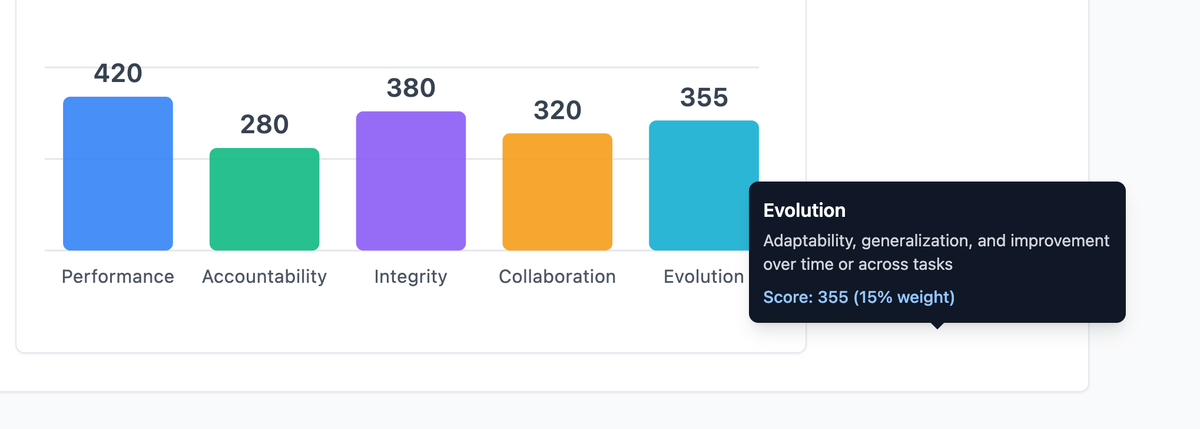
That's what the Evolution dimension in PAICE (People + AI Collaboration Effectiveness) measures. And while it carries the lowest weight of the five dimensions at 15%, it may be the most important one for your career trajectory.
What Evolution Actually Means
Evolution is not about using the latest tools. It is not about being an early adopter, having accounts on every new platform, or knowing the technical specifications of the latest model release.
It's about behavioral adaptation. Specifically, the Evolution dimension assesses three interconnected capabilities.
Capability awareness. Do you have a reasonably accurate understanding of what AI can and can't do right now, in your professional context? Not a theoretical understanding. A working one. The kind that comes from actually testing current capabilities against real tasks, not from reading headlines or vendor marketing.
Workflow adaptation. When AI capabilities change, do you update your collaboration patterns? This is the behavioral core of Evolution. It shows up in how you delegate tasks, where you focus your verification effort, what you ask AI to do versus what you handle yourself. If your workflow looks the same as it did a year ago, that is an Evolution signal.
Experimental mindset. Do you test new approaches, or do you stick with what worked last time? Professionals with high Evolution scores treat their AI collaboration patterns as hypotheses, not settled practices. They try new things, evaluate results, and adjust. They are not reckless about it. They experiment within appropriate professional boundaries. But they do experiment.
These three components work together. Capability awareness without workflow adaptation is just knowledge. Workflow adaptation without an experimental mindset is just reaction. An experimental mindset without capability awareness is just guessing.
Why Evolution Carries 15% Weight
At first glance, 15% might seem like an afterthought. It is not. The weight reflects a deliberate design choice about what PAICE measures and when.
The other four dimensions measure your current collaboration effectiveness. Performance measures how clearly you communicate and whether you get results efficiently. Accountability measures whether you verify AI output and catch errors. Integrity measures whether you maintain factual and ethical standards. Collaboration measures how effectively you iterate and give feedback.
Evolution measures something different: your trajectory. It asks whether your collaboration skills are improving, stagnating, or falling behind as AI capabilities change.
A professional scoring high on Evolution will naturally improve their other scores over time. They will notice when their verification patterns need updating. They will recognize when their communication approaches are no longer optimal. They will adapt because adaptation is their default behavior.
The 15% weight reflects this forward-looking nature. In any single assessment, your current skills matter more than your trajectory. But over a career, trajectory determines everything. Evolution is the compound interest of AI collaboration.
The Adaptation Trap
There are two failure modes for Evolution, and they sit at opposite ends of the spectrum. Both are common. And both are professionally dangerous.
Over-trust
Over-trust happens when you assume AI can now do things it still can't, because it recently became capable of something similar. You watched AI get better at document summarization, so you assume it can now reliably extract specific contractual obligations. You saw it improve at data analysis, so you trust it with regulatory compliance calculations without verification.
The underlying error is treating AI capability growth as uniform. It is not. AI capabilities advance unevenly across tasks, domains, and contexts. Being good at summarizing case law does not mean being good at identifying which precedent applies to a novel situation. These are different cognitive tasks, and AI handles them with very different levels of reliability.
Over-trust is particularly dangerous in regulated industries because the consequences are not theoretical. A financial advisor who over-trusts AI analysis of a client portfolio is not just making a workflow error. They are creating personal liability.
Under-trust
Under-trust is the mirror failure. It happens when you continue treating AI as unreliable in areas where it has become genuinely capable. You still manually verify every calculation even though AI handles that class of calculation accurately. You still draft every email from scratch even though AI produces professional-quality drafts that need only minor editing. You still refuse to delegate research tasks even though AI now surfaces relevant sources reliably.
Under-trust is less dramatically dangerous than over-trust, but it carries real costs. It wastes your time. It limits your productivity. And critically, it means you are spending verification effort where it is not needed instead of redirecting it to where it matters.
The best Evolution performers do not verify less. They verify differently. They redirect their attention from tasks where AI has become reliable to the edges where AI still struggles. That reallocation is what high Evolution looks like in practice.
What High Evolution Looks Like
High Evolution is not about being an AI enthusiast. It is about demonstrating specific behaviors that indicate adaptive capacity. Here is what it looks like in practice.
Periodically testing AI on tasks you previously handled manually. A lawyer who asks AI to draft a standard motion they normally write themselves, not to skip the work but to evaluate whether AI can now handle it reliably. A financial analyst who runs AI analysis alongside their manual analysis on the same dataset to compare accuracy. These are Evolution behaviors because they actively probe current capabilities.
Adjusting verification intensity based on demonstrated capability. This does not mean reducing verification. It means directing it where it matters. If AI has proven reliable at a specific class of task in your domain, you can spend less time double-checking those outputs and more time scrutinizing outputs where AI still makes errors. This is risk-appropriate trust allocation, and it is an Evolution skill.
Recognizing when a new capability changes your workflow. When AI became capable of reliable document comparison, professionals with high Evolution scores noticed and updated their review processes. When AI became capable of generating code that compiles on the first pass, developers with high Evolution scores shifted their review focus from syntax to logic and architecture. The key behavior is noticing, then acting on the implications.
Staying current on capabilities relevant to your profession. Not reading every AI news article. Not following every model release. Staying current on the specific capabilities that affect your work. A healthcare professional tracking AI diagnostic capabilities. An insurance underwriter following AI risk assessment developments. Targeted awareness, not general enthusiasm.
What Low Evolution Looks Like
Low Evolution is often invisible to the person demonstrating it. It shows up as consistency that feels like reliability but is actually rigidity.
Using the same prompts and verification patterns you developed a year ago. If your AI collaboration approach has not changed in twelve months, something is wrong. Either you have not been paying attention to capability changes, or you have noticed them and chosen not to adapt. Both are Evolution failures.
Assuming AI capabilities are static. Treating AI like a fixed tool rather than an evolving capability means your mental model falls further out of alignment with reality over time. The gap between what you think AI can do and what it actually can do grows wider in both directions.
Not experimenting with new collaboration patterns. Sticking with approaches that work is comfortable. But in a domain where underlying capabilities change every few months, "what works" is a moving target. A collaboration pattern that was optimal six months ago may now be leaving significant value on the table.
Blanket responses to new capabilities. Either trusting everything new without evaluation, or distrusting everything new without testing. Both bypass the critical step of forming an evidence-based judgment about specific capabilities. High Evolution requires the willingness to evaluate each new capability on its own terms.
How to Develop Your Evolution Score
Evolution is arguably the most developable of the five dimensions because it responds well to structured habits. Here are specific practices that build the underlying capability.
Schedule quarterly AI capability reviews for your profession. Set a calendar reminder. Once every three months, spend an hour investigating what has changed in AI capabilities relevant to your work. Read your professional association's latest guidance on AI use. Look at what peers in your field are doing differently. This is not about being comprehensive. It is about maintaining calibration. Depending on your field and your appetite, you may choose to do this on an an even tighter cadence (60 days? 45 days?). The most important part is not the interval, it's the fact that there is one.
Test AI on one new task per month. Pick something you currently do manually. Give it to AI. Evaluate the result carefully. Keep notes on what worked and what did not. Over a year, you will have tested twelve new potential collaboration patterns, and your capability awareness will be current and evidence-based.
Read your professional body's guidance on AI. These guidelines are evolving rapidly. The American Bar Association, medical licensing boards, financial regulatory bodies, and insurance regulators are all updating their positions. If you have not checked in six months, you are probably behind.
Share what works with colleagues. Evolution is not just an individual skill. When you discover that AI handles a particular task well (or poorly), sharing that finding with your team multiplies the value. It also forces you to articulate what you learned, which deepens your own understanding.
Maintain a personal capability log. Keep a simple record of what AI handles well and what it does not in your specific work. Update it regularly. This log becomes your personal calibration instrument. When you need to decide whether to trust AI with a new task, you have evidence to draw on rather than intuition or headlines.
Evolution in Regulated Industries
For professionals in regulated industries, Evolution carries additional weight beyond its 15% score contribution. Regulatory guidance on AI use is evolving alongside AI capabilities, and professionals who do not adapt risk being left behind on two fronts simultaneously.
Your regulators are updating expectations. Medical boards, bar associations, financial authorities, and insurance commissioners are issuing new guidance on AI use in professional practice. These are not suggestions. They are standards that affect licensing and liability.
Your peers are adapting. Even if you maintain your current level of competence, falling behind the pace of adaptation in your profession means relative decline. A lawyer whose AI collaboration skills were strong in 2025 but have not evolved since then is now below average. The field moved.
Your professional standards bodies are setting new benchmarks. What counted as responsible AI use two years ago is now baseline. The bar keeps rising, and Evolution is the dimension that measures whether you are rising with it.
This is not about pressure to adopt every new tool. It is about maintaining the professional competence that your license represents. Evolution measures whether your approach to AI collaboration reflects current capabilities and current professional standards, or whether you are working from an outdated model.
The Trajectory That Matters
Evolution is the only PAICE dimension that directly predicts future performance. A professional with a moderate overall score but high Evolution is on an upward trajectory. They will improve because they are wired to adapt. A professional with a high overall score but low Evolution may be excellent today, but their skills are not keeping pace with a changing landscape.
The 15% weight in a single assessment reflects how much Evolution contributes to your current collaboration effectiveness. But across a career, it is the dimension that separates professionals who will thrive from those who will plateau.
AI capabilities will continue to change. The question is whether your collaboration patterns will change with them, and whether that change will be deliberate, evidence-based, and professionally grounded. That is what Evolution measures. That is what it develops. And that is why it matters more than its weight suggests.
Want to see how your Evolution score compares to your other dimensions? Take the PAICE assessment to get detailed feedback on all five dimensions, including where your adaptation patterns are strong and where there is room to grow.
Get Involved:
- Take the assessment (free, always)
- Explore our Baseline offerings (for organizations)
- Read the whitepaper (comprehensive framework)
- Contact us about your specific requirements
Recommended Reading
📖 Dimension Deep Dives:
- The Performance Dimension - How PAICE measures communication clarity and efficiency in AI interactions
- The Accountability Dimension - How PAICE measures error detection and verification in AI collaboration
- The Integrity Dimension - How PAICE measures factual and ethical standards in AI collaboration
- The Collaboration Dimension - How PAICE measures iteration, feedback, and working effectively with AI
📖 Understanding the Dimensions:
- The Five Dimensions of AI Collaboration - How all five PAICE dimensions work together
- What PAICE Tests For - The behavioral signals behind every score
📖 Scores and Development:
- What Your PAICE Score Really Means - Interpreting your results effectively
- Improving Your PAICE Score - Practical strategies for skill development
📖 The Bigger Picture:
- The Future of AI Collaboration Trends - Where People+AI collaboration is heading
- From Tool to Assistant to Partner - How the relationship with AI is evolving
Curious but short on time?
Take the 3-minute PAICE Pulse — a quick confidence check that maps how you see your own AI collaboration posture. No login required.