The Performance Dimension
Why How You Communicate With AI Matters Less Than You Think
Eloquence is not specificity.
Two professionals receive the same task: extract the key liability risks from a contract and flag anything that needs attorney review.
The first writes three polished paragraphs. They explain the context, describe their role, outline the document type, articulate what they're hoping for, and ask AI to surface anything important. The response covers general contract risk categories. It's well-organized and reads confidently. It's also generic.
The second writes four lines: the contract type, the jurisdiction, two specific clause categories they're most concerned about, and the format they want the output in. The response flags three specific provisions worth flagging, explains why each matters in that jurisdiction, and structures the output exactly as requested. Usable on the first pass.
Performance measures the second professional's approach. The first professional's articulate, thorough request earned them less useful output.
What Performance Means in PAICE
Performance is the dimension most associated with "prompt craft" in popular discourse about AI. Entire communities have built around optimizing the language of AI requests. Frameworks exist. Courses exist. The word "prompt engineer" entered professional vocabularies.
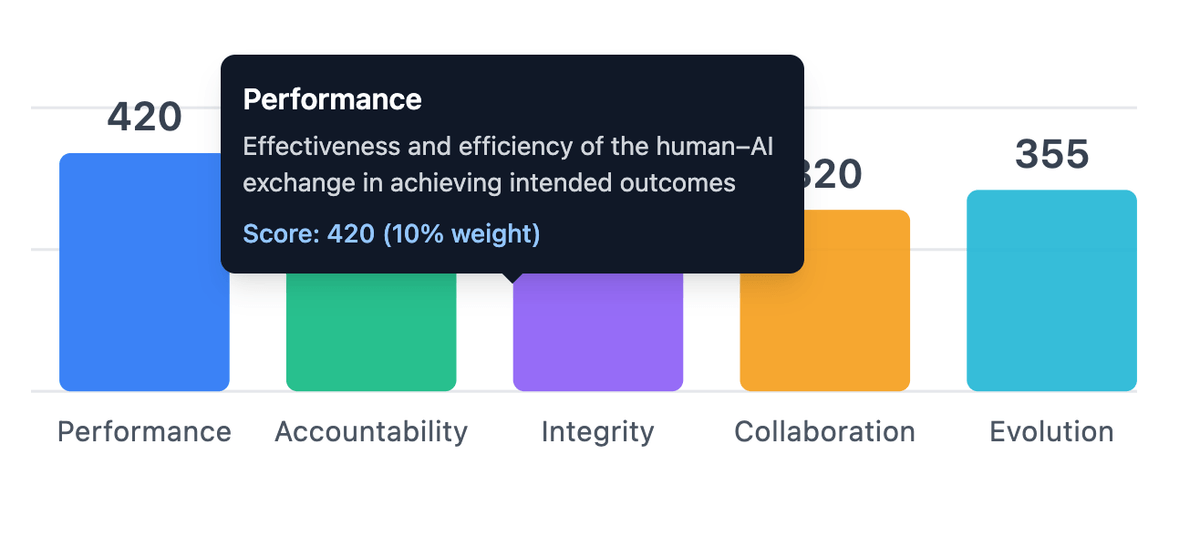
PAICE weights Performance at 10% — the lowest of the five dimensions. Understanding why requires understanding what Performance actually measures, and where it stops.
Clarity of Intent
Does your request convey what you actually need, or does AI have to reconstruct your intent from incomplete information? Clarity of intent means the difference between asking for "a summary" and asking for "a three-point summary of the regulatory obligations, ordered by compliance deadline."
The gap matters. When intent is unclear, AI fills it with assumptions — usually the most generic interpretation available. When intent is specific, AI has something to work with.
Appropriate Scope
Requests scoped too broadly produce generic responses. Requests scoped too narrowly over-constrain AI in ways that produce stilted, mechanical output. Appropriate scope means framing the task at the level of specificity that lets AI do its best work.
A request for "write an email" is too broad. A request for "write an email using exactly 73 words, formatted as three paragraphs, opening with a question" is too narrow. "Write a 150-word follow-up to a client who asked about our pricing, acknowledging their question and offering to schedule a call" gives AI the right amount of room.
Efficiency
Reaching a useful result without burning turns on avoidable clarification is an efficiency signal. Some back-and-forth is valuable — that's what the Collaboration dimension measures. But clarification rounds that exist because the initial request was under-specified are friction, not collaboration. Performance tracks the difference.
Why 10% Weight
Performance is a threshold skill, not an infinite-return skill. That distinction is why it carries the lowest weight in PAICE.
Every professional needs a baseline level of communication clarity to use AI effectively at all. Below that threshold, unclear requests produce unusable output and compound frustration. Getting above the threshold matters. But once you're over it, additional investment in prompt polish has rapidly diminishing returns.
A clear, specific four-line request consistently outperforms a polished three-paragraph request that buries the actual task in context. After a point, more eloquence is noise. The behaviors that actually determine whether AI collaboration produces reliable professional outcomes — catching errors (Accountability), maintaining information quality (Integrity), iterating effectively (Collaboration), adapting as AI evolves (Evolution) — all operate above and beyond the performance baseline.
The 25% Learning Arc
Performance and Evolution together account for 25% of your PAICE score. The pairing is meaningful: Performance measures the quality of your AI communication right now; Evolution measures how fast you're updating those patterns as AI capabilities change.
What you can do today and how fast you're improving are connected. A professional with strong Performance habits and high Evolution is building compound returns — their baseline communication quality keeps rising as they adapt to new capabilities. A professional with adequate Performance but low Evolution has a fixed ceiling: their communication is clear enough today, but they aren't recalibrating as the landscape shifts under them.
The 25% together reflects a deliberate design choice. These are the dimensions most tied to individual communication skill and learning velocity. They matter. They're also the dimensions where targeted effort produces visible improvement fastest — which is why they're weighted below the behavioral dimensions (Accountability, Integrity) where failure has more direct professional consequences.
The Fluency Trap
The professionals who score lowest on Performance are often those who believe they are scoring highest. Articulate, thoughtful people tend to write articulate, thoughtful prompts. And articulate, thoughtful prompts that lack specificity produce polished, confident, generic responses.
This is the fluency trap. Eloquence is not specificity. Length is not clarity. A well-constructed paragraph that describes the general situation without specifying the actual need produces a well-constructed response to the general situation — not what was needed.
The clearest signal of the fluency trap in PAICE assessments: professionals who write extensive context-setting paragraphs before stating the task, then express frustration that the response didn't address their specific concern. The specific concern was there, buried in the third paragraph. AI averaged across everything and responded to the average.
High Performance comes from clarity about what you actually need, not fluency in describing the situation around it.
What High Performance Looks Like
High Performance shows up in specific, observable request patterns.
Bounded, specific requests. "Identify the three provisions most likely to create liability exposure for a software vendor in a standard SaaS agreement governed by California law" produces more useful output than "review this contract for problems." The task is the same. The specificity of the request determines the specificity of the output.
Explicit output specification. Telling AI what a useful response looks like — format, length, structure, level of detail — removes a large category of guesswork. "Give me a bulleted list of no more than five items, each with a one-sentence explanation" gives AI a clear target. "Give me some ideas" does not.
Appropriate context, not exhaustive context. High-Performance professionals calibrate how much background to include. Enough for AI to understand the constraints that matter. Not so much that the relevant detail gets lost in narrative. The skill is identifying what AI needs to know to handle this specific task — not everything you know about the situation.
Scope narrowing before sending. When a request feels too broad, the instinct of a high-Performance professional is to narrow it before sending, not after getting a generic response. "Is this answerable in one pass at the level of specificity I need?" is the check.
What Low Performance Looks Like
Low Performance patterns are among the most common in AI collaboration, and the most underdiagnosed.
Vague open-ended requests that force clarification. "Can you help me with this project?" tells AI almost nothing. The subsequent clarification round that extracts what you actually needed is avoidable friction, not iterative collaboration.
Under-specified output requests. "Write something about X" produces something about X — usually the most generic possible version of it. Low Performance means not specifying what a useful response looks like, then being disappointed by the generality of what arrives.
Over-specified requests that constrain unnecessarily. The opposite failure: requests so rigidly specified that AI has no room to do useful work. Specifying exact word counts, requiring specific sentence structures, or over-prescribing format can produce output that follows all the rules while missing what was actually needed.
Treating every task as the same complexity. A quick factual lookup and a nuanced professional analysis need different levels of request precision. Low Performance means applying the same level of specificity to both — under-specifying complex tasks and over-specifying simple ones.
How to Develop Your Performance Score
Performance responds faster to deliberate practice than any other PAICE dimension. The habits are specific, learnable, and produce visible results almost immediately.
Add one constraint before sending. Before submitting any request, add one specific constraint that isn't already there. A deadline, a format, an audience, a scope limit, a required output structure. This single habit closes the most common Performance gap — requests that are clear in intent but under-specified in what "useful" looks like.
Define the output before writing the request. Before describing what you need, decide what a good response would look like. How long? What format? What level of detail? What's in scope and what isn't? Writing this down first changes how you frame the request — you stop describing the situation and start specifying the task.
Run the scope check. Ask before sending: is this request answerable in one pass at the level of specificity I need? If the answer is no, narrow the request. Broad requests answered broadly are not useful; a narrower request answered specifically is.
Calibrate context to task. Practice identifying what AI actually needs to handle each specific task. For a contract review, that's the document type, jurisdiction, and what you're concerned about — not the history of the relationship with the counterparty. Separating task-relevant context from background context is a learnable skill.
Review requests that produced generic output. When AI returns something that misses the mark, read your original request before blaming the response. Most generic outputs trace directly to generic requests. Identifying what the request was missing is a fast feedback loop for building Performance habits.
Performance and Collaboration
Performance is the quality of each message. Collaboration is the quality of the full exchange. They are related but distinct, and the Collaboration dimension post covers how they interact.
The practical relationship: high Performance reduces how much Collaboration work is required. When initial requests are specific and well-scoped, there are fewer clarification rounds, less revision, and more productive use of subsequent turns for genuine iteration rather than course correction. But Collaboration compounds far more value than Performance on its own. The professional who collaborates well with adequate communication skills consistently outperforms the one with excellent communication skills who accepts the first response and moves on.
Performance is the floor. Collaboration is the ceiling. Investing in Performance gets you off the floor faster; investing in Collaboration is what raises the ceiling.
What This Means for Your Practice
A 10% weight is sometimes read as "this doesn't matter." The actual meaning is different: Performance matters enough to measure, and the threshold is reachable.
Most professionals can meaningfully improve their Performance score within weeks. The habits are concrete, the feedback loop is fast, and the improvement is visible in the quality of AI responses you receive from day one of deliberate practice.
But the weight also reflects something real: after you clear the clarity threshold, the returns on additional Performance investment are small compared to the returns on Accountability, Integrity, Collaboration, and Evolution. The professionals who thrive with AI over time are not those who have perfected their prompts. They're those who catch errors, maintain information quality, iterate effectively, and keep adapting as the landscape changes.
Performance is how well you communicate with AI today. Evolution is how fast that improves. Together they're 25% of your score — the learning arc that underpins everything else. The other 75% is what you do with the responses once they arrive.
Want to see where your communication habits land across all five dimensions? Take the PAICE assessment to get detailed feedback on Performance, and how it compares to your Accountability, Integrity, Collaboration, and Evolution scores.
Get Involved:
- Take the assessment (free, always)
- Explore our Baseline offerings (for organizations)
- Read the whitepaper (comprehensive framework)
- Contact us about your specific requirements
Recommended Reading
📖 Dimension Deep Dives:
- The Accountability Dimension - How PAICE measures error detection and verification in AI collaboration
- The Integrity Dimension - How PAICE measures information quality and attribution in AI collaboration
- The Collaboration Dimension - How PAICE measures iteration, feedback, and working effectively with AI
- The Evolution Dimension - How PAICE measures whether your collaboration skills adapt as AI capabilities change
📖 Understanding the Dimensions:
- The Five Dimensions of AI Collaboration - How all five PAICE dimensions work together
- What PAICE Tests For - The behavioral signals behind every score
📖 Scores and Development:
- What Your PAICE Score Really Means - Interpreting your results effectively
- Improving Your PAICE Score - Practical strategies for skill development
- Common AI Collaboration Mistakes - Recurring pitfalls and how to prevent them
Curious but short on time?
Take the 3-minute PAICE Pulse — a quick confidence check that maps how you see your own AI collaboration posture. No login required.